

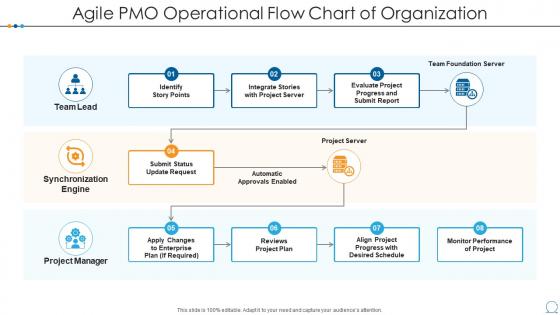
Agile pmo operational flow chart of organization




Try Before you Buy Download Free Sample Product
 Impress Your
 Audience
 100%
100% Editable
 Save Hours
 of Time


Our Agile PMO Operational Flow Chart Of Organization are topically designed to provide an attractive backdrop to any subject. Use them to look like a presentation pro.
People who downloaded this PowerPoint presentation also viewed the following :
Agile pmo operational flow chart of organization with all 9 slides:
Use our Agile PMO Operational Flow Chart Of Organization to effectively help you save your valuable time. They are readymade to fit into any presentation structure.








FAQs for Agile pmo operational flow
So traditional PMOs are basically the project police - tons of control, rigid processes, endless status reports. Agile PMOs flip that completely. You become more like a coach helping teams succeed rather than a gatekeeper slowing them down. Way less bureaucracy, way more support. Instead of demanding detailed plans upfront, you focus on removing whatever's blocking your teams and helping them deliver value faster. Honestly, it's so much better than the old command-and-control approach. Start by asking what's frustrating your teams right now - that's your roadmap for change. Oh, and ditch those heavy governance gates if you can.
Honestly, you want consistent frameworks but don't be a control freak about it. Create shared tools for tracking progress and dependencies - that part's crucial. But let teams tweak the details however works for them. I've seen too many PMs get obsessed with perfect processes when really you just need visibility, not micromanagement. Focus on connecting teams when they're stuck on blockers they can't solve alone. Your job becomes more facilitator than boss. Oh, and map out where teams actually need help first - some are totally fine flying solo. Start there instead of trying to "fix" everything at once.
Honestly, skip the compliance BS and focus on stuff that actually moves the needle. Velocity trends and cycle time show if you're shipping well. Defect rates matter too - nobody wants buggy releases. But here's the thing - you could be the fastest team ever and still build garbage nobody wants. That's why customer satisfaction and feature adoption rates are clutch. Also track team health stuff like whether people actually follow through on retro actions. Pick maybe 4-5 metrics max that fit your company's goals. I've seen teams drown in dashboards and it's painful to watch. Start small, add more later.
So basically, a good Agile PMO makes people feel safe to screw up and learn from it. No blame games when experiments don't work out. They focus on retrospectives and honest feedback instead of just tracking if you hit every single deadline - which honestly makes way more sense. The metrics shift to "what did we figure out this sprint?" rather than the old-school approach of just checking boxes. Oh, and they actually listen when teams say what's blocking them, then do something about it. Start there - ask your people what's slowing them down, then fix it.
Dude, you absolutely need good tech for an Agile PMO. Without it, you're basically herding cats blindfolded. Get dashboards that show project health instantly, plus automated reporting so you're not doing manual work all day. The real game-changer? Tools that actually connect to each other instead of creating more mess. I learned this the hard way - silos are the worst. Map out your current workflow first, then figure out where tech can fix your biggest headaches. Real-time collaboration tools are non-negotiable too. Trust me on this one.
Look, an Agile PMO basically becomes the translator between what executives want and what teams actually do - because let's be real, those groups speak completely different languages. They set up regular check-ins to keep projects aligned with business goals instead of just cranking out random deliverables. Visual roadmaps help too, showing how each initiative connects to bigger objectives. The whole thing works through frequent planning adjustments rather than some massive upfront document nobody reads anyway. I'd start by having your PMO map current projects against strategic priorities - you'll probably find some weird disconnects that'll surprise everyone.
Honestly, the biggest pain points are gonna be people hating change and trying to balance agile flexibility with all that PMO structure stuff. Teams think PMOs are just bureaucratic nightmares - and let's be real, a lot of them are! Focus on helping instead of controlling though. Keep your metrics super light at first. Actually embed your PMO people with the teams instead of sitting in some ivory tower. Ditch the massive upfront planning and track value delivery as you go. Oh, and definitely listen to team feedback and adjust. You've gotta prove you're speeding them up, not bogging them down with pointless paperwork.
So basically, Agile PMOs ditch the whole "here's your weekly status report" thing. You're doing quick check-ins instead of formal meetings, getting people into sprint reviews, using those visual boards everyone can actually see. Way more conversation, way less PowerPoint - though honestly, some execs will never give up their slides. The big shift? Stakeholders help shape the work instead of just hearing about it afterward. Find your most important people and get them to your next sprint demo. That's where the magic happens.
Honestly, I'd go with Scrum, SAFe, and Kanban - they work well together. Start with Scrum for your basic project stuff. SAFe is clutch when you've got tons of teams that need to coordinate (though it can get pretty heavy). Kanban's amazing for showing execs where things are getting stuck - saves you so many headaches in meetings. Oh, and LeSS or Nexus are decent if you're doing big development projects. But seriously, don't overthink it. Pick Scrum first, then add whatever else you actually need. I've seen too many places try to implement everything at once and it's a mess.
Think of an Agile PMO as your scaling backup - they standardize stuff without micromanaging teams. Start with one business unit (trust me on this). They'll set up frameworks like SAFe, coach new teams, and create those communities where Scrum Masters can actually admit what's broken. The real value? They handle the messy dependency mapping between teams and translate your sprint metrics into executive-friendly reports. Because someone has to deal with the C-suite still asking for Gantt charts, right? Once you nail it with one unit, roll it out everywhere else.
Definitely get Scrum certified first - CSM or PSM are both good options. The facilitation stuff is honestly where you'll spend most of your time anyway, running retros and dealing with team drama. Analytics matter too since bosses love their dashboards and metrics. Agile frameworks like Kanban and SAFe are worth learning, but I'd probably start with basic Scrum. Oh, and change management skills are clutch because you're basically translating between old-school PMO people and dev teams all day. It's a weird middle ground but super valuable once you get the hang of it.
Honestly, just bake feedback into your regular PMO stuff instead of treating it like an afterthought. Do quick retros after big milestones. Send those short pulse surveys every sprint - people actually fill out the 2-minute ones. Schedule stakeholder check-ins that people won't blow off (good luck with that one, but try anyway). Make it automatic so you're not scrambling when everything's on fire. Add "what's working/what's not" to your standard meeting agendas. Quick polls work great, or just throw up an async feedback board somewhere. Pick one thing to start with this week, then slowly add more once your teams stop being weird about giving honest feedback.
Get your teams doing regular demo days - people actually love showing off what they built and it breaks down those annoying silos naturally. Cross-functional communities work great too. Everyone should see the same dashboards and use similar tools so there's actual visibility into what's happening. Scrum of scrums or PI planning keeps things aligned without being super heavy-handed about it. Oh, and don't make collaboration feel like extra work nobody wants to do. Pick one thing that's genuinely bugging teams right now and start there. Makes it way more likely to stick.
Think guardrails, not roadblocks. Give teams clear boundaries but let them work inside those however they want - like standardizing retrospective formats and how risks get escalated, but teams pick their own sprint lengths. Here's the thing though: be picky about what you actually control. Don't micromanage every little process (that's old-school PMO stuff). Do enforce what matters for visibility and keeping everyone compliant. Dashboards work way better than those heavy status reports nobody reads anyway. Teams get clear expectations without feeling trapped, leadership gets their oversight. Win-win.
Your Agile PMO can spark innovation by making teams feel safe to experiment - no punishment for smart failures. Give people dedicated time for side projects, maybe 20% of their week. Breaking down those departmental walls is huge too, that's honestly where the coolest stuff happens. Track innovation metrics alongside your usual delivery ones. Quick funding for promising ideas keeps momentum going. Oh, and celebrate the failures that taught you something valuable - that mindset shift is everything. Set up showcases where teams demo their experiments. Even the ones that flopped teach others what doesn't work.
-
Great product with effective design. Helped a lot in our corporate presentations. Easy to edit and stunning visuals.
-
Awesome presentation, really professional and easy to edit.