


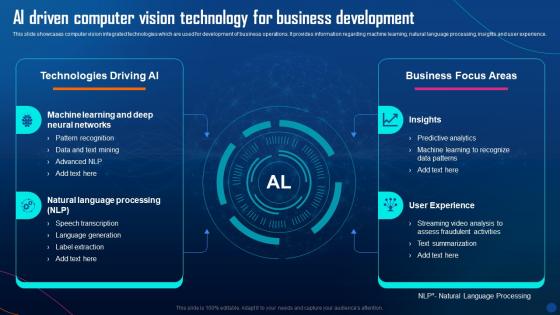
Ai Driven Computer Vision Technology For Business Development




Try Before you Buy Download Free Sample Product
 Impress Your
 Audience
 100%
100% Editable
 Save Hours
 of Time


This slide showcases computer vision integrated technologies which are used for development of business operations. It provides information regarding machine learning, natural language processing, insights and user experience.
People who downloaded this PowerPoint presentation also viewed the following :
Ai Driven Computer Vision Technology For Business Development with all 6 slides:
Use our Ai Driven Computer Vision Technology For Business Development to effectively help you save your valuable time. They are readymade to fit into any presentation structure.





FAQs for Ai Driven Computer Vision Technology
So AI computer vision is doing some pretty wild stuff right now. Medical imaging is huge - it can catch tumors and fractures in X-rays and MRIs, sometimes even faster than doctors. Honestly, that's both impressive and slightly terrifying. Agriculture's another big one though. Farmers use it to spot diseased crops, count animals, track pests, you name it. The harvesting robots are getting crazy good too. Both industries love it because these systems don't need coffee breaks or sleep. My advice? Pick one small thing to test first instead of going full sci-fi mode right away.
So basically, deep learning lets computers figure out visual patterns on their own instead of you coding every little rule. Way more accurate than the old methods. These neural networks catch stuff that would totally fly over our heads - like seriously, some of the patterns they find are mind-blowing. Your object detection, facial recognition, whatever - it all gets way better. Processing is super fast too since the real work happens during training. Oh, and definitely check out pre-trained models like ResNet or YOLO first. Don't reinvent the wheel, you know?
Honestly, preprocessing is where most people mess up their AI projects. You're basically cleaning up your images before the model sees them - getting rid of noise, making sure everything's the same size, fixing weird lighting issues. Without it, your model gets confused by inconsistent data and your accuracy tanks. I learned this the hard way on my first project lol. The formats need to match too, otherwise you'll get errors everywhere. It's not the fun part, but spending time on a solid preprocessing pipeline usually means the difference between decent results and actually impressive ones. Worth the effort upfront.
Honestly, AI computer vision is pretty game-changing for security. It processes video feeds way faster than any human could and sends you alerts for sketchy stuff - unauthorized access, weird behavior, you name it. The system learns what "normal" looks like at your place and catches anything off. Way better than having some poor guy staring at 20 monitors all day, right? The AI handles the boring surveillance work and only bothers you when there's actually something to worry about. I'd start by figuring out where your security gaps are - that's where you'll see the biggest difference right away.
Honestly, the privacy stuff is what'll bite you first - people hate feeling watched without consent, even in public. Bias is another massive headache since these systems consistently mess up on certain groups, which obviously creates discrimination issues. You can't really let people "opt out" of street cameras, so definitely put up clear signs about monitoring. The whole Big Brother thing freaks people out too (can't blame them). Only grab the data you actually need, get lawyers involved early, and maybe talk to the community beforehand? Trust me, addressing concerns upfront beats dealing with angry residents later.
Dude, neural networks are changing everything in computer vision right now. Object detection and image classification have gotten insanely accurate. The cool part? New architectures with attention mechanisms don't just spot a car - they understand it's turning left at an intersection. Context matters now, which is honestly mind-blowing. Your projects will perform way better without all that manual feature work you used to do. Plus you can generate synthetic training data, which saves so much time. I swear this field moves faster than I can keep up with sometimes.
Honestly, facial expressions are just the tip of the iceberg - emotions are way more complicated than that. Cultural stuff throws everything off too. Like, my confused face probably looks angry to someone from a different background. People also fake emotions constantly or feel multiple things at once, which screws with the data. Then you've got technical issues - bad lighting, weird camera angles, blurry photos. Building the training dataset is a nightmare since you need tons of diverse faces, and that costs serious money. My advice? Start with the obvious expressions first, then work up to the tricky ones.
So basically, computer vision acts like the car's eyes - it takes all those camera feeds and figures out what's what in real-time. Pedestrians, road signs, lane markings, other cars. The crazy part is how it combines cameras with lidar and radar to build this whole 3D map of what's around you. I mean, it can actually tell the difference between a plastic bag blowing around and an actual rock in the road, which honestly still blows my mind. GPS gets way better too since the system can spot landmarks and road stuff that satellites totally miss. Oh, and if you're building these systems - definitely train with different weather conditions. Makes a huge difference.
So basically, old-school computer vision means you're manually coding what to look for - edges, corners, that kind of stuff. AI methods just learn all that automatically from training data. Way more flexible, honestly. Traditional approaches work fine if you've got really controlled conditions, but they fall apart when things get messy. Deep learning handles real-world chaos much better, though you'll need massive datasets. For new projects? I'd go AI-driven unless you're dealing with something super niche or have weird hardware limitations.
Your dataset basically controls everything your model can do. Train on ImageNet? Great for objects, but medical images will wreck it. Size matters a ton - more diverse data helps it generalize better. Small or biased datasets? You're stuck with something super narrow. Honestly, it drives me crazy how picky models are about this stuff. You really need training data that matches what you'll actually use it for. Transfer learning from similar domains can help though. Oh, and definitely check your dataset for weird stuff before you waste time training!
Transfer learning is a game changer for computer vision. You don't have to train from zero - just grab a pre-trained model that already knows basic visual stuff from millions of images. Then fine-tune it for whatever you're working on. Honestly saves you so much time and computing power it's not even funny. ResNet or EfficientNet are solid starting points. The crazy part? You'll get way better results even with just a few hundred images of your specific objects. It's basically like getting a massive head start instead of reinventing the wheel.
So AI handles occlusions in a few ways. Multi-scale detection helps spot partial objects, while contextual reasoning fills in gaps when stuff's blocked. Breaking images into regions works well too - attention mechanisms focus on what matters and ignore the noise. Depth estimation is where things get really cool though. Modern systems actually understand 3D space now, which honestly blows my mind sometimes. The trick is training on messy, real-world datasets instead of perfect lab images. Pro tip: test your models on cluttered scenes from the start. Don't make my mistake of using clean studio shots first - you'll just end up retraining everything later.
So SLAM and object tracking are getting insanely good right now. Hand gestures are huge - nobody wants controllers anymore, which honestly makes sense. Single-camera depth estimation is improving fast, so mobile AR doesn't need those expensive sensors. Eye tracking's becoming standard for foveated rendering. Semantic scene understanding is finally letting apps actually know what they're looking at instead of just throwing 3D stuff around randomly. Oh, and neural radiance fields are wild for photorealistic reconstruction - that's where the coolest stuff is happening if you ask me.
So computer vision is seriously cool for accessibility stuff. It can describe images to people who can't see them, translate sign language into text, and help with navigation by spotting obstacles. Reading text aloud from photos too. People with motor issues can use it for gesture controls or eye tracking - honestly didn't know that was even possible until recently. The APIs are getting way better and cheaper, so if you're building anything accessibility-related, you should definitely check them out. It's like giving someone digital eyes that actually understand what they're looking at.
Definitely go with **OpenCV** for basic image stuff and **PyTorch** for the deep learning side. OpenCV is clutch for camera work and filtering - honestly saved my butt so many times. **TensorFlow** works too but I think PyTorch is way more intuitive when you're learning. YOLO and Detectron2 are solid if you need object detection without building everything yourself. Oh, and Hugging Face has pre-trained models that'll get you up and running fast. I'd start simple though - grab a pre-trained model first, mess around with it, then worry about training your own later. Trust me on that one.
-
Colors used are bright and distinctive.
-
Easily Understandable slides.