


AI In Space Exploration Powerpoint Template Bundles Ppt Presentation





Try Before you Buy Download Free Sample Product
 Impress Your
 Audience
 100%
100% Editable
 Save Hours
 of Time


Our AI In Space Exploration Powerpoint Template Bundles Ppt Presentation are topically designed to provide an attractive backdrop to any subject. Use them to look like a presentation pro.
People who downloaded this PowerPoint presentation also viewed the following :
Content of this Powerpoint Presentation
Slide 1: This slide introduces AI in Space Exploration. State your company name and begin.
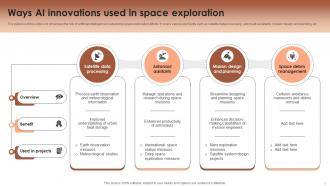
Slide 2: The purpose of this slide is to showcase the role of artificial intelligence in advancing space exploration efforts. It covers various elements such as satellite data processing, astronaut assistants, mission design and planning, etc.
Slide 3: The purpose of this slide is to highlight various applications of AI in space to increase efficiency in understanding of cosmos. It covers use cases such as space debris management, anomaly detection, mission planning, etc.
Slide 4: The purpose of this slide is to showcase complexities involved in integrating AI technology into space missions and how engineers are working to overcome these challenges. It covers issues such as limited data, power constraints and durability.
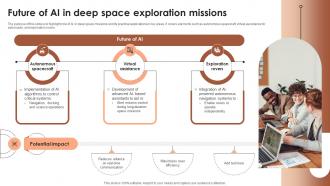
Slide 5: The purpose of this slide is to highlight role of AI in deep space missions and its practical applications in key areas. It covers elements such as autonomous spacecraft, virtual assistance for astronauts, and exploration rovers.
Slide 6: The purpose of this slide is to highlight the achievements and advancements achieved through the integration of AI in space exploration. It covers advances such as voyager probes, mars rovers, hubble space telescope, etc.
Slide 7: The purpose of this slide is to highlight emerging applications in advancing space exploration with AI. It covers elements such as Autonomous robotics for planetary surface exploration, Adaptive learning systems for long-duration space mission, etc.
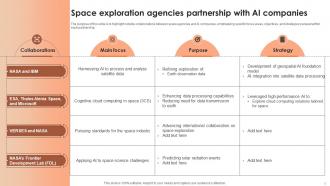
Slide 8: The purpose of this slide is to highlight notable collaborations between space agencies and AI companies, emphasizing specific focus areas, objectives, and strategies pursued within each partnership.
Slide 9: The purpose of this slide is to highlight how AI enhances navigation, resource management, data analysis, etc. It covers elements such as operator, ground segment, space segment, etc, with key insights such as AI processing datasets from space missions to accelerate discoveries.
Slide 10: The purpose of this slide is to highlight the practical applications of AI technologies developed for space exploration. It covers various elements such as autonomous navigation systems, remote sensing and data analysis and robotics and automation, etc.
Slide 11: The purpose of this slide is to highlight critical ethical aspects that need to be addressed when integrating AI into space exploration missions. It covers elements such as transparency, accountability and fairness.
Slide 12: The purpose of this slide is to outline the opportunities that AI presents in the context of outer space exploration. It covers opportunities such as enhanced automation for mars exploration, improved robotic systems for on-orbit construction, etc.
Slide 13: The purpose of this slide is to present a comparative analysis of various projects driving AI automation in space exploration. It covers various elements such as projects, actions, objectives and benefits.
Slide 14: The purpose of this slide is to highlight key drivers fueling growth of space exploration market through practical integration of artificial intelligence (AI) technology. It covers drivers such as increasing space missions, autonomous spacecraft and rovers, etc.
Slide 15: The purpose of this slide is to highlight in the exploration and understanding of galaxies and the analysis of data from telescopes. It covers elements such as galaxy exploration and mapping, data analysis from telescopes, etc.
Slide 16: The purpose of this slide is to serve as quick reference for understanding how AI is utilized in various aspects of space missions. It covers elements such as mission strategy, managing mission operations, data collection, etc.
Slide 17: This slide shows AI powered robots supporting space exploration icon.
Slide 18: This slide presents AI in space exploration icon for debris management.
Slide 19: This slide displays AI rovers in space exploration icon.
Slide 20: This is a Thank You slide with address, contact numbers and email address.
AI In Space Exploration Powerpoint Template Bundles Ppt Presentation with all 28 slides:
Use our AI In Space Exploration Powerpoint Template Bundles Ppt Presentation to effectively help you save your valuable time. They are readymade to fit into any presentation structure.















FAQs for AI In Space Exploration Powerpoint Template
So basically, spacecraft need AI because waiting for Earth commands is useless when you're trying to land on Mars - we're talking like 24-minute delays, which is forever in space time. The AI analyzes sensor data instantly and makes course corrections on the spot. Landing sequences especially need this since everything happens crazy fast. Honestly, the further your mission goes from Earth, the more your spacecraft has to think for itself. Pretty wild how we've gotten to the point where we're sending robots millions of miles away to make their own decisions.
So ML is basically doing all that tedious work astronomers used to hate - you know, spending months manually sifting through data. Now algorithms can spot exoplanets, classify galaxies, catch weird anomalies automatically. They're crazy good at filtering noise and false positives too, which honestly saves so much wasted time chasing dead ends. The real game-changer? You can analyze stuff in real-time now while you're actually observing. No more waiting weeks to see if your data's even useful - just adjust your telescope settings on the spot. Definitely check out existing tools first before building something from scratch.
Honestly, AI makes satellite comms way less frustrating. Your signals get rerouted automatically when conditions suck, so no more random dropouts. The software predicts atmospheric interference and manages bandwidth better than doing it manually - which, let's be real, nobody wants to babysit 24/7. It'll track moving targets with beam steering too. Plus you get predictive maintenance, so equipment doesn't just randomly fail on you. Oh, and latency drops since it picks the best transmission paths. I'd start with AI signal processing first - that's where you'll notice the difference right away.
So basically AI is doing all the grunt work sifting through tons of space data that would take us ages to get through. Machine learning scans radio signals from SETI and picks up atmospheric patterns on exoplanets that might show signs of life. These systems spot weird anomalies we'd probably miss completely. They'll churn through years of telescope data in just hours, which is honestly pretty crazy when you think about it. Mars rover samples get the AI treatment too. Oh, and definitely look into Breakthrough Listen if you're into this stuff - their AI tools are insane.
Okay so basically the big issues are autonomy, accountability, and not screwing up other planets. Your AI is gonna be making calls millions of miles away with zero human input - so if it messes up, whose fault is that? There's contamination risks too if the AI decides wrong about sample collection or whatever. We're literally letting algorithms choose what happens to entire worlds. Oh and here's the fun part - once that thing launches, you can't exactly hit undo. I'd say build solid ethical rules into the AI's programming beforehand, but honestly the whole thing feels like a massive gamble either way.
Dude, AI simulations are game-changers for space missions. You can test thousands of scenarios without blowing billions on actual launches - smart move when you're talking about years-long journeys to Mars or whatever. They model launch windows, fuel usage, equipment failures, the whole nine yards. What's crazy is these things crunch decades of possibilities in just hours, factoring in planetary alignments and solar radiation. Honestly feels like cheating sometimes, but hey, it's just good physics. My advice? Figure out your mission's biggest question marks first - that's where you'll get the most bang for your buck with AI modeling.
Radiation will absolutely fry your circuits - that's probably the worst part. Temperature swings are brutal too, messing with how everything performs. When stuff breaks, you can't just send someone to fix it, which honestly sucks for mission planning. Your AI has to handle everything alone since communication takes 20+ minutes each way to Mars. Real-time help? Forget it. Weight limits are insane - every gram costs thousands to launch, so you're constantly cutting corners. Build redundant systems and test the hell out of everything first. Try simulating radiation bit-flips and thermal cycling to see what breaks.
Honestly, robots are perfect for this kind of work. They can 3D print shelters and assemble everything while working 24/7 in conditions that would literally kill astronauts. No oxygen needed, no sleep breaks - just constant building. The smart ones use computer vision to catch structural problems early and get better at construction through machine learning. Pretty cool tech, actually. You'd deploy them ahead of time so when humans finally arrive, boom - instant shelter waiting for them. Way safer than having astronauts build everything from scratch after landing.
Dude, you basically NEED AI for Mars missions because it's not like you can just order more supplies when you run out. The algorithms can spot water ice in soil samples and extract oxygen from the atmosphere way better than humans could manage manually. Plus it handles power distribution for life support - pretty critical stuff. Equipment breakdowns are a nightmare when Earth is 140 million miles away, so having AI predict failures before they happen is huge. It's honestly like having a logistics genius that works 24/7. If you're doing any mission planning, build in solid AI systems from the start. Don't treat it as an afterthought.
So basically, you set up AI to watch all your spacecraft systems and catch problems before they happen. The algorithms pick up on weird patterns in temperature or vibration data that show something's about to crap out. Way better than having stuff break when you're literally nowhere near help, right? Machine learning gets better at spotting these warning signs after each mission too. You can actually plan maintenance instead of scrambling to fix things. I'd probably start with whatever systems would screw you over most if they failed. Oh, and the real-time monitoring part is clutch - gives you actual time to react.
Honestly, autonomous navigation is where it's at for space missions. Those Mars rovers that dodge rocks without waiting 20 minutes for mission control? That's the future right there. Predictive maintenance using ML is clutch too - can't exactly call AAA when you're orbiting Saturn lol. Computer vision helps spacecraft actually see where they're going. Real-time analysis is pretty cool because it lets probes spot interesting stuff and decide what's worth investigating on their own. The whole point is building systems that won't need babysitting for months at a time.
So basically, AI handles all the split-second decisions when there's crazy communication delays - like 4-24 minutes each way depending on where planets are sitting. Think about Mars rovers (those things are honestly pretty impressive). The AI can adjust flight paths, manage power during emergencies, or pick which instruments to use based on what it's seeing right then. You can't exactly call Earth and wait 20 minutes for an answer when something urgent happens. It's not replacing human control though - more like adding this smart layer that keeps everything running when quick choices matter.
So AI basically predicts when stuff's about to break before it actually does, which is huge for keeping crews alive. The emergency response automation is pretty sweet too - no waiting around when things go sideways. Real-time health monitoring catches medical problems early, and honestly the navigation help alone is worth it since human error during tricky maneuvers can be... yeah, not good. What really blows my mind though is how fast it processes all that telemetry data compared to ground control. Oh, and it optimizes life support and spots spacewalk hazards. Definitely use those AI risk assessment tools for mission planning - they're finding stuff we'd totally miss.
Honestly, the speed difference is insane - AI can churn through satellite and rover images way faster than any human geologist could dream of. It automatically spots rock types, minerals, geological structures across whole planets. The crazy part? These algorithms catch patterns we'd totally miss, like tiny color shifts that signal specific minerals or erosion telling a planet's story. You can train models to flag the most interesting formations too, which helps teams figure out where rovers should go next. (Though I still think nothing beats a human brain for the really complex stuff.) Bottom line: let AI handle the grunt work so geologists can focus on the big picture interpretations.
Honestly, AI could totally revolutionize how space agencies work together. Picture having systems that automatically sync up mission schedules between NASA, ESA, and everyone else - no more coordination nightmares across different time zones. Plus it'd handle language barriers way better than we do now. The tech would optimize joint missions and stop agencies from accidentally working on the same stuff (which happens more than you'd think). Most importantly, it prevents those resource conflicts that always seem to pop up. You should definitely check out the pilot programs some agencies are already testing - that's where the cool stuff is actually happening right now.
-
SlideTeam provides PPTs on every single topic. Their templates suit my job very well. I am very grateful!
-
Helpful product design for delivering presentation.