


Android app developers proposal powerpoint presentation slides




Try Before you Buy Download Free Sample Product
 Impress Your
 Audience
 100%
100% Editable
 Save Hours
 of Time


Utilize Android App Developers Proposal PowerPoint Presentation Slides to present your application building skills. With the help of our development and designing app contract PPT visual, you can convince your customers that they will be able to achieve their goals by choosing your services. This completely editable online app development bid PowerPoint visual can be of great assistance in pinpointing the issues faced by customers and recommending suitable measures for the smooth performance of the app. You can state the service offerings like mobile web app, native app, and hybrid app and their features and constraints. The importance of flourishing in the aggressive market and position your consumer’s business as a leader in the industry can be communicated efficiently by employing this android application design agreement PowerPoint theme. The sequential procedure of app designing comprising key steps such as discovery, features & architecture, design, development, quality assurance, launch & marketing, maintenance, training, and support can be explained by this ready-made application development contract PowerPoint visuals. This wide spectrum of professionally designed web application bid PPT template consists of project synopsis, capabilities section to describe your firm’s potential, enterprise summary, past project descriptions, statement of contract, investment plan, etc. Project objectives like developing a web application from the client’s point of view, launching and marketing app to provide maximum visibility and app maintenance & support can be mentioned here. Missions like creating an outstanding application according to your vision and successful launching of the app can be elucidated efficiently. Download our web application and development proposal PowerPoint template to sell your services to your clients and hence increase your clientele.
People who downloaded this PowerPoint presentation also viewed the following :
Content of this Powerpoint Presentation
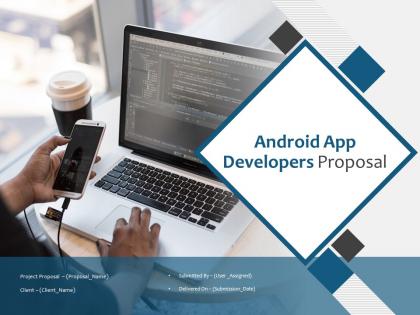
Slide 1: This slide introduces Android App Developers Proposal. State User name, Submission date, Client name.
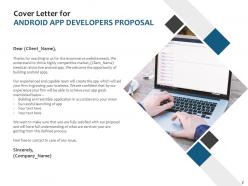
Slide 2: This slide displays Cover letter.
Slide 3: This slide displays the Table of Contents of the presentation.
Slide 4: This slide represents Project Overview with- Project Context, Project Objectives.
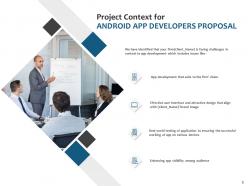
Slide 5: This slide showcases Project Context for Mobile App Development Proposal.
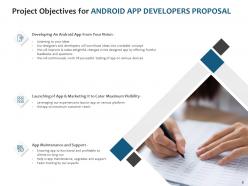
Slide 6: This slide depicts Project Objectives for Mobile App Development Proposal.
Slide 7: This slide depicts Our Capabilities with- Service Offering, Our Process, Time frame.
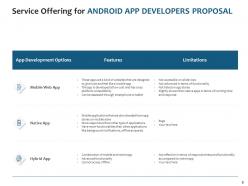
Slide 8: This slide showcases Service Offering with- Mobile Web App, Hybrid App, Native App.
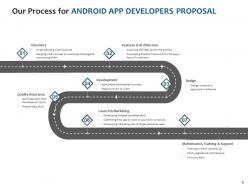
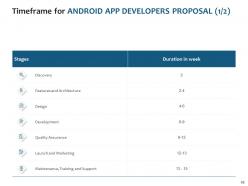
Slide 9: This slide showcases Our Process containing- Discovery, Features & Architecture, Design, Development, Quality Assurance, Launch & Marketing, Maintenance, Training & Support.
Slide 10: This slide depicts Timeframe for Android App Development.
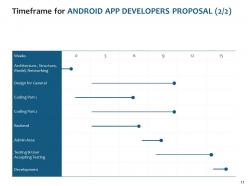
Slide 11: This slide also depicts Timeframe for Android App Development Proposal.
Slide 12: This slide showcases Your Investment to display related information.
Slide 13: This slide showcases Your Investment to showcase related information.
Slide 14: This slide is continued with Your Investment for Mobile App Development Proposal.
Slide 15: This slide showcases Company Overview.
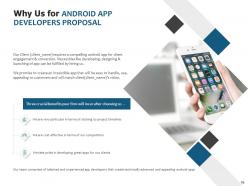
Slide 16: This slide describes Why Us for Android App Development Proposal.
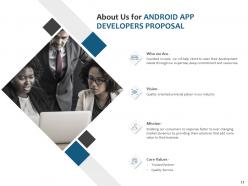
Slide 17: This is About Us slide to showcase company information.
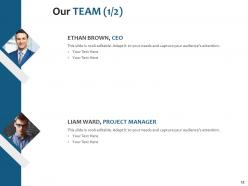
Slide 18: This is Our Team slide with Names and Designations.
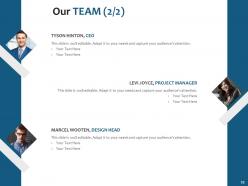
Slide 19: This is also Our Team slide with Names and Designations.
Slide 20: This slide represents Our Past Experience.
Slide 21: This slide displays Client Testimonials with Names and Designations.
Slide 22: This slide showcases Client Testimonials with Names and Designations.
Slide 23: This slide showcases Case Study for Android App Development Proposal.
Slide 24: This slide depicts Statement of Work and Contract.
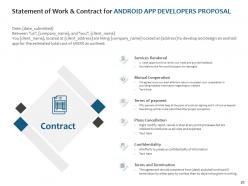
Slide 25: This slide showcases Statement Of Work & Contract for Mobile App Development Proposal
Slide 26: This slide showcases Next Steps.
Slide 27: This slide also depicts Next Steps for Android App Development Proposal.
Slide 28: This is Contact Us slide with Address, Contact number and Email address.
Slide 29: This slide is titled as Additional Slides for moving forward.
Slide 30: This is About Us slide with company information.
Slide 31: This is Our Mission slide with Vision, Goal and Mission.
Slide 32: This is Timeline slide.
Slide 33: This is 30 60 90 Days Plan slide.
Slide 34: This slide showcases Roadmap for Process Flow.
Android app developers proposal powerpoint presentation slides with all 34 slides:
Dispel any false impressions created with our Android App Developers Proposal Powerpoint Presentation Slides. Be able to deliver an incisive argument.










FAQs for Android app developers proposal
Start with the basics clients actually want to see - core features, who's using it, tech requirements. Timeline and budget breakdown are obvious must-haves. Which Android versions you're supporting matters too. Third-party stuff like APIs can blow your budget if you forget them (learned that one the hard way). Testing plan, app store process, ongoing support - cover all that. Honestly, wireframes or mockups will sell your idea better than paragraphs of text. Be super clear about what's included versus extra costs. Trust me, that conversation sucks to have later when they're expecting free changes.
Okay so first thing - don't fall into that "everyone will love my app" mindset because that's honestly just setting yourself up to fail. Get super specific about who actually needs this thing and has money to spend on it. Yeah, start with the basic stuff like age and income, but then go way deeper. What apps do they already use? What pisses them off about current solutions? I'd make 2-3 detailed personas based on actual research - surveys, interviews, whatever you can manage. Oh and pro tip: check out your competitors' app store reviews. People love to complain there and it's basically free market research. The more narrow you go, the easier everything else becomes.
Honestly, I'd break it down by phases - design, coding, testing, then ongoing stuff. Google Play charges $25 upfront which is whatever. The real pain comes from backend servers and third-party integrations you didn't think about initially. Always add 20% padding because clients WILL ask for changes halfway through (trust me on this one). Device testing across different phones gets pricey fast. Security audits are another line item people forget. Oh, and be super clear about change requests upfront - that's where budgets go to die. ASO costs can sneak up on you too if you want decent visibility.
Kotlin's gonna be your main focus - Google basically pushed it as the go-to for Android now. Jetpack components are huge too, they make everything way cleaner than the old methods. Android Studio for your IDE obviously. Room handles databases, Retrofit does networking, and Glide's solid for images. MVVM architecture is what everyone wants to hear about since it keeps code organized. Oh and Jetpack Compose is taking over UI development - honestly took me a while to get used to it but it's pretty powerful once you do. Clients eat up that "maintainable code structure" talk.
Break it into clear phases with realistic milestones - discovery/requirements first, then UI/UX design, dev sprints, testing, and deployment. I always tack on 20% buffer time because something inevitably goes sideways. Get specific with deliverables like "wireframes done by week 3" or "beta testing kicks off week 8." Map out client review points where you need their input to keep moving. Oh, and call out any dependencies on their end right away - saves you from awkward conversations later when things get delayed because they didn't deliver something on time.
Hey! So the big ones are device fragmentation - different Android versions, screen sizes, the whole mess. Security stuff too if you're dealing with user data. Testing is honestly a nightmare and will eat up way more time than you think. App store approval can be unpredictable, older devices might run like garbage, and third-party integrations love to break at the worst moments. Oh, and definitely pad your timeline because something random will go wrong - it always does. Have backup plans ready for each risk area and maybe overexplain your testing approach.
Here's what you gotta do - figure out the one thing your app does way better than everything else out there. Like, what specific problem are you actually solving that others aren't? Then show the real benefits users get, not just a boring feature list. I'd dig into some market research too, or at least talk to people about their frustrations with current apps. Oh and definitely do a side-by-side comparison - honestly, most people won't download something new unless they can clearly see why it's worth switching from what they're already using.
You should definitely track the basics first - daily users, how long people stick around, which features they actually click on. Crash rates matter too obviously, plus keep an eye on app store reviews (trust me, bad ratings spread fast). If you're making money from it, conversion rates and customer acquisition costs are huge. Oh and user lifetime value - that one's super telling about whether people really love your app or just download and bounce. Honestly though? Set up your analytics before you launch. Way easier than trying to piece together data after the fact.
Definitely add a user feedback section to your proposal - stakeholders eat that stuff up. Beta testing phases are clutch, plus in-app feedback tools and regular surveys during development. A/B testing for major features too. The key thing is budgeting actual time to act on what you collect, not just gather it and ignore it (seen that mistake way too many times). Set up feedback loops with your target users early. Oh and include specific examples of how you'll work insights into your dev sprints - makes it feel real instead of just theoretical fluff.
Honestly, I'd go with a mix of free and paid stuff. ASO is your best friend - get those keywords and screenshots dialed in since it's basically free users. Social media can work really well if your content doesn't suck. Google and Facebook ads will speed things up but man, they're expensive these days. Try reaching out to influencers or getting on some podcasts in your space. That usually brings in better quality users anyway. Just make sure you're tracking what each channel costs you per user - otherwise you're flying blind and will probably waste a ton of money.
Build compliance checks right into your workflow from the start. Google's Developer Policy Center is your bible - check it early when planning features. Their policies shift constantly (super annoying tbh), so I always do one last audit before hitting submit. Focus on the major stuff first: data privacy disclosures, content ratings, permission requests. Oh, and definitely set up automated scanning tools while you're coding. Trust me, catching violations early beats expensive rewrites later. The big violations can get you rejected instantly, so it's worth being paranoid about this stuff.
Android 7.0+ is what you want - hits about 94% of users so you're not missing much. Phones and tablets both, obviously, since people expect apps to work on whatever they're using. Going older than 7.0? Don't even think about it, total nightmare to maintain. Plus your dev team will thank you for not making them deal with ancient compatibility stuff. This decision kinda drives everything else - user base, how complex the code gets, maintenance costs down the road. I'd nail this down ASAP so they can build with the right specs in mind.
Definitely add a section on your tech architecture and roadmap. Outline your modular code structure - clients need to see you're not building something that'll fall apart when they want changes later (and trust me, they always do). Detail your cloud setup, database scaling, and how you'll handle traffic spikes. Sketch out future features and integrations too. Shows you're thinking past the first launch. Include rough timelines for updates and mention your testing pipeline. Honestly, the whole thing screams "we're planning for growth" which is exactly what they want to hear.
Oh dude, you definitely need design stuff in there. Wireframes and mockups are a must - they help clients actually see what you're building instead of just imagining it. I'd throw in a basic prototype too if you have time (seriously makes you look way more legit). The whole design section shows you get their users and aren't just some code monkey, you know? Plus it gives stakeholders something visual to get excited about rather than drowning them in tech speak. Just make sure you connect your design choices back to their brand somehow.
Make a section mapping out who talks to whom and when. Weekly demos, sprint reviews, milestone check-ins - list who needs to be there. Do a communication matrix too because some execs are all about Slack while others want formal emails (honestly the worst part of my job lol). Set up escalation paths for when stuff goes sideways. Response time expectations matter. Figure out who approves what at decision points. Oh and be super clear about communication ownership - you don't want things slipping through cracks later.
No Reviews