


Website development proposal powerpoint presentation slides




Try Before you Buy Download Free Sample Product
 Impress Your
 Audience
 100%
100% Editable
 Save Hours
 of Time


Our Website Development Proposal Powerpoint Presentation Slides are topically designed to provide an attractive backdrop to any subject. Use them to look like a presentation pro.
People who downloaded this PowerPoint presentation also viewed the following :
Content of this Powerpoint Presentation
Slide 1: This slide introduces Website Development Proposal. State Client details, User details and begin.
Slide 2: This slide displays Cover Letter for Website Development Proposal
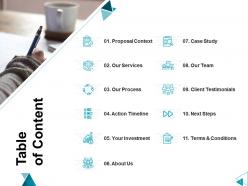
Slide 3: This is Table of Content of presentation slide.
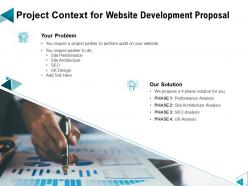
Slide 4: This slide showcases Project Context for Website Development Proposal.
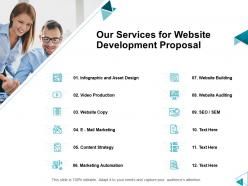
Slide 5: This slide depicts Our Services for Website Development Proposal
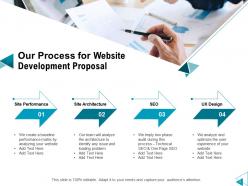
Slide 6: This slide shows Our Process for Website Development Proposal
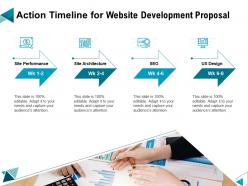
Slide 7: This slide shows Action Timeline for Website Development Proposal.
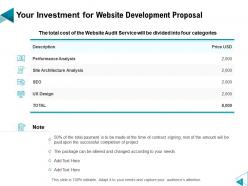
Slide 8: This is Your Investment slide for Website Development Proposal
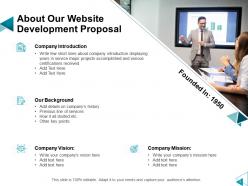
Slide 9: This is About Our Website Development Proposal slide. Write few short lines about company introduction displaying years in service major projects accomplished and various certifications received
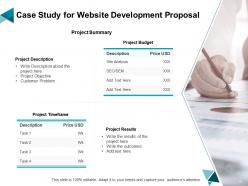
Slide 10: This slide shows Case Study for Website Development Proposal with- Project Summary, Project Description, Project Objective, Customer Problem, Project Results, Write the outcomes.
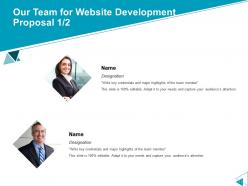
Slide 11: This is Our Team slide with Names and Designations.
Slide 12: This is also Our Team slide with Names and Designations.
Slide 13: This slide depicts Client Testimonial for Website Development Proposal.
Slide 14: This slide showcases Next Step for Website Development Proposal
Slide 15: This slide shows Terms and Contract for Website Development Proposal Payment
Slide 16: This is Contact Us slide with Company Name, Company address, Phone number, Company logo.
Slide 17: This is Icons Slide for Website Development Proposal
Slide 18: This slide is titled as Additional Slides for moving forward.
Slide 19: This is Our Mission Vision Goal slide.
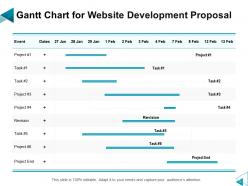
Slide 20: This slide displays Gantt Chart for Website Development Proposal
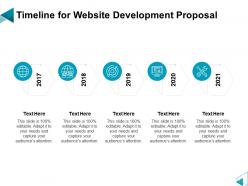
Slide 21: This slide depicts Timeline process.
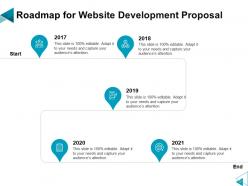
Slide 22: This slide displays Roadmap process.
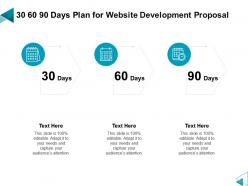
Slide 23: This is 30 60 90 Days Plan slide.
Website development proposal powerpoint presentation slides with all 23 slides:
Use our Website Development Proposal Powerpoint Presentation Slides to effectively help you save your valuable time. They are readymade to fit into any presentation structure.
FAQs for Website development proposal
Start with scope, timeline, budget, and deliverables - can't skip those. Tech stack details matter too, plus hosting and maintenance stuff. Trust me, vague specs will bite you later (learned that the hard way). Don't forget revision process and testing phases. Show them portfolio pieces that actually match their vibe or industry. Post-launch support should be crystal clear. Oh, and always end with next steps and deadlines - keeps things moving and you'll look way more professional than half the people they're probably talking to.
Honestly, figuring out your audience first is what makes or breaks a website proposal. Everything flows from there - your design picks, what features to include, even how much to charge. Building for millennials who live on their phones? Totally different approach than designing for older executives who just want to find contact info without clicking through five menus. Plus clients actually trust you more when you clearly get their users. I always map out the audience right at the top, then build my whole pitch around that. Makes the rest so much easier.
Dude, budget estimation is literally everything for your proposal. It shapes which features you can actually build and what you promise the client. I use mine to figure out must-haves vs nice-to-haves, pick the right tech, map out timelines. Can't tell you how many projects I've watched crash because someone lowballed the estimate. Plus it lets you offer different packages - clients love options and you protect your profit. Oh, and always pad it with extra buffer time. Scope creep will happen, trust me on this one.
Dude, you HAVE to get your timelines right or everything falls apart. I learned this the hard way on a project last year - client thought we'd be done in two weeks, we were still fixing bugs after a month. Awkward emails for days. Here's what works: pad your estimates with extra time for revisions and random stuff that breaks. Honestly, I probably overestimate now but it's better than scrambling. Set those expectations early in your proposal so everyone's on the same page about resources and deadlines. Trust me, spending more time planning upfront saves you from wanting to disappear later.
Start with your main tech stack - React or Vue for frontend, Node.js or Python on the backend. PostgreSQL or MongoDB for databases. Hosting wise, AWS or Vercel work great. Git's obviously a given for version control. I always list Figma too because honestly, clients eat that visual stuff up. Testing frameworks are clutch, plus security measures and Google Analytics. Oh, and mention any CMS if the project needs one. Just be specific enough to show you know your stuff without dumping every random library on them.
So competitor analysis is basically your homework before writing the proposal. Look at what's already out there - you'll spot gaps your project can fill and figure out what the industry standard actually is. Honestly, it's kinda like stalking your competition but in a professional way. This helps you justify why you're choosing certain features or design approaches. You can point to what works (and what totally doesn't) in their space. Plus it keeps your timeline and budget realistic. I'd throw in 2-3 solid competitor examples and explain how you're gonna do it differently or better.
Dude, biggest mistake? Being vague about scope and deadlines - clients freak out without specifics. Also never lowball just to get the gig. Learned that one the hard way when scope creep destroyed my sanity lol. Technical details matter too. List every platform, feature, deliverables - all of it. Oh and don't forget maintenance costs upfront or they'll expect free support forever. Set revision limits from the start. Trust me on this one - without boundaries you'll be tweaking stuff until you die. Honestly the whole thing comes down to being crystal clear about everything before you even start.
Dude, you HAVE to talk scalability in your proposals. Learned this one the hard way - clients will outgrow their site faster than you think. Nobody wants to rebuild everything in 18 months when their business takes off. Talk about handling more traffic, adding features later, maybe e-commerce down the road. Don't make it sound like you're trying to upsell them though - frame it as protecting what they're investing in now. Even small projects need some kind of growth plan. Trust me, it's what makes you look legit vs. just another freelancer.
So you'll definitely want to track the technical stuff first - page load times, uptime, mobile responsiveness. User metrics are super important too: bounce rate, time on site, conversion rates. SEO is where the real money is though - organic traffic growth and search rankings will make or break the long-term success. Google Analytics handles most of this automatically, plus Search Console for the SEO side. I'd set up monthly reports with your client. That way you can actually show ROI and spot problems before they get ugly.
Add an SEO section to your proposal - most developers totally skip this part. Cover the basics like site speed, mobile stuff, and meta tags. Then talk about keyword research and setting up analytics. Clients love seeing you actually care about getting them traffic, not just making things look pretty. I'd throw in specific deliverables too - Google Search Console setup, keyword audit, maybe a content calendar for the first few months. That's what separates you from the "build it and they'll come" crowd.
Show them real numbers - lead increases, lower support costs, better conversion rates. Case studies work great because people want to see what happened with businesses like theirs. Calculate time savings too, like how automation frees up their team. But honestly, don't just say "you'll make more money" - that's lazy. Break it down: "2% conversion bump means $X extra monthly with your current traffic." I always connect everything back to their actual problems and goals. Time savings calculations are surprisingly convincing since most business owners feel stretched thin anyway.
Don't just slap UX design at the end of your proposal - weave it through everything. Show them how you'll research their users, map journeys, wireframe, and test usability at every step. I swear, I've seen gorgeous sites that are impossible to navigate (so frustrating). Budget time for user testing and iterations - that's honestly where the real breakthroughs happen. Present it as a business investment, not some fluffy design extra. Because at the end of the day, beautiful designs mean nothing if they don't convert.
Start with discovery calls to nail down their vision, then don't wait until the end to show them stuff - send draft sections as you go. Seriously saves your sanity later. Google Docs works great since they can just comment right in there, or do quick check-ins at big milestones. Some people love those structured feedback forms with specific questions about scope and budget. Oh, and always figure out how they prefer to give feedback before you start - builds those review rounds right into your timeline from day one.
Look, case studies are like your proof that you're not just talking BS. Pick 2-3 examples that actually match what they need - same industry or similar tech stuff. Screenshots showing before/after work really well too. Numbers are your friend here: "boosted conversions 40%" or "cut load time by 3 seconds." Most proposals are boring as hell, so real examples make you stand out. It shows your process and how you solve problems instead of just promising vague results. Honestly, it's way more convincing than generic sales talk.
Dude, this choice basically rewrites your entire proposal - scope, timeline, budget, everything. Custom dev takes months and way more cash, but you're building something actually unique for them. Templates? Sure, you'll knock it out in weeks for cheaper, but they're stuck with whatever features exist and honestly, they might look like every other site out there. I'd probably push custom if they've got the money - better ROI down the road. Just spell out these trade-offs super clearly upfront so nobody freaks out later about costs or timelines.
-
Excellent Designs.
-
Easy to edit slides with easy to understand instructions.
-
Excellent products for quick understanding.
-
Informative design.
-
Attractive design and informative presentation.