


Website landing page design proposal powerpoint presentation slides




Try Before you Buy Download Free Sample Product
 Impress Your
 Audience
 100%
100% Editable
 Save Hours
 of Time


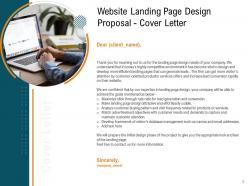
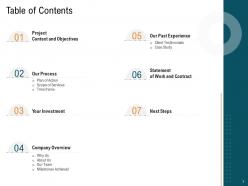
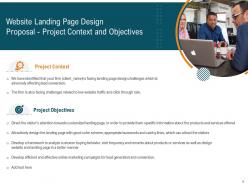
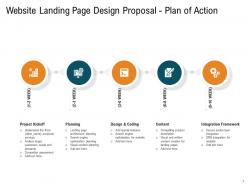
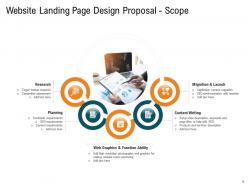
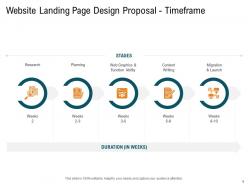
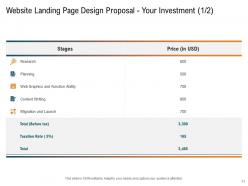
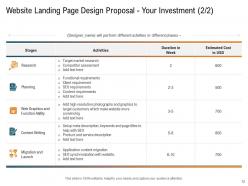
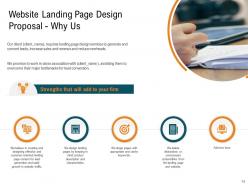
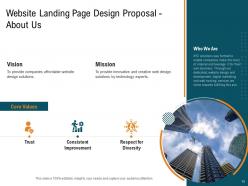
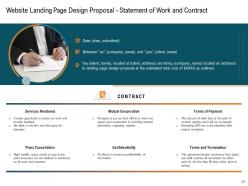
A landing page is a marketing method designed to generate leads, conversions and drive visitors to the website. It appears upon clicking on a link given in the email, on facebook, youtube, and other websites. In this highly competitive space, every business must have a landing page as a part of its marketing strategy. Corporations running their business online have started creating landing pages for an improved marketing approach. Therefore, enlighten your audience about the benefits of a landing page with our professionally-designed website Landing Page Design Proposal PowerPoint Presentation Slides. With the help of our aptly-designed cover letter, pitch your company’s expert website designing services. Highlight the several sections of your society in this table of contents slide. Understand the website-related issues and explain your project objectives innovatively by employing our lead capture page PowerPoint template. Assure them to create an eye-appealing landing page that instantly grasps the client's attention and increases the website traffic. Impress your clients by showcasing the plan of action required to initiate the project, such as project kick-off, planning, designing, coding, content, and integration framework. With the help of our creatively-designed lead generation page PowerPoint slideshow, detail the scope of page designing services like research, planning, web graphics & functionality, content writing, migration, and research. Utilize our single property page PowerPoint proposal deck to exhibit the time duration required to complete each activity creatively using icons and colors. Disclose the cost details and funds needed for acquiring your services clearly and concisely with our content-specific jump page PowerPoint design. Adopt our static page PPT proposal presentation to establish credibility and transparency by providing testimonials and achievements. You can also provide contact details so they can immediately reach out to you. The proposal also contains additional slides at the end for a seamless customized experience.
People who downloaded this PowerPoint presentation also viewed the following :
Website landing page design proposal powerpoint presentation slides with all 34 slides:
FAQs for Website landing page design proposal
An effective landing page design proposal should include target audience analysis, clear value proposition definition, wireframe layouts, conversion optimization strategies, and mobile responsiveness specifications. These elements work together by establishing user personas, defining compelling headlines and calls-to-action, and implementing A/B testing frameworks, with many agencies finding that data-driven proposals ultimately deliver higher conversion rates and stronger client results.
Visual hierarchy guides visitors through strategic use of size, color, contrast, spacing, and positioning to emphasize key elements like headlines, call-to-action buttons, and value propositions. Through deliberate font weights, contrasting colors, and whitespace management, businesses create clear pathways that lead visitors from initial interest to conversion, with many companies finding that well-structured visual flow increases engagement rates and ultimately drives higher conversion performance.
Color psychology significantly influences landing page conversions by triggering emotional responses, establishing brand trust, guiding user attention, and encouraging specific actions through strategic color choices. Through careful selection of primary colors, call-to-action buttons, and visual hierarchies, businesses across sectors like e-commerce, financial services, and healthcare enhance user engagement, reduce bounce rates, and ultimately drive higher conversion rates.
A/B testing can be incorporated by proposing systematic testing of headlines, call-to-action buttons, form layouts, color schemes, and visual elements against defined conversion metrics. Through split-testing methodologies, businesses can optimize user engagement, reduce bounce rates, and increase conversion rates by 15-30%, with many e-commerce and SaaS companies finding that data-driven design iterations ultimately deliver measurable ROI improvements.
Key metrics for landing page success include conversion rate, bounce rate, time on page, click-through rates, and cost per acquisition. These measurements enable businesses to optimize user experience, maximize ROI, and enhance overall performance, with many companies finding that tracking these analytics simultaneously delivers better customer engagement and significantly improved marketing outcomes.
The proposal should emphasize responsive design frameworks, mobile-first development approaches, touch-friendly navigation elements, optimized loading speeds, and cross-device compatibility testing. Through adaptive layouts and streamlined mobile interfaces, businesses enhance user experiences, reduce bounce rates, and improve conversion rates across all devices, with e-commerce and service companies finding that mobile-optimized landing pages significantly boost customer engagement and sales performance.
Compelling landing page copy includes clear value propositions, benefit-focused headlines, concise messaging, strategic keyword placement, and persuasive call-to-action language. These elements work together by addressing visitor pain points, establishing credibility through testimonials, and guiding users toward conversion, with many businesses finding that copy-design alignment significantly improves engagement rates and conversion outcomes.
Effective CTA placement significantly influences user behavior by guiding attention flow, reducing decision fatigue, and creating clear conversion pathways through strategic positioning above the fold, after compelling content, and at natural reading endpoints. Well-positioned CTAs can increase conversion rates by 15-30%, with many e-commerce and SaaS companies finding that multiple, contextually relevant CTAs throughout the page ultimately deliver higher engagement and streamlined user journeys.
UX design principles enhance landing page effectiveness through clear visual hierarchy, intuitive navigation, fast loading times, mobile responsiveness, and strategic call-to-action placement. These principles streamline user journeys by reducing cognitive load, minimizing friction points, and guiding visitors toward conversion goals, with many e-commerce and SaaS companies finding that optimized UX delivers higher engagement rates and significantly improved conversion performance.
Competitor analysis informs landing page design by revealing industry standards, identifying content gaps, highlighting successful visual elements, and uncovering messaging strategies that resonate with target audiences. Through systematic evaluation of competitor layouts, value propositions, and conversion tactics, businesses can differentiate their offerings while adopting proven design principles, ultimately creating more compelling user experiences and competitive advantage.
Images and videos serve as powerful engagement tools that immediately capture attention, convey brand messaging, demonstrate product functionality, and build emotional connections with visitors. Through strategic visual storytelling, businesses across retail, SaaS, and financial services enhance user comprehension, reduce bounce rates, and significantly increase conversion rates, ultimately delivering more compelling customer experiences and competitive advantage.
Trust elements integrate seamlessly through strategic placement of customer testimonials near value propositions, security badges prominently in header and footer areas, client logos in dedicated trust bars, and certification badges adjacent to form fields. These elements enhance credibility by reducing visitor anxiety, increasing conversion rates, and building immediate confidence, with many businesses finding that strategically positioned trust indicators significantly improve lead generation and customer acquisition rates.
Load times directly impact landing page success through reduced bounce rates, improved conversion rates, enhanced SEO rankings, and better user experience metrics. Proposals should address this by recommending image optimization, content delivery networks, streamlined coding practices, and performance monitoring tools, with many businesses finding that faster loading pages increase conversions by up to 74% while delivering significant competitive advantages.
The proposal should detail SEO integration through strategic keyword placement, meta tag optimization, page speed enhancement, mobile responsiveness, and structured data implementation. These practices streamline search visibility by improving organic rankings, reducing bounce rates, and enhancing user experience, with many businesses finding that SEO-optimized landing pages deliver significantly higher conversion rates and sustainable competitive advantage.
Strategies include consistent brand messaging, targeted content that matches campaign objectives, conversion-optimized layouts, A/B testing protocols, and integrated analytics tracking. Through strategic alignment of visual elements with marketing funnels, businesses streamline user journeys, enhance conversion rates, and maximize ROI, with many organizations finding that cohesive design-marketing integration delivers measurable competitive advantage.
-
Excellent work done on template design and graphics.
-
Top Quality presentations that are easily editable.
-
Very unique and reliable designs.