

Artificial Intelligence For IT Operation AIOps IT Powerpoint Presentation Slides




Try Before you Buy Download Free Sample Product
 Impress Your
 Audience
 100%
100% Editable
 Save Hours
 of Time


Grab our competently designed Artificial Intelligence for IT Operation AIOps template that gives a brief idea about the businesss current situation by understanding its problems and impact, implementation of AIOps in the company, and post-implementation results. In this Artificial Intelligence for IT Operations AIOps PowerPoint Presentation, we have covered the need for AIOps in business, its importance, reasons to invest, how it will overcome business problems, its impact on business performance, and issues AIOps intended to solve. In addition, this Artificial Intelligence for IT Operations AIOps PPT contains an introduction to AIOps, critical elements, stages, essential functions, and business benefits of AIOps. Also, the Artificial Intelligence for IT Operations AIOps PPT presentation includes the working of AIOps, market moment, return on investment, and critical requirements for an effective AIOps solution. Furthermore, this Artificial Intelligence for IT Operations AIOps template caters to applications of AIOps in various industries, a budget, a training program, and implementation of AIOps in the company. Lastly, this Artificial Intelligence for IT Operations AIOps deck includes a 30 60 90 days plan, roadmap, dashboard, post-implementation impact on business, etc. Download it now.
People who downloaded this PowerPoint presentation also viewed the following :
Content of this Powerpoint Presentation
Slide 1: This slide displays title i.e. 'Artificial Intelligence for IT Operations (AIOps)' and your Company Name.
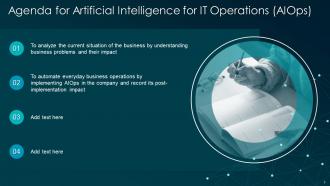
Slide 2: This slide presents agenda.
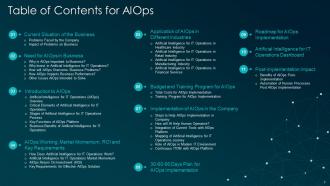
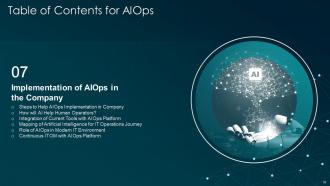
Slide 3: This slide exhibits table of contents.
Slide 4: This slide depicts title for two topics that are to be covered next in the template.
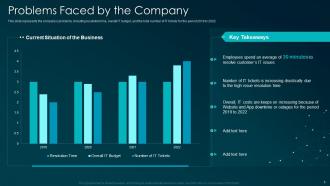
Slide 5: This slide represents the company's problems, including resolution time, overall IT budget, and the total number of IT tickets for the period 2019 to 2022.
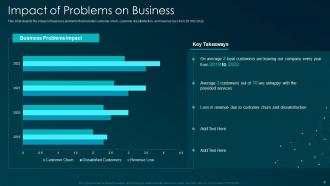
Slide 6: This slide depicts the impact of business problems that includes customer churn, customer dissatisfaction, and revenue loss from 2019 to 2022.
Slide 7: This slide depicts title for five topics that are to be covered next in the template.
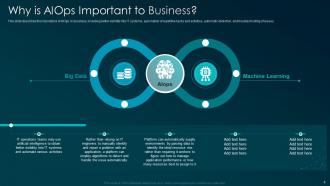
Slide 8: This slide describes the importance of AIOps in business, including better visibility into IT systems, automation of repetitive tasks, etc.
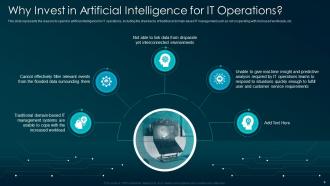
Slide 9: This slide represents the reasons to spend in artificial intelligence for IT operations.
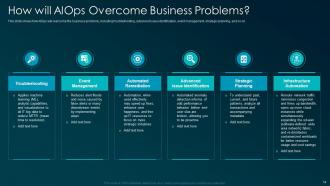
Slide 10: This slide shows how AIOps will overcome the business problems, including troubleshooting, advanced issue identification, event management, etc.
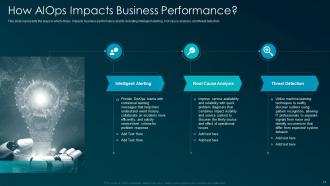
Slide 11: This slide represents the ways in which AIOps impacts business performance and its including intelligent alerting, etc.
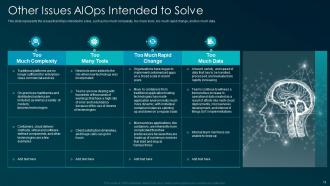
Slide 12: This slide represents the issues that AIOps intended to solve, such as too much complexity, too many tools, too much rapid change, and too much data.
Slide 13: This slide depicts title for five topics that are to be covered next in the template.
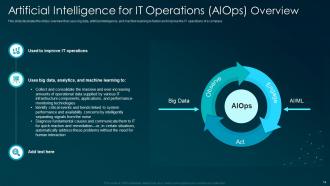
Slide 14: This slide illustrates the AIOps overview that uses big data, artificial intelligence, and machine learning to fasten.
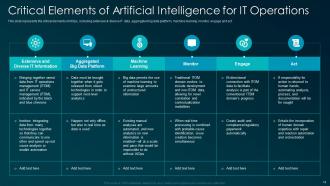
Slide 15: This slide represents the critical elements of AIOps, including extensive & diverse IT data, aggregated big data platform, machine learning, etc.
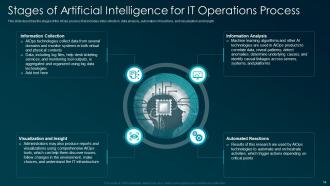
Slide 16: This slide describes the stages of the AIOps process that includes data collection, data analysis, automation of reactions, etc.
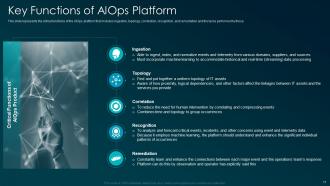
Slide 17: This slide represents the critical functions of the AIOps platform that includes ingestion, topology, correlation, recognition, etc.
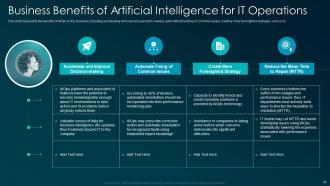
Slide 18: This slide represents the benefits of AIOps to the business, including accelerating and improving decision-making, etc.
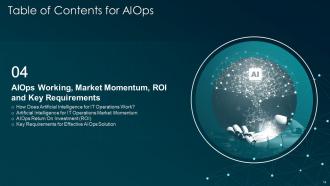
Slide 19: This slide depicts title for four topics that are to be covered next in the template.
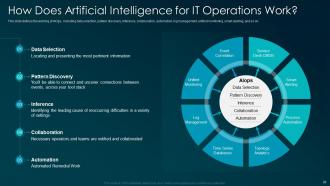
Slide 20: This slide defines the working of AIOps, including data selection, pattern discovery, inference, collaboration, automation, log management, etc.
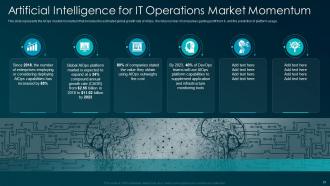
Slide 21: This slide represents the AIOps market momentum that includes the estimated global growth rate of AIOps, etc.
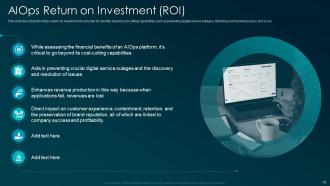
Slide 22: This slide describes the AIOps return on investment to consider its benefits beyond cost-cutting capabilities.
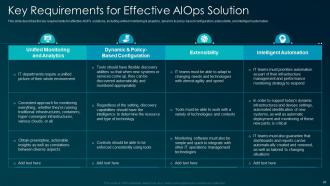
Slide 23: This slide describes the key requirements for effective AIOPs solutions, including unified monitoring & analytics, etc.
Slide 24: This slide depicts title for four topics that are to be covered next in the template.
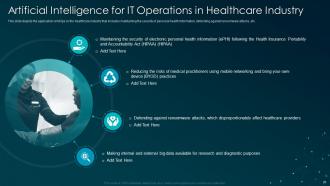
Slide 25: This slide depicts the application of AIOps in the healthcare industry that includes maintaining the security of personal health information.
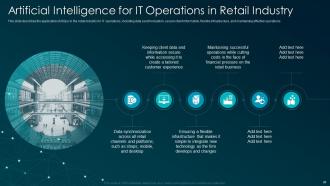
Slide 26: This slide describes the application of AIOps in the retail industry for IT operations, including data synchronization, etc.
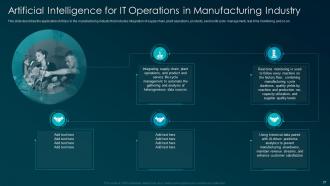
Slide 27: This slide describes the application of AIOps in the manufacturing industry that includes integration of supply chain, plant operations, etc.
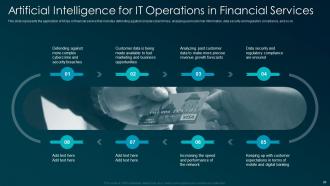
Slide 28: This slide represents the application of AIOps in financial service that includes defending against complex cybercrimes, etc.
Slide 29: This slide depicts title for two topics that are to be covered next in the template.
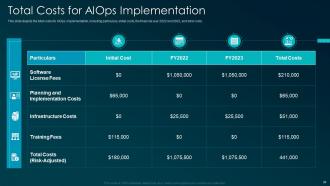
Slide 30: This slide depicts the total costs for AIOps implementation, including particulars, initial costs, the financial year 2022 and 2023, and total costs.
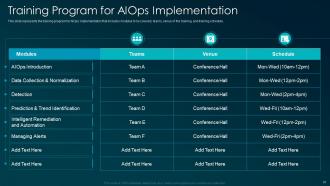
Slide 31: This slide represents the training program for AIOps implementation that includes modules to be covered, teams, venue of the training, etc.
Slide 32: This slide depicts title for six topics that are to be covered next in the template.
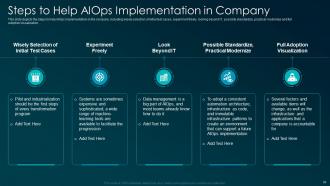
Slide 33: This slide depicts the steps to help AIOps implementation in the company, including wisely selection of initial test cases, etc.
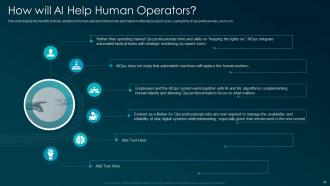
Slide 34: This slide depicts the benefits of AIOps adoption to human operators that include automated monitoring by expert users, etc.
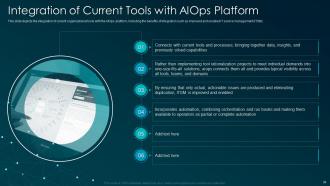
Slide 35: This slide depicts the integration of current organizational tools with the AIOps platform, including the benefits of integration.
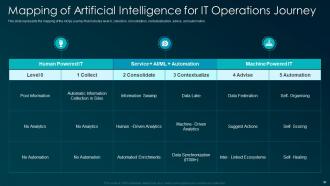
Slide 36: This slide represents the mapping of the AIOps journey that includes level 0, collection, consolidation, contextualization, advice, and automation.
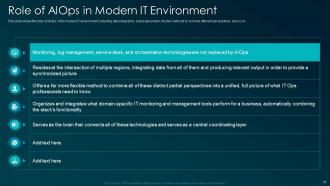
Slide 37: This slide shows the roles of AIOps in the modern IT environment, including data integration, output generation, etc.
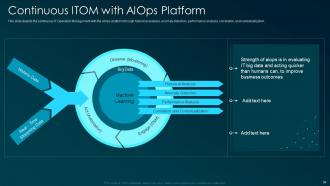
Slide 38: This slide depicts the continuous IT Operation Management with the AIOps platform through historical analysis, anomaly detection, performance analysis, etc.
Slide 39: This slide depicts title for the topic that is to be covered next in the template.
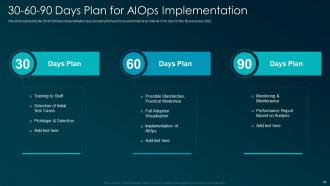
Slide 40: This slide represents the 30-60-90 days implementation plan, including the tasks to be performed at an interval of 30 days for the financial year 2022.
Slide 41: This slide depicts title for the topic that is to be covered next in the template.
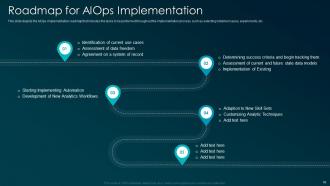
Slide 42: This slide depicts the AIOps implementation roadmap that includes the tasks to be performed throughout the implementation process.
Slide 43: This slide depicts title for the topic that is to be covered next in the template.
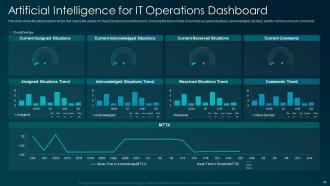
Slide 44: This slide shows the dashboard for AIOps that covers the details of Cloud DevOps team performance.
Slide 45: This slide depicts title for two topics that are to be covered next in the template.
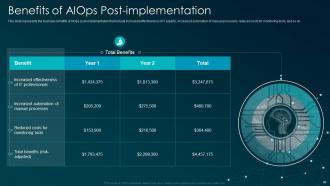
Slide 46: This slide represents the business benefits of AIOps post-implementation that include increased effectiveness of IT experts, etc.
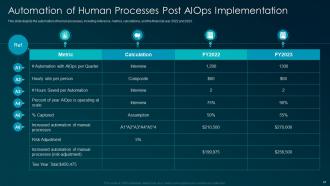
Slide 47: This slide depicts the automation of human processes, including reference, metrics, calculations, and the financial year 2022 and 2023.
Slide 48: This is the icons slide.
Slide 49: This slide presents title for additional slides.
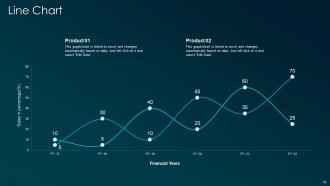
Slide 50: This slide exhibits yearly sales line charts for different products. The charts are linked to Excel.
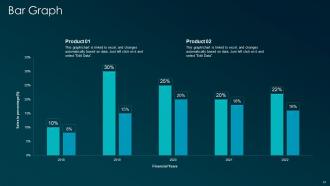
Slide 51: This slide shows yearly sales bar graph for different products. The charts are linked to Excel.
Slide 52: This slide depicts posts for past experiences of clients.
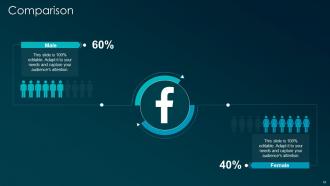
Slide 53: This slide highlights comparison of products based on selects.
Slide 54: This slide displays target of the company.
Slide 55: This slide shows puzzle for displaying elements of company.
Slide 56: This slide displays Venn.
Slide 57: This slide exhibits ideas generated.
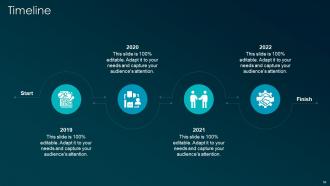
Slide 58: This slide exhibits yearly timeline of company.
Slide 59: This is thank you slide & contains contact details of company like office address, phone no., etc.
Artificial Intelligence For IT Operation AIOps IT Powerpoint Presentation Slides with all 64 slides:
Use our Artificial Intelligence For IT Operation AIOps IT Powerpoint Presentation Slides to effectively help you save your valuable time. They are readymade to fit into any presentation structure.






FAQs for Artificial Intelligence For IT Operation AIOps IT
So you've got four main pieces: data ingestion, ML engines, automation platforms, and analytics dashboards. They work with your existing monitoring stuff - don't need to rip and replace everything. Connect your ITSM, APM, and log tools through APIs. The ML part analyzes patterns from all your data sources (more is definitely better here). Automation handles the boring stuff like ticket routing. Your current tools keep doing their thing, but now there's this centralized system spotting issues faster and suggesting fixes. Honestly, I'd start by picking which data sources to connect first - makes the whole thing less overwhelming.
So AIOps catches problems before they blow up into full outages, which is honestly a game changer. It spots weird patterns and connects dots across your whole setup automatically. No more waiting for angry users to tell you something's broken. The machine learning gets really good at ignoring the BS alerts too - finally, no alert fatigue. When issues do happen, it'll suggest fixes or sometimes just handle the routine stuff itself. Mean time to resolution drops pretty dramatically. Oh, and start small with your most critical services first. Don't try to boil the ocean right away.
So ML is what actually makes AIOps smart instead of just another monitoring dashboard. It chews through tons of data from your systems to spot patterns and predict when stuff's about to break. Plus it connects the dots between incidents across different platforms - honestly pretty cool when it works right. The algorithms learn your specific environment over time, so they get better at catching your unique failure modes. I'd say start with anomaly detection first. That's where you'll actually notice a difference pretty quickly, and it's not as overwhelming as jumping into the deep end with everything at once.
Oh man, AIOps is a game changer for this stuff. Instead of spending hours digging through logs like some kind of digital archaeologist, it automatically connects the dots between all your systems in real-time. Machine learning does the heavy lifting - finds patterns you'd probably miss anyway. The coolest part? It actually learns from previous incidents, so it gets better over time. I'd say start small with one critical service first. You'll notice the difference right away, trust me.
So AIOps takes all your old IT data and basically predicts what's gonna break next. Machine learning models spot patterns in logs and metrics to warn you about server failures or traffic spikes before they happen. Honestly, it's like having that one coworker who actually pays attention to everything (but doesn't need coffee). You can catch weird behavior early and avoid those 3am emergency calls. My advice? Start small - pick one thing you want to predict and make sure your historical data isn't a mess first. Otherwise you'll just get garbage predictions.
Data silos are probably your biggest pain point - nothing talks to each other properly. Good luck finding people who actually know both AI and operations too. Teams will freak out thinking robots are taking their jobs, which I get but is exhausting to deal with. Costs add up fast and proving ROI is always messy. Oh, and getting clean data when your monitoring tools hate each other? Total nightmare. Honestly though, just pick one small thing to automate first. Get a win under your belt, then people will actually listen when you want to expand it.
So AIOps basically tears down those annoying walls between IT and business teams - everyone gets to see what's actually happening with the systems. Business folks don't have to sit there pulling their hair out wondering why everything's running like molasses. They get real-time data they can actually make sense of. Your IT crew can jump ahead of problems and explain timelines without all the technical jargon that makes people's eyes glaze over. Plus the predictive stuff helps everyone plan better (which honestly saves so much headache later). Figure out what business metrics your stakeholders care about most, then show how AIOps ties those back to your infrastructure.
Track your MTTD and MTTR first - that's mean time to detection and resolution. False positives matter too because alert fatigue is honestly the worst. I'd also watch how much your alert volume drops after implementation. Business-wise, measure incident frequency, uptime, and cost savings from automation. The real win is when resolution times shrink but your team isn't constantly stressed. Oh, and definitely baseline everything before you start, otherwise you'll have no clue if it's actually working. Check progress monthly to prove it was worth the money.
So basically you can train these AIOps tools on your own data and set custom alerts that actually make sense for your industry. Healthcare anomaly detection is completely different from e-commerce stuff, right? Most platforms let you build dashboards around your specific metrics and integrate with whatever tools you're already stuck using. Start with your biggest pain points first - don't try customizing everything at once or you'll go crazy. Train the algorithms on historical data, set up compliance rules if you need them. Honestly, pilot one use case and see how it goes before expanding.
Pick one area first - maybe monitoring or incident response. Don't go crazy trying to do everything at once. Your data needs to be clean because garbage in, garbage out, you know? I'd focus on making your current tools smarter rather than ripping everything out and starting over. That approach usually ends badly from what I've seen. Train your team on how to actually read the AI suggestions, and set up clear steps for when it detects issues. Oh, and make sure people trust it gradually - otherwise they'll just tune out all the alerts like they probably do now anyway.
So AIOps basically looks at your old usage data and spots trends to predict what you'll need down the road. Way better than scrambling when things break, honestly. It watches your systems 24/7 and finds resources you're not really using - then you can shrink or move stuff around. The algorithms forecast when demand's gonna spike and tell you exactly how to adjust capacity. Oh, and it catches bottlenecks before they tank your performance. I'd start monitoring your critical systems first since you'll get the most bang for your buck there.
So there's basically three big things to worry about with AIOps ethics. First, transparency - your AI needs to explain its decisions because black box systems making infrastructure calls is honestly terrifying. Second thing is bias in training data, which can mess up how resources get allocated between different teams. Nobody wants their app getting deprioritized because of wonky data. Third is accountability - humans still need to be in charge and responsible for what the AI does. Oh, and definitely audit your AI's decisions regularly and write down your ethical rules before everything hits the fan.
AIOps is actually pretty solid for cybersecurity - it spots threats and weird patterns that your team would probably miss. The system watches network traffic and user behavior 24/7, flagging suspicious stuff in real-time. What's neat is it adapts to your specific environment, so over time it gets way better at telling normal quirks apart from actual problems. You'll catch incidents faster and deal with fewer false alarms too. Honestly, the best part is your security people can stop drowning in logs and focus on actually responding to threats. I'd start by figuring out where you have the biggest visibility gaps.
Predictive analytics is getting crazy good right now. AIOps isn't just monitoring anymore - it's doing full-stack observability and automated fixes. Multi-cloud setups are such a mess that companies basically need AI to figure out what's happening. DevSecOps integration is huge too, plus real-time decision making. Everyone's trying to be proactive instead of just putting out fires all the time. Oh, and cross-domain correlation is clutch if you're picking platforms. Look for explainable AI features - trust me, you'll want to know why it made certain decisions when something goes wrong.
Start with solid data governance - clear policies on what your AIOps tools can access. Role-based controls are crucial so only the right people see sensitive stuff. Encrypt everything, both in transit and at rest. Audit your data sources regularly because garbage in definitely means garbage out (learned this the hard way). Pick vendors who are transparent about security and offer on-premises options for really sensitive data. Oh, and set up continuous monitoring for data quality metrics. Can't fix what you can't measure, right? Some vendors are way better than others at being upfront about their practices.
-
The slides are remarkable with creative designs and interesting information. I am pleased to see how functional and adaptive the design is. Would highly recommend this purchase!
-
Helpful product design for delivering presentation.