


Batteries renewable energy powerpoint presentation slides
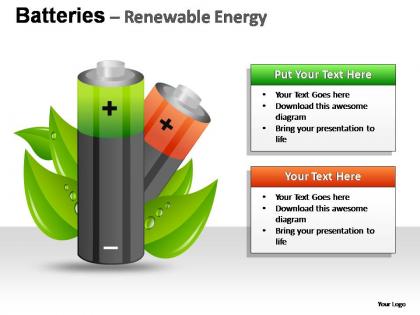




Try Before you Buy Download Free Sample Product
 Impress Your
 Audience
 100%
100% Editable
 Save Hours
 of Time


Your success is dear to our Batteries Renewable Energy Powerpoint Presentation Slides. They truly desire your continued growth.
People who downloaded this PowerPoint presentation also viewed the following :
Batteries renewable energy powerpoint presentation slides with all 11 slides:
Take the field with your ideas. Our Batteries Renewable Energy Powerpoint Presentation Slides will bat for you.


FAQs for Batteries renewable energy
So basically you've got three main types: lithium-ion, lead-acid, and flow batteries. Lithium-ion is everywhere now - costs keep dropping and they pack tons of energy. Tesla made them cool, I guess. Lead-acid batteries are still decent for home setups if you're trying to save money upfront, but honestly they'll die on you sooner. Flow batteries are kind of interesting for big projects since you can adjust capacity without messing with power output. Really depends on your budget and space though. Oh, and how long you want this thing to actually work. I'd figure out what power you need first, then pick from there.
Dude, the battery you pick totally changes how much solar power you'll actually get to use. Lithium-ion is where it's at - you're looking at 90-95% efficiency, so barely any energy gets wasted. Lead-acid sucks in comparison, maybe 80-85% tops, and they die way faster too. There's this newer LiFePO4 stuff that lasts forever but costs more upfront. Worth it though if you can swing it. Oh, and don't forget to account for those efficiency losses when you're figuring out storage size - learned that one the hard way!
Honestly, lithium-ion batteries are what make renewables actually work. The whole problem with solar and wind is timing - you can't predict when you'll get power, but batteries let you save it for later. Costs are dropping pretty fast too, which is helping renewables compete with fossil fuels. They scale really well from small home setups to huge grid installations. One thing though - if you're planning any renewable projects, budget for batteries upfront. They're usually like 20-30% of your total costs, but without them the whole system is pretty much useless.
So basically, a BMS is like having a smart babysitter for your battery pack. It watches the temperature, voltage, all that stuff to stop your batteries from getting fried by overcharging or getting too hot. Plus it balances out the individual cells so one crappy cell doesn't mess up the whole system. Honestly, it's probably the best investment you can make - my neighbor skipped getting a decent one and his batteries died way too early. A good BMS will easily add 30-50% more life to your setup while keeping everything running smooth.
Yeah, so battery production is actually pretty brutal for the environment. They have to mine lithium and cobalt, which destroys habitats and contaminates water supplies. Plus there's tons of carbon emissions from the whole process. When people just throw dead batteries in regular trash, all those toxic chemicals leak into soil and groundwater - not great. But here's the thing: recycling programs can actually recover like 95% of the materials now, which is honestly impressive. Most electronics stores will take your old batteries for free, so there's really no excuse not to do it. Way better than letting them sit in a landfill somewhere.
Dude, solid-state batteries could totally change renewables. Current lithium-ion ones suck at storing grid-level energy and die pretty fast. But solid-state tech? Way better energy density, lasts longer, safer too - like 10x better in some cases. Solar and wind farms could actually store enough juice for when it's cloudy or still outside. The cost thing is huge - it might finally make renewables cheaper than fossil fuels straight up. QuantumScape and Toyota are probably your best bets for who'll get there first, though Toyota's been promising this stuff forever lol.
Honestly, it's mostly about raw materials and not having enough factories. Lithium, cobalt, nickel - those supply chains are totally screwed right now and can't keep up. Plus we just don't have enough gigafactories to actually make batteries at the scale these renewable projects need. Costs are still pretty rough, though they're dropping which is good news. Quality control gets messy when you're trying to ramp up fast. Oh and the upfront capital? Brutal. My advice - plan for way longer lead times than you think and start building those supplier relationships now.
So here's the deal - batteries are what's killing wind projects right now. Wind doesn't blow on command, which means you're either dumping power when it's windy or panicking when it's not. Grid people hate that unpredictability. But here's where it gets interesting: bigger battery capacity changes everything. You can actually store wind energy and deliver it whenever, making your whole operation way more reliable. Investors suddenly care because now you're not at weather's mercy. Honestly, if you want funding approval, just go bigger on battery storage. That's like 90% of what makes or breaks these projects nowadays.
So cycle life is how many times you can charge and drain your battery before it craps out on you. For solar setups, this matters *a lot* because you're cycling daily - charging when the sun's up, using power at night. Trust me, the difference between 5,000 and 10,000 cycles is massive. We're talking replacing everything in 7 years vs 15 years. Lithium iron phosphate batteries cost more upfront but they'll last way longer than the cheap stuff. Do the math on replacement costs and you'll see why.
Dude, battery prices have crashed hard - we're talking $100-200/kWh for lithium-ion now. Wild considering where they were 10 years back. Here's the thing: you can stick batteries pretty much anywhere, unlike pumped hydro which needs specific terrain. Deployment's way faster too. They're crushing it for that 1-4 hour storage sweet spot most projects need. Plus the grid services revenue is solid. I mean, pumped hydro still has its place, but honestly? Run your numbers - batteries probably make more sense for what you're doing.
Honestly, solid-state batteries are where all the cool stuff's happening right now. They charge way faster without destroying themselves like regular ones do. Silicon nanowire anodes are another thing - super fast charging but they expand weirdly so still figuring that out. Smart charging algorithms basically read the grid and adjust automatically, which is neat. The AI systems that learn your usage patterns are probably the most exciting part though. Oh, and the new lithium-ion chemistries don't degrade as much with fast charging. I'd watch the solid-state space if you're planning anything - should be mainstream soonish.
Think of grid batteries like a buffer for all that unpredictable renewable stuff. Your solar panels go crazy during sunny days but nobody needs that much power? The batteries soak it up. Then clouds roll in (which honestly happens way too often) and boom - stored energy kicks in to keep everything steady. Wind dies down? Same deal. Without them you'd get all these voltage spikes and dips that mess with equipment. The tricky part is figuring out the right battery size for whatever renewable setup you're running and how much power people actually need throughout the day.
So batteries are like your energy storage hub - they grab excess power from your solar panels or wind setup when there's plenty, then you can charge your car anytime, even at night or when it's not windy. Smart ones will automatically find the cheapest electricity rates too, which is nice. Some EVs actually let you flip it around and power your whole house during blackouts (my neighbor does this and it's honestly pretty sweet). Short answer: if you're going all-in on renewable stuff, you'll definitely want a home battery system.
So basically, government funding and policy totally drives battery innovation for renewables. Federal grants flow to research labs and companies working on storage tech. Tax credits for energy installations are pretty generous - sometimes almost too good to be true lol. Regulations also force manufacturers to hit certain performance standards. Oh and if you're thinking about investing in this stuff, definitely watch policy announcements. They directly affect which technologies get fast-tracked and how quickly prices drop. The whole industry basically moves around what DC decides to fund.
So here's the deal with battery recycling - you can actually recover about 95% of the lithium, cobalt, and other materials from old batteries instead of mining new stuff every time. That's a massive win for the environment, honestly. Mining operations are pretty brutal. The whole process cuts manufacturing emissions and reduces toxic waste, making renewable energy way more sustainable overall. Short sentences work too. The trick is getting your suppliers to design batteries that are easier to take apart from day one - kind of a pain but totally worth it for the circular economy thing.
-
Much better than the original! Thanks for the quick turnaround.
-
Enough space for editing and adding your own content.