

Benchmarking competitive intelligence ppt slides




Try Before you Buy Download Free Sample Product
 Impress Your
 Audience
 100%
100% Editable
 Save Hours
 of Time


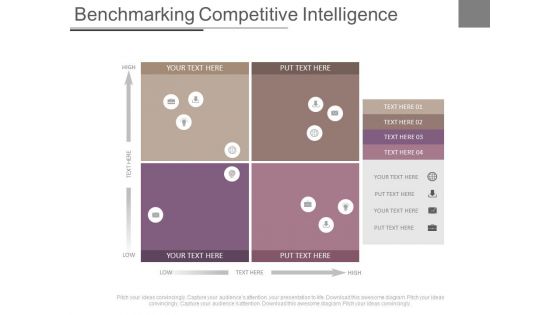
Presenting: "Benchmarking Competitive Intelligence Ppt Slides", a unique PowerPoint design for presenting your marketing strategies and benchmarking competitive intelligence related powerpoint presentations. This PPT slide is a design is crafted on the visuals of the square-shaped sections, filled with alluring colors to include different topics od the process being used. We have conceptualized this slide on a flat design, so that it's easier for the observer to understand the motive of the presentation. This PowerPoint template contains the concept of Strategic Planning Analysis, including business icons in this PPT slide helps us to display complex corporate data to a plain and comprehensible form and making it more engaging and easily understandable. Text area used in the layout can be used to describe your actions needed to be taken in order to achieve desired goals. Just get started with all new experiences with our most engaging PPT template and forget about disappointments, click on the download button and get started right away. Our Bench marking Competitive Intelligence Ppt Slides are an excellent bulwark. Go ahead with complete confidence.
People who downloaded this PowerPoint presentation also viewed the following :
Benchmarking competitive intelligence ppt slides with all 5 slides:
Our Benchmarking Competitive Intelligence Ppt Slides enable you to elaborate, discuss and arrive at conclusions. They help get the agenda going.

FAQs for Benchmarking competitive
Key metrics include market share analysis, pricing comparisons, product feature assessments, customer satisfaction scores, financial performance indicators, and digital presence measurements. These benchmarking tools enable organizations to identify competitive gaps, optimize strategic positioning, and enhance operational efficiency across sectors like retail, technology, and financial services, ultimately delivering actionable insights that drive market advantage.
Organizations effectively identify primary competitors through market research, industry reports, customer surveys, search engine analysis, and social media monitoring. These methods enable comprehensive competitor mapping by analyzing market share, target audiences, product offerings, and competitive positioning, with many companies finding that combining direct, indirect, and aspirational competitors delivers strategic insights for effective benchmarking initiatives.
Effective competitive intelligence tools include SEMrush and Ahrefs for digital marketing insights, SimilarWeb for website analytics, Brandwatch for social media monitoring, and Crayon for comprehensive competitor tracking. These platforms streamline data collection by automating market research, tracking competitor campaigns, and analyzing industry trends, ultimately delivering strategic advantages through real-time insights and competitive positioning intelligence.
Companies should update competitive intelligence benchmarks quarterly for comprehensive reviews, with monthly monitoring of key competitors and weekly tracking during critical periods like product launches or market shifts. This strategic approach enables organizations to respond swiftly to competitive threats, capitalize on market opportunities, and maintain their competitive advantage in increasingly dynamic business environments.
Customer feedback serves as a critical data source for competitive intelligence benchmarks, revealing market perceptions, service gaps, competitive positioning insights, and emerging customer expectations across industries. Through systematic analysis of feedback patterns, organizations can identify competitive vulnerabilities, validate market assumptions, and refine their strategic positioning, with many companies finding that customer insights ultimately deliver more accurate competitive assessments and stronger market differentiation strategies.
Benchmarking competitive intelligence enhances strategic decision-making by providing data-driven insights into competitor performance, market positioning, pricing strategies, and industry best practices. This comprehensive analysis enables organizations to identify strategic gaps, anticipate market shifts, and make informed resource allocation decisions, with many companies finding that regular competitive benchmarking delivers faster adaptation to market changes and sustainable competitive advantage.
Companies should consider respecting intellectual property rights, avoiding deceptive practices, maintaining transparency in research methods, protecting confidential information, and ensuring compliance with legal regulations. These ethical guidelines help organizations build sustainable competitive intelligence programs while preserving industry relationships, ultimately delivering strategic insights without compromising integrity, with many businesses finding that ethical approaches enhance long-term credibility and market positioning.
Small businesses can leverage competitive intelligence benchmarking by analyzing larger competitors' pricing strategies, marketing approaches, customer service standards, product features, and digital presence tactics. This strategic analysis enables smaller companies to identify market gaps, adopt proven successful practices, streamline their operations more efficiently, and discover niche opportunities that larger competitors may overlook, ultimately delivering competitive advantages through agility and targeted positioning.
Companies ensure competitive intelligence accuracy through multiple source verification, regular data validation processes, and cross-referencing information from primary research, industry reports, and direct market observations. By establishing systematic collection methodologies, implementing fact-checking protocols, and continuously updating intelligence databases, organizations enhance decision-making reliability while maintaining competitive advantage in increasingly dynamic markets.
Common pitfalls include relying on outdated data, focusing too narrowly on direct competitors, lacking systematic collection processes, failing to validate information sources, and not translating insights into actionable strategies. Many organizations also struggle with information overload, insufficient cross-departmental collaboration, and inadequate technology infrastructure, ultimately missing competitive advantages that could streamline decision-making and enhance market positioning.
Competitive intelligence informs product development by identifying market gaps, analyzing competitor features, tracking emerging technologies, and revealing customer pain points competitors haven't addressed. Through systematic monitoring of competitor launches, patent filings, and customer feedback, organizations can accelerate innovation cycles, differentiate offerings, and prioritize R&D investments, ultimately delivering products that capture market share while avoiding costly development missteps.
Industries with intense competition and rapid innovation cycles benefit most from rigorous competitive intelligence benchmarking, including technology, pharmaceuticals, financial services, retail, and telecommunications. These sectors leverage benchmarking to track market positioning, pricing strategies, and product development timelines, with many organizations finding that systematic competitive analysis enables faster strategic pivots, optimized resource allocation, and sustained competitive advantage in increasingly dynamic markets.
Organizations should prioritize competitive intelligence benchmarking based on strategic business impact, focusing on market positioning, pricing strategies, product development cycles, customer acquisition methods, and operational efficiency metrics. This targeted approach enables companies to allocate resources effectively while gaining actionable insights, with many finding that concentrating on 3-5 key areas delivers measurable competitive advantages.
Best practices for communicating competitive intelligence findings include creating executive summaries with actionable insights, using visual dashboards and data storytelling, tailoring messages to specific stakeholder needs, and establishing regular reporting cadences. These approaches enhance decision-making by translating complex market data into strategic recommendations, prioritizing time-sensitive opportunities, and ensuring cross-functional alignment, with many organizations finding that structured communication frameworks ultimately deliver faster responses to competitive threats and improved strategic positioning.
Social media platforms enable competitive intelligence benchmarking by monitoring competitor content strategies, audience engagement rates, product launches, customer sentiment, and market positioning across channels. Through social listening tools, organizations can track competitor performance metrics, identify content gaps, analyze customer feedback patterns, and benchmark their own social presence against industry leaders, ultimately delivering strategic insights that enhance competitive positioning and inform marketing strategies.
-
Excellent work done on template design and graphics.
-
Easily Editable.