


BFSI Company Profile Powerpoint Presentation Slides




Try Before you Buy Download Free Sample Product
 Impress Your
 Audience
 100%
100% Editable
 Save Hours
 of Time


BFSI Company Profile illustrate details to clients and other stakeholders on a broad range of specific activities. Our profile exhibits information about our engagement in investing, insurance, trading, banking, asset management, etc. Grab our professionally designed BFSI Company Profile. This profile showcases the executive summary with mission and vision, organization overview with core values, awards, recognition, USP, etc. Moreover, it highlights global presence, workforce diversity, business areas, products and services, and business models. This banking service profile shows subsidiary companies with their financials. The financial institution company profile also covers the company management team, organizational structure, ownership structure, and firm timeline and milestones. In addition, it shows a global clientele list and their testimonials. Besides, this profile contains strategic partners, global market share, and competitor comparison based on products and services and financials. Finally, it captures a financial snapshot providing revenue, net interest income, total deposits, loans and advances, capital adequacy ratio, provisional coverage ratio, operating profit, and net profit. It also shows expansion and plans, SWOT analysis, CSR initiatives, and case study. Download our BFSI company profile templates now.
People who downloaded this PowerPoint presentation also viewed the following :
Content of this Powerpoint Presentation
Slide 1: This slide introduces BFSI Company Profile. State your company name and begin.
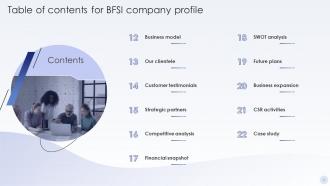
Slide 2: This slide presents Table of Content for the presentation.
Slide 3: This is another slide continuing Table of Content for the presentation.
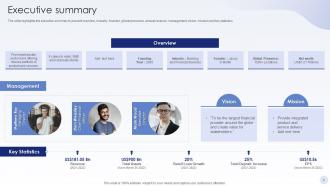
Slide 4: The slide highlights the executive summary to present overview, industry, founder, global presence, annual revenue, management, vision, etc.
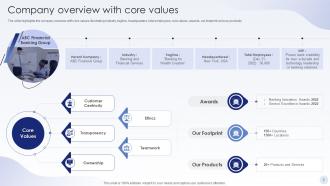
Slide 5: The slide highlights the company overview with core values illustrating industry, tagline, headquarters, total employees, core values, awards, etc.
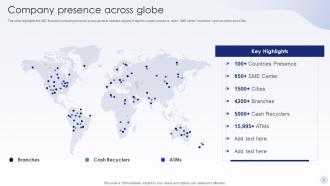
Slide 6: The slide highlights the ABC financial company presence across globe in multiple regions.
Slide 7: The slide highlights the workforce diversity and composition details depicting graphical representations for employee strength, etc.
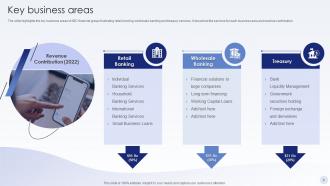
Slide 8: The slide highlights the key business areas of ABC financial group illustrating retail banking, wholesale banking and treasury services.
Slide 9: The slide highlights the products and services offered by financial banking group.
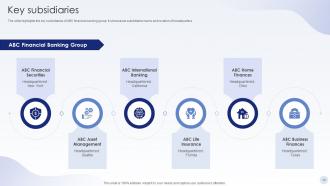
Slide 10: The slide highlights the key subsidiaries of ABC financial banking group. It showcases subsidiaries name and location of headquarters
Slide 11: The slide highlights the snapshot of subsidiaries companies showcasing company name, incorporation year, company shareholding, market capitalization, etc.
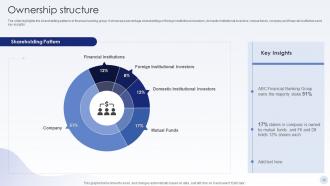
Slide 12: The slide highlights the shareholding patterns in financial banking group.
Slide 13: The slide highlights the company management team which depicts managing director, chief executive officer, chief financial officer, executive director, etc.
Slide 14: The slide highlights the company organization structure of financial bank.
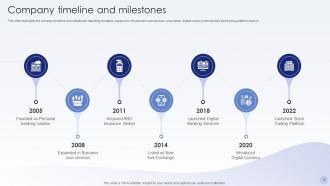
Slide 15: The slide highlights the company timeline and milestones depicting inception, expansion of business loan services, acquisition, etc.
Slide 16: The slide highlights the business model which illustrates key partners, key activities, key resources, value proposition, customer relationship, etc.
Slide 17: The slide highlights the key company clients associated with bank which includes government, corporate houses, hedge fund firms, etc.
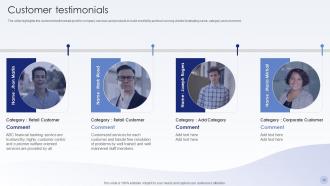
Slide 18: The slide highlights the customer testimonials post for company services and products to build credibility and trust among clients illustrating name, etc.
Slide 19: The slide highlights the key strategic partners which assists in growth of business operations.
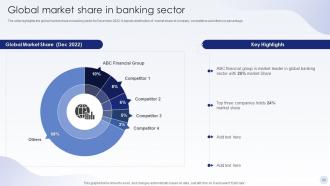
Slide 20: The slide highlights the global market share in banking sector for December 2022.
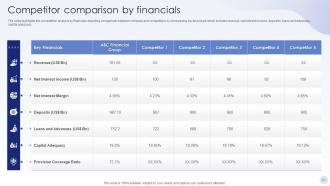
Slide 21: This slide highlights the competition analysis by financials depicting comparison between company and competitors by showcasing key financials.
Slide 22: The slide highlights the competition analysis by products and services.
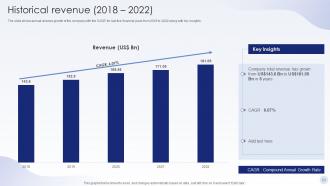
Slide 23: The slide shows annual revenue growth of the company with the CAGR for last five financial years from 2018 to 2022 along with key insights.
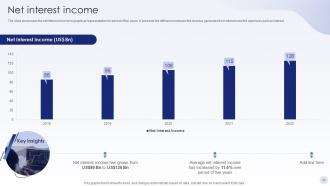
Slide 24: The slide showcases the net interest income in graphical representation for period of five years.
Slide 25: The slide highlights the operating profit and margin of financial banking group.
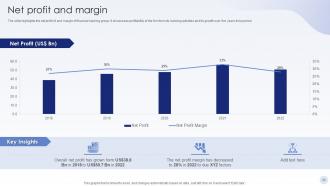
Slide 26: The slide highlights the net profit of and margin of financial banking group.
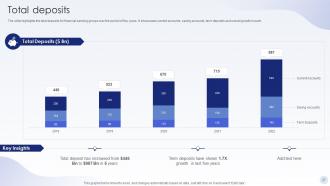
Slide 27: The slide highlights the total deposits for financial banking groups over the period of five years.
Slide 28: The slide showcases the total loans and advances for a period of five years.
Slide 29: The slide highlights the capital adequacy ratio depicting for the time period of five years from 2018 to 2022.
Slide 30: The slide highlights the company net worth and its growth over five year time period with key insights
Slide 31: The slide highlights the provisional coverage ratio for five years with key insights.
Slide 32: The slide highlights the SWOT analysis for financial banking group.
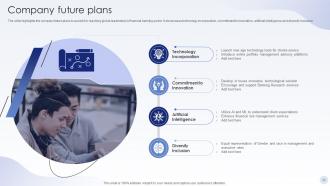
Slide 33: The slide highlights the company future plans to assist it in reaching global leadership in financial banking sector.
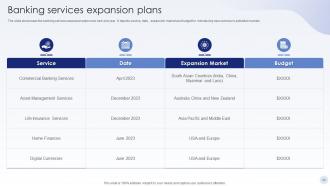
Slide 34: The slide showcases the banking services expansion plans over next one year.
Slide 35: The slide highlights the CSR activities and spending depicting disaster relief, education, healthcare, skill development and others.
Slide 36: This slide shows the case study which includes challenge faced by client in document processing resulting in shipping delays and inefficiencies.
Slide 37: This slide contains all the icons used in this presentation.
Slide 38: This slide is titled as Additional Slides for moving forward.
Slide 39: This is About Us slide to show company specifications etc.
Slide 40: This is Our Mission slide with related imagery and text.
Slide 41: This is Our Team slide with names and designation.
Slide 42: This is Our Goal slide. State your firm's goals here.
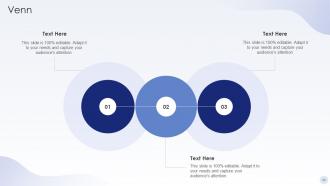
Slide 43: This slide depicts Venn diagram with text boxes.
Slide 44: This slide describes Line chart with two products comparison.
Slide 45: This is a Timeline slide. Show data related to time intervals here.
Slide 46: This slide presents Roadmap with additional textboxes.
Slide 47: This is a Thank You slide with address, contact numbers and email address.
BFSI Company Profile Powerpoint Presentation Slides with all 52 slides:
Use our BFSI Company Profile Powerpoint Presentation Slides to effectively help you save your valuable time. They are readymade to fit into any presentation structure.


























FAQs for BFSI Company Profile
So BFSI is pretty straightforward - it's banking, financial services, and insurance. Banks do the obvious stuff like loans and deposits. Financial services are more about wealth management and investment advice (honestly the fees can be brutal though). Insurance covers life, health, property - you know the drill. Most companies nowadays don't stick to just one area anyway. Like your bank probably sells insurance too. When you're looking at any BFSI company, just figure out which of those three buckets their main revenue comes from and you'll understand their business model pretty quick.
Hey! So digital stuff has totally changed banking and finance. People open accounts and apply for loans right from their phones now - like, who even goes to branches anymore? The apps are pretty smart too, giving you personalized suggestions and those chatbots that don't completely suck. Everything's instant - transfers, notifications, even unlocking with your fingerprint. Honestly, if banks aren't doing this digital-first thing by now, they're gonna lose customers to the ones that actually get it. It's just so much easier when everything works seamlessly.
Honestly, BFSI companies are getting slammed by regulations right now. GDPR's still a nightmare, and digital payments keep changing rules every few months. Don't even get me started on crypto compliance - that's a moving target. AML requirements are tightening up too. If you're operating internationally, good luck juggling all those cross-border regulations. Plus there's cybersecurity mandates on top of protecting customer data while you're trying to innovate digitally. My advice? Build frameworks that can actually adapt quickly instead of playing catch-up every time something new drops.
Banks and financial companies basically take tons of data - transactions, how people behave, market stuff - and analyze it to make better calls. Your loan approval happens instantly because of this. Insurance companies do the same thing with risk factors, which honestly makes way more sense than the old guessing games. They're also catching fraud faster and suggesting products you might actually want. Oh, and staying compliant with regulations too. The whole point is ditching gut feelings for actual data. If you're dealing with these clients, definitely ask about their data sources - it'll give you insight into how they think.
Dude, cybersecurity in banking is HUGE. These companies are sitting on everyone's money and personal info - one breach and they're screwed. The hackers targeting them are honestly pretty terrifying with how clever they get. Banks pour crazy money into layered security systems because they have to meet all these strict regulations like PCI DSS. Plus there's ransomware, fraud attempts, you name it. My cousin works at a credit union and says they do security audits constantly. It's expensive but way cheaper than dealing with a massive data breach that kills your reputation.
Honestly, fintech companies are making banks scramble to catch up. Your customers want everything instant now - payments, loans, investing - because apps like Venmo made it so easy. Banks can't rely on physical branches anymore when people expect to do everything on their phone. Some are buying fintech startups, others are partnering up. The smart ones went digital early. If you're working in banking, you've probably noticed how much pressure there is to modernize everything. It's wild how fast things changed - like, my mom does all her banking through apps now and she used to hate technology.
Honestly, BFSI is going through some wild changes right now. Digital transformation is everywhere - companies are throwing cash at fintech, AI risk tools, and better customer platforms because traditional banks feel like they're stuck in 2005. ESG stuff is also becoming massive, with green bonds and sustainable finance being must-haves for investors. Oh, and compliance tech is booming since regulations won't stop changing (which is exhausting but profitable if you're on the right side). I'd focus on companies crushing the digital game while staying on top of all these new rules. That's where the real money is.
So BFSI companies basically set up these massive compliance teams that watch for regulatory changes 24/7. They use automated systems to flag weird transactions in real-time - pretty cool tech actually. The audit cycle never stops though, internal and external auditors everywhere. Training employees is huge since people mess up way more than systems do. Oh and the certifications - there's like a million of them. If you're dealing with these companies, just ask about their recent audit results. That'll tell you if they're actually serious about compliance or just going through the motions.
Honestly, you've got to segment in BFSI - the customer needs are just too different otherwise. A college kid wanting their first credit card isn't the same as someone in their 50s planning retirement, you know? Can't send mortgage ads to both and expect results. Demographics, spending behavior, life stage - use whatever data you have to group people properly. Your conversion rates will thank you later. Plus you'll stop wasting money on campaigns that don't land. I'd start by looking at your current customer base and finding the obvious patterns first. Way easier than you'd think once you dig into it.
So customers basically became digital natives overnight during COVID. They don't want to step foot in branches anymore - everything's gotta be online now. People are way pickier about fees and rates too, shopping around like crazy before committing. Real-time everything is the expectation now... instant loan decisions, immediate chat support, you name it. Oh and they're super into those budgeting tools and personalized financial advice features. Honestly, if your app sucks or your rates aren't competitive, they'll just bounce to one of those fintech startups instead.
So for BFSI companies, you're gonna want to look at the usual financial stuff - ROA, ROE, net interest margins. Cost-to-income ratios matter too. Customer metrics are huge now - acquisition costs, how well they retain people, satisfaction scores. Oh, and regulatory stuff is basically make-or-break, especially those capital adequacy ratios (regulators don't mess around). Digital metrics are getting just as critical as the old-school ones - mobile usage, online transactions, all that. Honestly though? Don't just look at one quarter's numbers. Track the trends over time because consistency beats flashy one-offs every time.
BFSI companies aren't treating ESG like some side project anymore - it's becoming central to everything they do. Banks now tie exec pay to sustainability goals. Insurance companies are rebuilding their entire risk models around climate data, which honestly makes total sense when you think about it. Investment firms are rolling out green bond platforms left and right. Between regulatory pressure and customer demands, you don't really have a choice here. Your lending, investment strategies, even basic office operations need ESG metrics built in. I'd start tracking those KPIs now because they're gonna matter just as much as your financial numbers for reporting.
Dude, banks are going crazy with AI right now - fraud detection, chatbots, automated loan approvals, the works. Cloud computing is everywhere too, plus they're using RPA to handle boring back-office stuff. APIs are massive because they're powering open banking and faster integrations. Most places are pushing mobile-first everything and real-time payments. Oh, and blockchain for security obviously. Honestly though? The companies killing it aren't just picking one tech - they're mixing everything together. That's where you see actual results instead of just flashy demos that don't move the needle.
So these financial companies basically spread their money around - different investments, different countries, you know? They're not stupid about it. Most use derivatives like options to protect themselves when markets go crazy. Think of it as buying insurance for their portfolios. Risk limits are huge too - they'll stress test everything regularly to see what happens if things go sideways. The really good ones bake volatility right into their pricing from the start. Honestly, if you're looking at any of these companies, just check how they did in 2008 or March 2020. That tells you everything.
Dude, the next ten years? AI personalization is gonna be huge, plus all that embedded finance stuff and regulatory tech going mainstream. Banks are finally realizing they can't beat fintechs so they're just partnering with them instead - smart move honestly. Everything's moving so damn fast though. People want instant everything now - payments, loans, investment advice - all baked into whatever app they're already scrolling through. Oh, and sustainable finance isn't optional anymore since ESG became this whole thing investors obsess over. My advice? Get your tech infrastructure sorted now and stay flexible. Companies that pivot quickly are gonna eat everyone else's lunch.
-
Stunning collection! With a wide variety of options available, I was able to find a perfect slide for my presentation. Thank you, SlideTeam!
-
Perfect template with attractive color combination.