


Brand positioning bulls eye template powerpoint guide




Try Before you Buy Download Free Sample Product
 Impress Your
 Audience
 100%
100% Editable
 Save Hours
 of Time


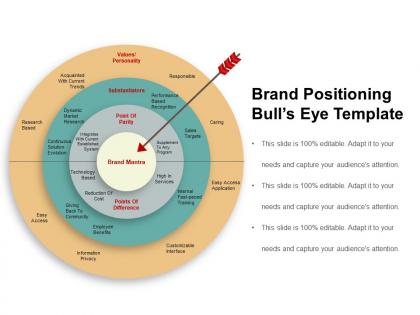
Uplift your arguments and gain an exponential advancement through our, brand positioning bull's eye template PowerPoint guide. Create the first impact through compelling brand positioning strategy that will maximize consumer relevancy and competitive distinctiveness, in expanding brand value. We have shown the visuals of a digital dart board in this brand position PPT example to elaborate on various plans. Engaging icons are shown in support of the concept to create a vivid image in the viewer's mind. Distinct topics shown here are, values, personality, responsibility, caring, easily accessible application, customization interface, information privacy research-based, dynamic marketing research as substantiations, the point of difference. We have shown the keyword brand mantra in the center as bull's eyes to make it clear the gist of the design. Download our, brand positioning bull's eye template PowerPoint guide to exceed further. Let our Brand Positioning Bulls Eye Template Powerpoint Guide give the updraft to your ideas. See them soar to great heights with ease.
People who downloaded this PowerPoint presentation also viewed the following :
Brand positioning bulls eye template powerpoint guide with all 5 slides:
Our Brand Positioning Bulls Eye Template Powerpoint Guide ensure harmonious existence Everyone acts for the common good.
FAQs for Brand positioning bulls eye
You know how some brands can charge way more and people still buy them? That's positioning working. It's like giving customers a reason to pick you beyond just price - which honestly saves you from those brutal price wars. Good positioning means people instantly get why you're different. They'll actually pay more because they see the value. Without it? You're basically begging customers to choose you, and that sucks. The trick is figuring out what you do that nobody else can match - or at least what you do way better. Once you nail that, everything else gets easier.
Check out who's already buying from you first - their age, what they do, why they actually hit purchase. Survey them if you can. Social media analytics are goldmine for this stuff too. Way easier than guessing, honestly. Build detailed personas from real patterns you find, not what you think might work. Then test different messages on each group and see what clicks. You want specific enough that people think "this is totally me" but not so narrow you're only talking to like 12 people. Makes sense?
You need three big things: know exactly who you're targeting, figure out what makes you different from competitors, and nail your value prop so it actually connects with people emotionally. Brand personality matters too - plus keeping your messaging consistent everywhere. Most companies totally blow this by trying to be everything to everyone instead of just owning their lane, which honestly drives me crazy. Map out your ideal customer first, then ask yourself what unique thing only you can give them. That's how you answer the "why should I pick you?" question in a way people will remember.
Think of customer feedback as your reality check - it reveals what people actually think vs what you're trying to say. Ask customers how they see your brand compared to competitors. Reviews are super telling too since they show what words people use to describe you. Social listening is honestly way easier than doing formal surveys, so start there. Look for mismatches between what you want your positioning to be and how it's actually coming across. Then tweak your messaging. Oh, and don't forget to check back regularly to see if your changes are working.
Think of storytelling as the thing that makes your brand stick. Don't just say "we're innovative" - actually show it through stories that hit people emotionally. Like, anyone can claim they're funny, but can you tell a decent joke? Stories separate you from competitors with the same boring features. Your origin story matters, customer wins matter, even how you screw up and recover matters. Honestly, most brands are terrible at this part. Find your main narrative that backs up your positioning, then tell it everywhere. Consistently. Your website, social, even customer service calls.
Dude, cultural stuff will make or break your brand overseas. What kills it in one place might totally bomb somewhere else. Take colors - red screams "lucky!" in China but spells danger here in the West. Crazy difference, right? Your messaging needs to hit different emotional buttons too. Individualistic cultures want personal benefits while collectivist ones care more about group harmony. Honestly, I've seen companies skip the cultural research and just translate their pitch word-for-word. Big mistake. You gotta dig deep into local values before launching anything new.
Dude, visuals are everything when it comes to brand positioning. They hit people emotionally before they even process your message. Your colors, fonts, the whole aesthetic - that stuff instantly tells people if you're fancy, friendly, cutting-edge, whatever. I've literally watched presentations bomb because the design totally clashed with what they were saying. Like, you can't claim to be innovative tech while using those awful default PowerPoint templates from forever ago. It's basically like showing up to a job interview in pajamas. Keep everything consistent with how you want people to see you. Makes a huge difference.
Honestly, the worst mistake is trying to appeal to everyone - you just end up being forgettable. Most companies also just copy what their competitors are doing instead of figuring out what makes them different. That drives me crazy because it's so lazy. Don't claim you're "premium" if your customer service sucks. Being vague is another killer - like saying you're "innovative" when literally everyone says that. Your positioning needs to be specific and something you can actually back up. Oh, and test it with real people first before going all-in.
Honestly, digital marketing tools are pretty amazing for brand positioning. Social listening shows you what people really think about you vs competitors - then you can tweak your messaging. Analytics reveal which positioning actually works (feels like cheating sometimes). Email segmentation lets you test different brand angles with various audience groups. Social media's perfect for reinforcing your position through targeted content. Oh, and definitely audit your current digital touchpoints first. You'd be surprised how often they're telling completely different brand stories. Start there.
Honestly, I'd focus on brand awareness stuff first - surveys, unaided recall, share of voice. Those give you the baseline. Perception metrics are huge too though. Like, are people actually connecting your brand with what you want them to? NPS and sentiment tracking work well for that. Purchase intent is obviously the big one since good positioning should make people want to buy. Oh, and competitive differentiation scores - track how you stack up over time. The trick is measuring before you roll anything out, then checking in quarterly after. Don't go crazy with metrics though. Three or four max, otherwise you'll drown in data.
Get super specific about who you're helping and what problem you actually solve. Don't try to be everything to everyone - that's way more expensive and honestly just doesn't work. Pick your lane and own it. Your small size is actually an advantage here. Share real stories about building this thing, talk to people directly on social, maybe team up with other small companies. Big budgets often make boring campaigns anyway. Being scrappy forces you to get creative. Oh and start with this: write one sentence about why your company exists. Like, really nail that first.
Here's what I've learned from watching brands mess this up - positioning is everything for building equity. You get clear on how customers see you compared to competitors, and that's what drives preference and loyalty down the line. Short sentences work here. The whole thing falls apart without consistency though, which honestly most companies suck at. Every touchpoint needs to reinforce the same message or you're just wasting money. I always think of it like this: positioning is your foundation, equity is what you build on top. Get the foundation wrong and the whole house comes crashing down eventually.
Honestly, think of your positioning statement as like your marketing GPS. Every campaign and message should trace back to it - who you're targeting, what sets you apart, why anyone should give a damn. I've watched teams blow through budgets because they had zero clarity on this stuff. It keeps you consistent across all your touchpoints and helps you figure out which features to actually talk about. Your tone of voice? That comes from it too. If some creative idea doesn't support your positioning, just... don't do it. Saves you so much headache later.
Dude, look at Old Spice - they went from being your dad's boring deodorant to this crazy Gen Z favorite with those weird but hilarious ads. Apple's another good one, ditching the whole "we just make computers" thing to become this lifestyle brand everybody wants. McDonald's stopped pretending they were just cheap food and made it about the whole experience instead. Oh and Netflix saw streaming coming way before Blockbuster even knew what hit them. Smart move there. Basically these companies figured out where things were going, not where they were. You gotta think future trends, not current reality.
Honestly, if you ignore trends like sustainability, you'll just look totally out of touch. Your customers want brands that actually match their values now. But here's the thing - you can't just slap "eco-friendly" everywhere and expect people to buy it. They're way too smart for that BS. Figure out which trends actually make sense for your brand and weave them in naturally. I'd start by checking what your competitors are doing first. Sometimes there's this perfect gap where you can own something they're all missing. Just make sure it connects to what you actually stand for, not what's trendy this week.
-
Very unique and reliable designs.
-
Unique research projects to present in meeting.