


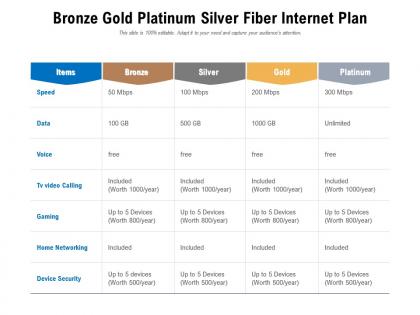
Bronze gold platinum silver fiber internet plan




Try Before you Buy Download Free Sample Product
 Impress Your
 Audience
 100%
100% Editable
 Save Hours
 of Time


Our Bronze Gold Platinum Silver Fiber Internet Plan are topically designed to provide an attractive backdrop to any subject. Use them to look like a presentation pro.
People who downloaded this PowerPoint presentation also viewed the following :
Bronze gold platinum silver fiber internet plan with all 2 slides:
Use our Bronze Gold Platinum Silver Fiber Internet Plan to effectively help you save your valuable time. They are readymade to fit into any presentation structure.
FAQs for Bronze gold platinum silver
Consumers should consider internet speed requirements, data usage patterns, contract terms, pricing structure, and provider reliability when selecting plans. Different households need varying speeds, with remote workers requiring higher bandwidth than casual users, while factors like installation fees, equipment costs, and customer service quality ultimately determine long-term satisfaction and value.
Data speed significantly impacts daily internet activities, with basic browsing requiring 1-5 Mbps, video streaming needing 25+ Mbps, and gaming demanding low latency connections. Higher speeds enhance productivity by enabling seamless video conferencing, faster file transfers, and simultaneous device usage, while slower connections can limit streaming quality and create delays, ultimately affecting user experience and efficiency across personal and professional applications.
Fiber uses light signals through glass cables delivering the fastest speeds and lowest latency, cable utilizes coaxial cables offering good speeds with shared bandwidth, and DSL operates through telephone lines providing basic connectivity. These technologies enable different performance levels, with fiber supporting high-demand applications like video conferencing and cloud computing, while cable and DSL serve standard browsing needs.
Users can determine bandwidth needs by assessing household size, device count, streaming habits, work-from-home requirements, and peak usage times. A family of four with multiple streaming devices typically needs 100-200 Mbps, while remote workers require additional upload speeds, with many households finding that overestimating slightly prevents slowdowns during high-demand periods.
Common hidden fees include installation charges, equipment rental costs, activation fees, early termination penalties, and data overage charges. These additional costs can significantly increase monthly expenses, with many consumers finding that promotional rates exclude equipment fees, while service providers often bundle mandatory router rentals, ultimately delivering higher bills than initially advertised pricing suggests.
Internet plans differ through bandwidth allocation, service level agreements, technical support availability, uptime guarantees, and pricing structures, with business plans emphasizing reliability and performance. While residential plans prioritize cost-effectiveness for basic browsing and streaming, business plans deliver dedicated bandwidth, priority customer support, and enhanced security features, ultimately enabling organizations to maintain operational efficiency and competitive advantage in increasingly digital environments.
Customer support significantly influences ISP selection through technical assistance, billing inquiries, service outage resolution, installation guidance, and plan modification help. Many businesses and households find that responsive support teams enable faster problem resolution, minimize downtime costs, and deliver superior user experiences, ultimately providing competitive advantage in an increasingly connected operational environment.
Bundling internet services with other utilities delivers cost savings, simplified billing, enhanced customer service coordination, promotional pricing opportunities, and streamlined account management. These strategic combinations enable households and businesses to reduce monthly expenses, minimize administrative overhead, and leverage negotiating power, with many telecommunications providers offering significant discounts for bundled packages that ultimately enhance operational efficiency.
Geographic location significantly influences internet plan availability and pricing through infrastructure density, provider competition, and regulatory factors. Rural areas typically face limited options and higher costs due to fewer providers and extensive infrastructure requirements, while urban centers benefit from competitive pricing and diverse high-speed options, ultimately creating disparate access levels across different regions.
Internet technologies present both environmental challenges and opportunities, with data centers consuming significant energy while fiber-optic networks proving more efficient than older copper infrastructure. Green hosting, renewable energy adoption, and optimized network protocols increasingly help providers reduce carbon footprints, with many telecommunications companies finding that sustainable practices ultimately deliver cost savings and competitive advantage.
Data caps significantly influence consumer decisions by affecting monthly costs, usage flexibility, and service reliability for streaming, gaming, and remote work needs. Households with heavy internet usage, particularly those with multiple devices or streaming services, often prioritize unlimited plans despite higher costs, while budget-conscious consumers may accept capped plans, ultimately driving providers to offer tiered options that balance affordability with strategic usage requirements.
Contract lengths typically range from month-to-month to two-year commitments, with longer contracts often offering lower monthly rates but requiring early termination fees ranging from $100-400. While extended contracts can deliver significant savings and price protection, consumers should carefully evaluate their mobility needs and service satisfaction, with many finding that month-to-month plans offer greater flexibility despite higher costs.
Consumers can effectively compare internet plans by evaluating speed requirements, data allowances, contract terms, pricing structures, and customer service ratings across providers. By analyzing these factors alongside their specific usage patterns, households can identify plans that deliver optimal value, reliable connectivity, and scalable bandwidth, with many finding that thorough comparison ultimately reduces costs while enhancing online experiences.
5G networks, fiber-optic expansion, satellite internet constellations, edge computing, and AI-driven bandwidth optimization are revolutionizing internet plan landscapes. These technologies streamline connectivity by delivering faster speeds, reducing latency, and enabling dynamic resource allocation, with telecommunications providers increasingly offering flexible, usage-based models that enhance customer experiences while optimizing operational efficiency.
Common complaints about internet service providers include slow speeds, frequent outages, poor customer service, hidden fees, and inadequate technical support. These issues can be addressed through infrastructure upgrades, transparent pricing models, improved customer service training, and proactive network monitoring, with many providers finding that investing in fiber networks and 24/7 support significantly enhances customer satisfaction and retention.
-
Very well designed and informative templates.
-
Innovative and Colorful designs.
-
The content is very helpful from business point of view.
-
Topic best represented with attractive design.
-
Use of different colors is good. It's simple and attractive.