


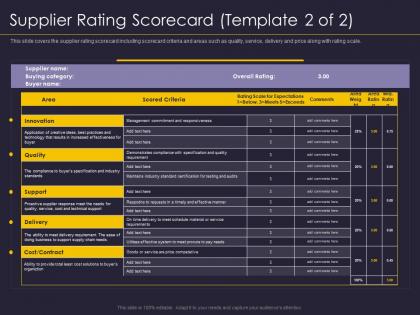
Supplier rating scorecard template 2 of 2 supplier relationship management strategy ppt microsoft




Try Before you Buy Download Free Sample Product
 Impress Your
 Audience
 100%
100% Editable
 Save Hours
 of Time


This slide covers the supplier rating scorecard including scorecard criteria and areas such as quality, service, delivery and price along with rating scale.
People who downloaded this PowerPoint presentation also viewed the following :
Supplier rating scorecard template 2 of 2 supplier relationship management strategy ppt microsoft with all 2 slides:
Use our Supplier Rating Scorecard Template 2 Of 2 Supplier Relationship Management Strategy Ppt Microsoft to effectively help you save your valuable time. They are readymade to fit into any presentation structure.
FAQs for Supplier rating scorecard template 2 of 2 supplier relationship management
Okay so you need four main things: supplier segmentation, performance tracking, relationship management, and risk stuff. First, sort your suppliers by how critical they are - your strategic partners deserve way more attention than random vendors. Set up regular check-ins with clear metrics and actual communication channels. Honestly, the relationship part is huge because contracts won't save you when things go sideways. Risk assessment should be ongoing, plus you want improvement programs with key suppliers. Oh, and don't try to do this with everyone at once - that's a nightmare. Pick your top 5-10 strategic ones first and get that right.
Track the basics first - delivery times, quality, costs vs what you're paying them. Honestly, a simple spreadsheet beats nothing if you don't have proper software yet. Schedule sit-downs every quarter to actually talk through problems, not just stare at numbers. Keep an eye on their finances too - I've seen suppliers tank overnight and completely mess up production schedules. Focus on your most important vendors first since you can't babysit everyone. The main thing? Don't just assume they're doing fine because you haven't heard complaints.
Honestly, tech makes supplier management so much less of a headache. You can automate the boring stuff like contract renewals and actually see what's happening in real-time instead of guessing. I love how you can catch problems early instead of scrambling later. Communication gets way better too - those nightmare email threads about delivery updates basically disappear. The analytics part is probably my favorite because you'll start seeing patterns you never noticed before. Makes it obvious which suppliers are worth your time and money. I'd start with whatever manual process annoys you most. You'll feel the difference immediately.
Monthly calls with your top suppliers work wonders - share what's coming up so they can actually help you plan ahead. Don't just complain when stuff goes wrong. Instead, hop on a call together and brainstorm fixes. I'm big on creating shared Slack channels too for quick questions. Makes everything way less formal and transactional. Pick your 3 most important suppliers first and set up regular touchpoints. The whole point is treating them like partners who get your business, not just people you order stuff from. Trust me, they'll start suggesting improvements you never thought of.
Track the basics first - quality scores, delivery times, costs. Those hit you immediately if they're off. But here's what I wish someone told me earlier: also watch how fast they respond to problems and whether they're actually following contracts. Financial health matters too, especially if they're critical suppliers. Innovation stuff is worth tracking if you care about that relationship long-term. I'd set up scorecards but weight them differently for each supplier - what matters for your main vendor isn't the same as some smaller guy. Review quarterly so you can catch patterns before they bite you.
Look, cultural stuff is huge when you're dealing with global suppliers. Some cultures are super direct, others beat around the bush for ages. What feels like a normal deadline to you might stress them out completely. Payment terms, negotiations, even how meetings work - it's all different everywhere. Honestly, I've seen people mess this up so badly. Best thing you can do? Just ask your suppliers straight up how they prefer to communicate and do business. Sounds obvious but most people skip this step. Taking time upfront to get their cultural context will save you tons of headaches later.
Oh man, where do I start? Communication breakdowns are probably the worst - like, suppliers saying one thing and doing another. Then you've got timing issues where stuff shows up late or just doesn't meet quality standards. Contract disputes happen way more than you'd think. Price changes out of nowhere will mess up your budget too. Some suppliers are sketchy about being upfront with their operations, which is super annoying. You really need to watch their financial health and compliance stuff closely. Performance tracking across different systems is honestly a pain. Get decent SRM software early - trust me on this one. Set clear KPIs from day one or you'll regret it later.
Don't just look at sticker price - that's where most people mess up. Factor in all the hidden costs like quality problems, late deliveries, having to redo work later. I'd use some kind of scoring system that weighs price against quality, delivery track record, and how risky they seem. Honestly, I've watched so many deals go sideways because someone got cheap. Set your minimum quality standards first - those are non-negotiable. Then let suppliers compete on price within those limits. Oh, and try a small pilot run before you commit to anything big. Extra work upfront but totally worth it.
Honestly, the biggest thing is just talking to them regularly and being straight up when stuff goes wrong. Pay them on time too - sounds basic but so many companies screw this up and wonder why suppliers hate them. I'd bring your main suppliers into planning meetings when it actually makes sense, and call out their wins publicly. When problems happen, work together to fix it instead of just blaming them. Treat them like actual partners, not some random vendor you can replace tomorrow. Oh, and maybe start doing quarterly check-ins with your top suppliers? That's worked really well for us.
Honestly, just bake the risk stuff right into how you already evaluate suppliers. Don't treat every vendor the same - some random office supply company isn't gonna tank your business like a critical component manufacturer could. Set up regular check-ins on their financial health, operations, compliance drama, political nonsense in their region. The whole thing needs to be ongoing though, not some yearly box-checking exercise. I'd set up alerts for red flags and have backup plans ready for your must-have suppliers. Think of it as staying in touch with what's actually happening, not waiting for problems to smack you in the face.
Look, when you build real partnerships with your top suppliers instead of just buying stuff from them, everything gets easier. They'll give you better prices and quality because now they actually care about your success. You get first dibs on their resources and new tech too. Honestly, I've seen companies waste so much time juggling random vendors when they could just focus on 3-5 key ones. The suppliers will even help solve problems instead of just shipping whatever - which saves you tons of headaches. Find your biggest spends and start there.
Look, contracts are basically your safety net with suppliers. They spell out who does what, when stuff needs to get done, and how you'll handle things when they go sideways (because they will). Without them, you're just crossing your fingers and hoping for the best - which honestly never ends well in my experience. Make sure you include solid performance metrics and penalty clauses. Oh, and build in regular check-ins to review how things are going. Here's the thing though - don't treat negotiations like you're going to war. It's actually a chance to build a good working relationship from day one, which pays off later.
Honestly, SRM is a game-changer for supply chain resilience. You diversify your supplier base and actually get to know these people - like what they're good at, where they might struggle, their backup plans. When stuff hits the fan (and it will), you can pivot so much faster. Think of it more like building actual relationships instead of just buying stuff from random vendors. Your suppliers will hook you up during shortages because they know you, plus you'll catch problems early through better communication. Oh, and start by figuring out who your critical suppliers are - then just talk to them regularly beyond the usual order stuff.
Track your key supplier stuff like delivery times, quality scores, and costs - honestly, most companies are flying blind here. Set up dashboards with automated alerts when performance drops. Then you can actually negotiate from a position of strength instead of just guessing. The real magic happens when you start comparing suppliers against each other - suddenly everyone gets competitive. Oh, and use the data to predict disruptions before they bite you. Don't try to boil the ocean though. Pick your top 3-5 critical suppliers first and nail that before expanding.
Definitely start with negotiation skills and contract management - those are your bread and butter. Communication is massive since you're always dealing with difficult vendors and stakeholders (honestly feels like babysitting half the time). You'll need solid risk assessment abilities too. Financial analysis helps when you're comparing suppliers and costs. Supply chain basics give you the full picture of how everything connects. Most procurement software is pretty intuitive once you get the hang of it, though data analytics is becoming huge now. Oh, and grab a certification like CPSM or CSCP - makes you way more credible when you're job hunting.
-
Graphics are very appealing to eyes.