

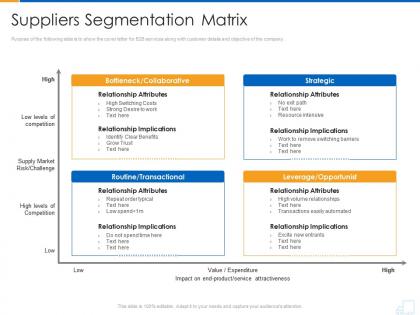
Suppliers segmentation matrix supplier strategy ppt inspiration structure




Try Before you Buy Download Free Sample Product
 Impress Your
 Audience
 100%
100% Editable
 Save Hours
 of Time


Purpose of the following slide is to show the cover letter for B2B services along with customer details and objective of the company.
People who downloaded this PowerPoint presentation also viewed the following :
Suppliers segmentation matrix supplier strategy ppt inspiration structure with all 2 slides:
Use our Suppliers Segmentation Matrix Supplier Strategy Ppt Inspiration Structure to effectively help you save your valuable time. They are readymade to fit into any presentation structure.
FAQs for Suppliers segmentation matrix supplier strategy
So there's basically two things to look at: how critical each supplier is and how risky they are. Critical means stuff like your spend with them, if they make key parts, how replaceable they are - you know, the obvious stuff. Risk is their financial health, where they're located, competition in their market. I used to overthink this whole thing but those two factors really cover it. Plot them on a simple grid and boom - you can figure out who needs close partnerships (high critical/high risk) versus who you can just treat more casually. Makes the whole supplier thing way less overwhelming honestly.
So basically you group your suppliers by how much you spend with them, how risky they are, and how strategic they are to your business. Makes way more sense than treating them all the same - that's just asking for problems. With your biggest strategic partners, you'll want to invest time building real relationships. But for low-risk stuff like office supplies? Just streamline those processes and move on. It's honestly such a game-changer for focusing your energy where it actually matters. Oh, and don't try to do everyone at once - start with your top 20 and go from there.
Dude, it's such a time-saver because you can actually focus on what matters instead of spreading yourself thin across every single supplier. Map out your top 20 first - that's where the real money is. You'll catch problems way before they blow up into expensive disasters. Plus when you need budget approval, leadership gets it immediately when you show them which suppliers could actually tank your operations. Honestly, treating a critical manufacturer the same as your office supplies vendor is just nuts. Short sentences work. The matrix lets you build solid backup plans for suppliers that actually move the needle on your business.
So basically, complexity is what pushes suppliers up that vertical axis on your matrix. Think about it - custom aerospace parts vs ordering printer paper, right? The aerospace supplier deals with crazy technical specs, tons of regulations, super specific customization. That office supply guy? Anyone can do that job. Higher complexity means they're harder to replace and need more specialized knowledge. Then you combine that complexity score with how much money/strategic value is involved, and boom - that tells you which quadrant they fall into. Honestly, it's pretty smart because then you know exactly how much time and energy to invest in each relationship.
So you'll want to grab data on two big things - how risky each supplier is and how much they matter to your business. Risk stuff includes their financial health, where they're located, whether you have backup options, and any past screw-ups. Business impact is about spend amounts, how critical they are to revenue, replacement difficulty. Honestly, the financial data is always the biggest headache to track down. Don't forget contract terms and quality metrics too. Start with whatever's already in your procurement system, then figure out what's missing. You can fill gaps through supplier surveys or buying reports from third-party sources.
Honestly, just automate the whole thing - pull data straight from your ERP and procurement systems instead of wrestling with endless spreadsheets. Analytics platforms can update supplier classifications automatically using real spend data and risk scores. The cool part? AI will actually alert you when suppliers need to move between quadrants, like when some random tactical vendor suddenly becomes critical because spending shot up. I'd set up dashboards that refresh regularly so you're not working with stale data. Makes sourcing decisions way easier when everything's current.
So once you've got your suppliers mapped out, SRM is how you actually deal with each group day-to-day. Your strategic partners? They get the white glove treatment - dedicated account managers, quarterly reviews, the whole nine yards. But honestly, why would you waste that energy on whoever sells you printer paper? Those transactional vendors just need basic check-ins. The segmentation matrix shows you who's who. Then SRM becomes your game plan for how much attention each relationship deserves. Makes total sense when you think about it - you can't treat every supplier like they're equally important.
Honestly, you should be doing this at least once a year - some places even do it quarterly. Markets shift constantly, your priorities change, and suppliers either get better or worse over time. Keep tracking the important stuff like spending, risks, and how strategic they are throughout the year instead of just during formal reviews. Oh, and definitely get other departments involved because procurement sees things way differently than ops or quality teams do. Set those calendar reminders though! This is exactly the type of thing that gets pushed to "next quarter" forever if you're not careful.
Biggest mistake? Going overboard with criteria. You'll create this monster matrix nobody can actually use - stick to 2-3 key factors max. Don't copy someone else's template either, your business is different. Focus on what actually drives your critical partnerships, not just the obvious stuff like cost and quality. Your suppliers change too, so you can't just set it and forget it. Honestly, I'd start by looking at your top 3-5 supplier relationships first. Figure out what makes those work, then build your matrix around that. Way easier than trying to categorize everyone at once.
So basically, supplier performance is what determines where they end up on your matrix - usually paired with spend or how strategic they are. Bad performers? They'll get bumped down to tactical categories even if they handle important stuff. Good ones earn their way into the strategic partner zone. Think of it like grades that show how much attention each supplier deserves. You should review this regularly too - suppliers can move up or down as their quality and delivery changes. Honestly, it's also a great way to give underperformers a reality check about where they stand.
So basically just make a simple grid - like a 2x2 or 3x3 chart where you plot each supplier as a dot. Most people do scatter plots with stuff like spend vs risk or how strategic they are vs complexity. Heat maps are solid too if you want to color-code everything. Honestly Excel works fine for the basics, though Tableau or Power BI are prettier if you have access. I've seen people overthink this part way too much. The whole point is that anyone can glance at it and immediately see which quadrant a supplier sits in and what you should do about it.
So look at your supplier matrix and match your negotiation style to where they sit. Strategic partners? Focus on building long-term value together, not just beating them down on price. Bottleneck suppliers are tricky - they've got you over a barrel and know it, so secure your supply first, then worry about terms. With routine suppliers, honestly just use standard contracts and don't waste too much time. The fun ones are your leverage suppliers - that's where you can really push hard on pricing since you've got other options. Makes way more sense than treating everyone the same.
So market chaos totally messes with how you categorize suppliers. Your "strategic" partners can suddenly become risky bottlenecks when their markets go sideways. Supply risk and profit impact? Both change fast now. I've been doing quarterly reviews instead of yearly ones - honestly feels like overkill sometimes but whatever. The trick is making your categories more flexible so you're not scrambling when everything falls apart. Short bursts, some longer thoughts that actually connect ideas together. Don't get stuck with old assumptions because suppliers flip categories overnight these days.
Look for suppliers in your high-risk categories who aren't pulling their weight. Missing deadlines, quality issues, cost overruns - that stuff becomes pretty obvious when you map it against the matrix. Strategic suppliers especially can't be screwing up consistently, you know? Also keep an eye on any suppliers sliding from good quadrants into crappier ones over time. That's always a warning sign. Regular scorecards help catch this drift early - honestly way easier than scrambling to fix things later. The matrix basically highlights where there's a mismatch between how important they are versus how well they're actually performing.
Quarterly reviews are ideal but honestly? Most teams can only handle it twice a year - which is fine. Just put it on your calendar so you don't forget. Check your spend volumes, how suppliers are actually performing, market shifts, stuff like that. Sometimes a supplier you thought was low-risk suddenly becomes critical (or vice versa). The real key isn't just updating numbers though. You've got to rethink your whole approach for each segment. I've seen too many people treat these matrices like they're set in stone when really, they should change as your business does.
-
Design layout is very impressive.
-
Visually stunning presentation, love the content.
-
Excellent template with unique design.
-
Unique design & color.
-
Easily Editable.
-
Easily Understandable slides.