

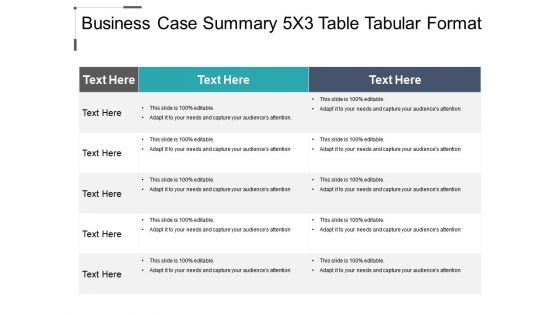
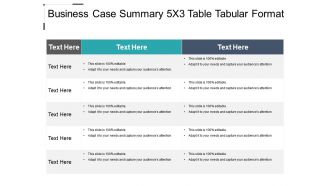
Business case summary 5x3 table tabular format





Try Before you Buy Download Free Sample Product
 Impress Your
 Audience
 100%
100% Editable
 Save Hours
 of Time


Get all the facts that concern you from our Business Case Summary 5x3 Table Tabular Format. They are almost like an encyclopedia.
People who downloaded this PowerPoint presentation also viewed the following :
Business case summary 5x3 table tabular format with all 5 slides:
Generate growth far exceeding expectations with our Business Case Summary 5x3 Table Tabular Format. It will guarantee abundance.


FAQs for Business case summary 5x3
Start with why this matters to the business - don't bury the good stuff on page 3. Cover the problem you're solving, your solution, timeline, and what resources you need. Financial projections should be realistic (honestly, execs are so over those crazy hockey stick charts). Include costs, benefits, and definitely the risks - they want to see you've thought about what could go wrong. Oh, and be super clear about what success actually looks like with real metrics. Keep it tight but complete. The whole thing should answer "so what?" within the first few paragraphs.
Honestly, just lead with the money stuff - ROI, financial impact, all that. That's what they actually care about. Skip the corporate speak that makes people zone out and explain the problem super clearly. You'll want specific timelines and measurable results so they can picture what success looks like. Tell it like a story but back everything up with real data. One page max though - these execs won't read anything longer, trust me. Oh, and make sure you're speaking to their specific goals. What's in it for them personally?
Look, data analysis is what makes or breaks your business case. Without solid numbers, you're just another person with opinions. You need proof there's a real problem, plus realistic ROI projections that show actual value. I've watched so many cases crash because they were basically wishful thinking on paper. Get your metrics locked down first - what's broken, what it's costing, and exactly how much fixing it saves. The story has to be crystal clear. Oh, and start collecting this stuff way before you write anything. Trust me on that one.
Dude, visuals are game-changers for business cases. Nobody wants to stare at walls of text - your stakeholders will zone out instantly. Charts make those boring spreadsheet numbers actually tell a story. ROI trends? Cost comparisons? Way easier to digest when they're visual. Infographics work perfectly for timelines or showing how processes flow. Good fonts and colors naturally guide people's eyes to what matters most. Oh, and always double-check your charts are readable from the back row - learned that one the hard way! Shoot for one visual per major point you're making.
Start with your main point right up front - don't bury it at the end. Executives are busy and want the key stuff immediately. The worst thing you can do? Get stuck explaining technical details when you should focus on business impact and ROI. Skip all that corporate jargon too, honestly it just makes people's eyes glaze over. Your financial numbers need to be realistic because crazy optimistic projections will tank your credibility fast. Oh, and keep it short! Everything should tie back to actual business value or they'll tune out.
Know your audience first - that's everything. CEOs want ROI and big picture stuff right up front, while tech teams need the problem breakdown and solution details. Middle managers? Hit them with timelines and what resources they'll need. I totally bombed a presentation once by putting the money stuff on page two when presenting to our CEO. Never again! Figure out what's actually stressing them out at night. Then nail that worry in your first paragraph. It's honestly that simple, but so many people get it backwards.
You definitely need one when stakeholders are being skeptical or you're fighting for budget against other projects. Executive buy-in for expensive stuff? Yeah, you'll want that business case ready. Long timelines make it super important too - I swear people have goldfish memory when it comes to why they approved things months ago. Mid-project changes are another big one. Honestly, just write it early and keep updating it. You think you won't need it much, but trust me, you'll be pulling it out way more often than expected. Better to have it and look prepared than scramble later.
Honestly, risk assessment is what separates the pros from the amateurs. Executives have watched too many projects implode, so they want proof you've thought about what could go sideways. Don't just throw in generic risks though - be specific about what might actually happen to YOUR project. Then show how likely each risk is, what damage it'd do, and your backup plan. I learned this the hard way on my first proposal (total disaster). But when you demonstrate you're realistic about potential problems, stakeholders trust you way more. Shows you're not just another overly optimistic dreamer.
Definitely go with bar graphs or line charts to show your revenue growth - way better than drowning people in spreadsheets. Tables work well for the key stuff like ROI and payback periods. Oh, and scenario analysis is clutch - best case, worst case, realistic case. Executives eat that up because they can see the whole picture. Cash flow timelines are money too, literally shows them when they'll start seeing returns. Just don't get too crazy with the projections or you'll lose credibility. Be upfront about your assumptions so nobody thinks you're just making stuff up.
Stop saying vague stuff like "improved employee satisfaction." Get specific - "reduced turnover by retaining key talent, saving recruitment costs and preserving institutional knowledge." Way more convincing. Who benefits and how? "Customers get faster resolution times" hits harder than "enhanced customer experience." I mean, yeah it feels like you're stretching the truth sometimes, but whatever. Connect those wins to actual business impact. Executives care about strategic goals and numbers they can point to - survey scores, retention rates, that kind of thing. Focus on outcomes leadership actually gives a damn about.
Keep it short - 1-2 pages tops, maybe 300-500 words if it's digital. Executives get bored fast, trust me. Hit the main points: what's broken, how you'll fix it, what it costs vs. what you'll make, and when it happens. Bullet points are your friend here because nobody reads walls of text anymore. Oh, and if you can't sell the idea in under two pages, you probably don't understand it well enough yourself. Focus on the money impact - that's what they actually care about.
Honestly, real examples are like magic for business cases. They prove your idea isn't just wishful thinking - someone else already pulled it off. I've literally watched proposals get the green light just because they threw in a good competitor case study. Try to find companies similar to yours, same industry or size if you can. Even if it's not a perfect match, it shows you actually researched this stuff instead of winging it. Oh, and don't forget the numbers! Include their specific results and how long it took them. Makes everything feel way less risky to whoever's writing the checks.
Honestly, just use PowerPoint or Google Slides if you're presenting it, Word or Google Docs for written stuff. Those work fine and don't make things weird and complicated. Some people love Canva but like... your content's gonna matter way more than making it super pretty. Oh, and if your company already uses Confluence or whatever, definitely go with that since everyone knows how it works. I'd start with whichever one you know best. You can make it look better later once you've got all your main points figured out.
Honestly, feedback loops are a lifesaver for catching stuff you'd never see on your own. Get different people looking at your work early - not just your usual team. They'll spot weak logic, missing risks, or sketchy financial numbers way better than you will. I swear, being too close to your own project makes you blind to obvious problems. Short sentences work. But also mix in some longer ones that feel natural when you're explaining your point. Set up review meetings throughout the whole process, and actually listen to what people tell you. Don't just nod and ignore it.
Think of it like being a translator between departments that don't speak the same language. Finance wants numbers, IT needs tech specs, marketing cares about customer impact - your summary gives them all what they need from one doc. Honestly, it's a game changer when you're trying to get everyone on board. Keep it short but hit the points each group actually cares about. I always start by figuring out what matters most to each stakeholder, then address those concerns right upfront. Makes the whole approval process way smoother than going in circles with different presentations.
-
Best Representation of topics, really appreciable.
-
Excellent design and quick turnaround.