


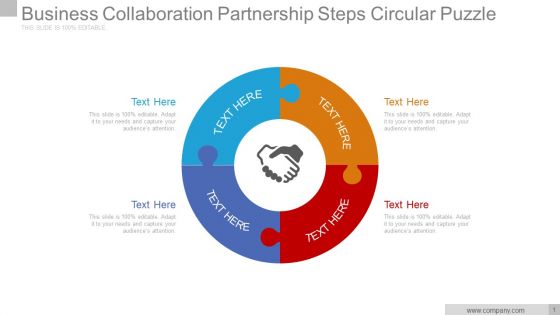
Business collaboration partnership steps circular puzzle ppt slide





Try Before you Buy Download Free Sample Product
 Impress Your
 Audience
 100%
100% Editable
 Save Hours
 of Time


Change attitudes for the better with our Business Collaboration Partnership Steps Circular Puzzle Ppt Slide. Generate am influential impact.
People who downloaded this PowerPoint presentation also viewed the following :
Business collaboration partnership steps circular puzzle ppt slide with all 5 slides:
Appease the inquisitive with our Business Collaboration Partnership Steps Circular Puzzle Ppt Slide. Give them all the information they hanker for.

FAQs for Business collaboration partnership steps circular
Honestly, working with other businesses opens up so many doors you can't reach solo. Sharing costs and risks makes big projects way less scary - plus you get access to their expertise and customer base. The tools we have now make partnering across time zones pretty seamless too. Different perspectives always speed up innovation, which is huge. I'd say start with just one solid partnership first (maybe someone whose skills complement yours?) and see how it boosts what you're already good at. It's kind of addictive once you see the results.
Good communication totally breaks down those annoying office silos. Listen to what people actually think, be clear about deadlines and what you expect - that's how you build real trust. When everyone feels heard, they'll share their best ideas instead of staying quiet. Honestly, I've seen teams fall apart over terrible emails more than you'd think! Ask your teammates how they want updates delivered. Some people hate Slack, others never check email. Regular check-ins help too, especially when you've got different working styles or cultures mixing. It's not rocket science, just don't assume everyone thinks like you do.
Honestly, tech is what makes teams actually work together these days. Project management stuff like Asana keeps everyone aligned (though half my team still ignores notifications). Video calls let you meet face-to-face even when Dave's calling in from his garage. Cloud sharing means no more emailing files back and forth like it's 2005. Real-time editing and instant messaging speed everything up. The trick? Don't just grab whatever tool is trending on LinkedIn. Pick something that fits how your people actually work, not what looks cool in demos.
Honestly, you've gotta model it first - listen to people, share credit when things go well, ask for input even when you think you know the answer. Coffee chats work wonders (even the virtual ones, though I prefer in-person). Nothing destroys teamwork faster than people hoarding information, so make sure everyone stays in the loop. Try setting up goals that force different teams to actually work together instead of competing. Oh and definitely celebrate group wins - people remember that stuff. The whole thing should feel natural, not like some corporate mandate. Maybe start with just one small initiative and see how it goes?
Honestly, you've got three main problems to fix: people aren't talking to each other properly, everyone's working toward different goals, and nobody knows who's supposed to make decisions. Set up actual conversations - not those useless status emails everyone ignores. Help teams see how their stuff fits the big picture, because when priorities clash, teamwork dies fast. Oh, and make it crystal clear who owns what decisions. People hate waiting around or accidentally duplicating work. Don't just cross your fingers hoping it'll work itself out - that never happens.
Track the obvious stuff first - project completion rates, how fast you're shipping, cost savings from sharing resources. But honestly? The soft metrics tell you way more. Employee engagement scores, how often teams actually talk to each other - that's where the real story is. Knowledge sharing is huge too. Check your internal wiki usage or count training sessions teams run for each other. Here's the thing though - don't go crazy measuring everything. Pick 3-4 things that actually move the needle for your business. Start simple with what you can track right now, then get fancy later if you need to.
Dude, it's totally about what your team will actually stick with. Slack's the winner for getting people engaged - the interface just feels right and conversations happen naturally. Teams works better if you're already using Microsoft stuff everywhere, plus their video calls are solid. Asana and Notion? Super powerful for project management but honestly, I've watched teams get overwhelmed and bail after like a week lol. My advice? Don't get caught up in fancy features. Pick whatever your team won't hate using every day. Do a trial run first and see what clicks with how you guys actually work.
Honestly, remote work changes everything about how you collaborate. You can't just bump into people by the coffee machine anymore (which actually sucks more than I expected). Communication has to be way more deliberate - I'm talking constant Slack updates, scheduled check-ins, the whole nine yards. Your tech stack becomes make-or-break too. Good video calls and real-time docs aren't optional. But here's the thing - you get access to crazy talented people who don't live in your city, and most folks are way more productive without office chaos. Just nail down your communication rhythm early or you'll be scrambling later.
Honestly, the magic happens when you throw together people who'd never normally work side by side. Get your engineers talking to marketing people, or stick finance folks with product designers - sounds weird but I've watched some crazy good ideas pop out of these random pairings. Make sure everyone feels safe to throw out messy, unfinished thoughts without getting shot down. Oh, and don't just look internally. Work with customers or suppliers on small projects too. Maybe even competitors if you're feeling bold? Start with one pilot thing and see what weirdness emerges.
First thing - figure out who owns what IP when you create stuff together. Seriously, this saves so much drama later. You'll need solid contracts covering responsibilities, how profits get split, and what happens if someone wants out. GDPR compliance gets messy when you're sharing customer data between companies, so watch that. Be upfront with customers about the partnership - people hate finding out they're dealing with some mystery third party. Make sure profit sharing is actually fair, especially if there's a size difference between companies. Oh, and antitrust laws can be a pain if you're both big players. Get a lawyer to look everything over first.
Honestly, getting your departments to actually work together is a game changer. No more of that silo nonsense where marketing has no clue what product is building. Sales finally gets realistic timelines, customer complaints reach the right people, and you stop wasting money on teams accidentally working against each other. Problem-solving happens way faster too. I've seen companies turn around just by having regular cross-team meetings - doesn't have to be fancy, even grabbing coffee together works. It's wild how much smoother everything runs when people actually talk to each other instead of staying in their little bubbles.
Oh man, there's so many good ones! Spotify teamed up with Uber so you can jam to your own playlist during rides. Classic combo is Starbucks inside Barnes & Noble - honestly genius move. BMW and Toyota are working together on hydrogen cars, which is pretty cool. Nike + Apple did that fitness tracking thing that blew up. You want partners where you're strong at what they suck at, and vice versa. That way you both create something way better than either could do solo. It's like... finding your business soulmate or whatever.
You gotta mix up who's running meetings and use async stuff so people can jump in when it works for them. Some people just hate talking in big groups but they'll drop really solid thoughts in writing later. Build your timelines around different time zones and schedules - honestly, this part gets overlooked way too much. Check in one-on-one with your quieter teammates too. They usually have killer insights but won't interrupt someone mid-sentence to share them. Basically just give people multiple ways to participate instead of forcing everyone into the same box.
Start with figuring out where your team's communication actually breaks down - maybe do a quick assessment first? Then hit the big ones: conflict resolution training and some solid team-building stuff. Active listening workshops are gold too, honestly people just don't listen anymore lol. Cross-functional projects where teams solve real problems together work great. Oh and definitely cover emotional intelligence - understanding how different people work is pretty crucial. Don't forget the tech side either, training on collaboration tools like Slack or Asana. Communication skills are probably your biggest bang for buck though.
Honestly, measuring collaboration ROI is kinda messy but doable. Track the obvious stuff first - faster project timelines, lower costs, less turnover. Revenue from cross-team work too. Then hit the softer metrics like engagement scores and customer satisfaction. The annoying part? Proving it's actually collaboration that moved the needle, not some other random factor. Executives love asking about that. Set your baselines before you start anything, then wait 6-12 months to see real changes. Oh, and decide what "success" means upfront - saves you from awkward conversations later when results don't match expectations.
-
Topic best represented with attractive design.
-
Helpful product design for delivering presentation.