


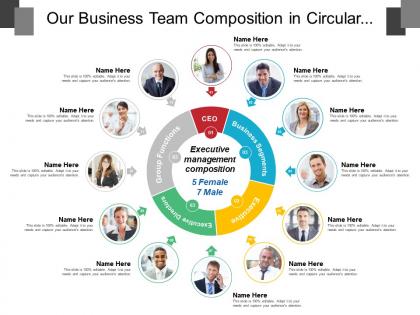
Our business team composition in circular format





Try Before you Buy Download Free Sample Product
 Impress Your
 Audience
 100%
100% Editable
 Save Hours
 of Time


Control your confidence with our Our Business Team Composition In Circular Format. Don't allow complacency to enter.
People who downloaded this PowerPoint presentation also viewed the following :
Our business team composition in circular format with all 6 slides:
Aesthetics are guaranteed with our Our Business Team Composition In Circular Format. Be certain of giving an elegant display.




FAQs for Our business team composition
Honestly, most teams that actually work well have the same basic setup. Someone needs to be the decision-maker and keep everyone on track. You'll want your technical experts who know their stuff inside out. A project person to handle timelines (trust me, this saves everyone's sanity). Plus someone who's good at talking to clients or upper management. The secret sauce though? Having that one person who just gets people - they smooth over drama before it starts and keep everyone from wanting to murder each other. Titles don't really matter, but those roles do.
Team structure is basically about who reports to who and how info flows around. Flat teams communicate faster since there's less bureaucracy, but sometimes it gets messy without clear ownership. With hierarchies, you get better accountability but decisions take forever - I've seen so many good ideas just die in endless approval chains, it's painful. Matrix structures are cool for cross-department stuff but honestly, half the time nobody knows who's actually calling the shots. You'll want to pick based on your team size and what kind of work you're doing. Just make sure people can actually talk to each other without jumping through hoops.
Honestly? Flat structures are amazing for quick decisions - no bureaucracy to wade through. Your team feels way more invested too since everyone gets a real voice. Communication flows so much better without that weird telephone game through five managers. But here's the thing - hierarchical works great for bigger teams where you need someone clearly accountable for stuff. It's just slower, which can be frustrating. Most teams I know mix both approaches. Like, go flat for creative brainstorming sessions but keep some hierarchy for day-to-day operations where you need clear ownership. Works pretty well from what I've seen.
Honestly, you need to get way more intentional about who owns what when your team's scattered. Those random "wait, who's doing this?" conversations just vanish when people aren't around. I've watched so many projects completely die because everyone thought someone else had it covered. Set up regular check-ins and maybe assign a few people to be the "culture keepers" - sounds cheesy but it works. Communication has to become deliberate now instead of accidental. Short version: overcommunicate everything or stuff will slip through the cracks.
Honestly, I'd focus on the basics first - how fast you're shipping stuff and whether it's actually good quality. Decision-making speed is huge too (nothing kills momentum like endless back-and-forth). Employee happiness surveys and turnover rates are pretty telling - people vote with their feet if the structure sucks. Check how often teams actually talk to each other instead of staying in their bubbles. Oh, and whether teams can get the expertise they need without jumping through hoops. Don't try to track everything at once though. Pick 2-3 things that actually matter for what you're trying to achieve and give it at least a quarter before you start reorganizing again.
Honestly, mixed teams just crush it when problem-solving. You get people attacking the same issue from totally different angles instead of everyone nodding along to the first okay idea. Someone from accounting might spot something the designers completely missed, you know? I've watched teams where the quietest person drops this random suggestion that ends up being genius. Different backgrounds mean different blind spots get covered. Oh, and personality types matter too - don't just grab all the extroverts. When you're putting together your next team, definitely mix up departments and skill sets. It's night and day compared to homogeneous groups.
Honestly, team size makes a huge difference in how things actually get done. You want that sweet spot - maybe 3-7 people where everyone can actually talk to each other without needing a meeting about the meeting, you know? Bigger teams can handle more complex stuff, but I've watched 12-person teams waste so much time just trying to stay coordinated it's ridiculous. Really depends on your project though. My advice? Start small and only add people when you've got totally separate work that won't turn into a communication nightmare.
So leadership is basically you setting up how your team actually works together. Roles, who reports to who, how stuff gets passed around - all that. But honestly, the initial org chart is just the starting point. Projects shift, people level up (or don't), new fires pop up constantly. You're kind of like an architect but also the maintenance guy who keeps fixing things. The trick is staying flexible without letting everyone get confused about what they're supposed to be doing. Keep the big picture clear while you adjust the details.
Okay so first thing - tell everyone exactly what's happening and why, like 2-3 weeks before you actually do it. People freak out when their job changes without warning. Draw up the new org chart showing who reports to who, which teams are splitting up or combining, all that stuff. Don't be one of those managers who drops bombs on Friday afternoons (seriously, I've watched those disasters unfold). You'll want transition meetings so people can ask questions and complain a bit - it's healthy honestly. Define everyone's new roles super clearly right away or you'll get endless "is this my responsibility now?" conversations. Then check in constantly the first month because problems always pop up.
Ugh, rigid structures are the worst - everything gets stuck waiting for approvals that shouldn't even be needed. People end up sitting around when they could just solve stuff themselves. The whole communication thing turns into this annoying chain where your message gets twisted by the time it reaches who it needs to. Your team can't actually develop either since they're trapped doing the exact same tasks forever. Honestly, I'd pick maybe one or two small processes where you can let people make their own calls. Start there and see how it goes.
So basically cross-functional teams mix different skill sets together instead of keeping everyone in their department bubbles. Like you'd have a marketer, engineer, and designer all working on the same project rather than passing stuff back and forth between separate teams. Honestly, the "throw it over the wall" thing gets old fast. Decisions happen quicker this way, communication doesn't suck as much, and you actually get solutions that make sense from everyone's angle right from the start. If you're considering it, maybe try a small pilot first? See how your people handle it before going all-in.
Honestly, there's so much out there now it's kinda overwhelming. Lucidchart and OrgCharter are solid for mapping out who reports to who - especially helpful with those messy matrix teams. Asana or Monday work great for tracking projects across different groups. Slack channels are a game changer for keeping convos organized (though my team definitely goes overboard with channel creation). Float and Forecast handle resource planning pretty well if you need that level of detail. I'd start by just sketching out your current setup first. Sounds basic but you'll spot the problem areas right away and know what tools you actually need.
Look, your team's cultural background totally dictates whether you should go flat or hierarchical. High-context cultures need clear reporting lines and formal communication - they actually want that structure. Low-context ones? They're fine with flatter, more autonomous setups. Power distance is huge too. I can't tell you how many Silicon Valley-style flat orgs I've watched crash and burn because nobody thought about local expectations first (honestly kind of painful to watch). Survey your people about how they prefer to communicate and make decisions. Don't just copy-paste some trendy org chart.
Honestly, start by making it crystal clear who owns what - like, write it down somewhere everyone can see. Weekly check-ins are your friend here, whether that's standup meetings or just a shared doc people actually update. I learned this the hard way when a project completely fell apart because we all just assumed someone else was handling the big stuff. When deadlines get missed (and they will), have those awkward conversations right away. Don't make it feel like you're micromanaging though. Pick one tracking method this week and see how it goes.
Honestly, feedback is like having a smoke detector for your team - catches problems before everything's on fire. Regular check-ins where people can actually say what's bugging them? Game changer. You'll reshape roles and processes based on real issues instead of just winging it. I watched one team totally flip their workflow after a single honest retrospective (wild how much was bottled up). The trick is people need to feel safe speaking up, then you act fast on what they tell you. That way your structure grows with the problems instead of... well, creating new ones. Quick fixes beat waiting until someone quits, you know?
No Reviews