

Our executive project team in circular format





Try Before you Buy Download Free Sample Product
 Impress Your
 Audience
 100%
100% Editable
 Save Hours
 of Time


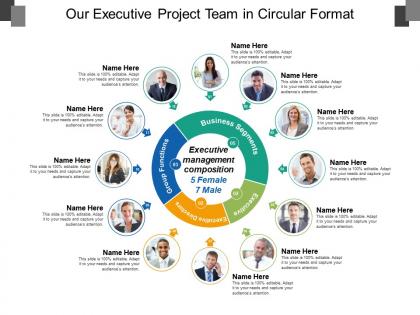
With stunning project management PPT ideas in mind, all one needs is a platform to present them. Slide Team offers you one such platform in form of our executive project team in circular format. Through the executive members of project team PPT PowerPoint presentation model you can put forth the much essential information in a visually impactful and easy to recall manner. The executive team members PowerPoint slide design displays twelve personnel with their photographs and name and designation label. Although the slide template has been titled as for executive members, one may use it for any purpose where group of individuals are to be mentioned exclusively. So basically, this twelve executive members and managers team PowerPoint presentation slide design diagram is a resourceful tool to communicate to your audience the force behind the positive and essential outcomes of the organization. Follow the ground rules with our Our Executive Project Team In Circular Format. They adhere to the desired code.
People who downloaded this PowerPoint presentation also viewed the following :
Our executive project team in circular format with all 6 slides:
Feel happy-go-lucky with our Our Executive Project Team In Circular Format. They take care of difficulties.

FAQs for Our executive project team
So basically it's about sharing leadership instead of having one person call all the shots. Different people step up depending on what the project needs or who knows that stuff best. Way less stressful than waiting for approval from above all the time. Everyone gets actual ownership and decisions happen faster. Oh and accountability goes both ways - not just kissing up to your boss, you know? The whole thing works because everyone's input actually counts. Start small though - maybe just rotate who runs your weekly meetings. You'll probably see people get way more engaged pretty quick.
So circular team dynamics - it's basically where everyone gets equal say instead of just the boss making calls. People rotate who's leading meetings and projects, which honestly works way better than you'd think. Your team actually starts caring more because their input matters beyond those awkward "any feedback?" moments. Plus you get way more creative solutions when different people are steering the ship. Oh, and relationships get stronger too since everyone's sharing the load. Start small though - maybe just rotate who runs your weekly meetings. That alone will shift things pretty quickly.
So with circular teams, nobody's waiting around for the boss to approve stuff - you just hash it out together. Everyone gets equal say, which sounds great until you're spending 2 hours debating what color to make a button (been there). Leadership kinda rotates based on who knows what they're talking about for that specific thing. Info moves around way more freely too. Just set some ground rules first about how you'll actually make decisions, or you'll talk in circles forever. Oh and definitely put time limits on your meetings - trust me on this one.
Dude, leading circular teams is way harder than regular leadership - you can't just tell people what to do! Your main job becomes asking good questions and making sure quieter people get heard. Create psychological safety first by literally telling everyone hierarchy doesn't apply here. Then model it yourself. You're more like a conversation conductor, helping different perspectives mesh together until the group finds consensus. The tricky part? Synthesizing all those ideas without steamrolling anyone. Oh, and some people will hate not having clear direction at first, but they'll adapt.
You'll need both hard numbers and gut-feel stuff. Track team velocity and how fast decisions get made - also watch if work gets spread around evenly. Employee engagement and retention rates tell you a ton. Psychological safety is weird to measure though, I'd skip formal assessments and just do quick pulse surveys. See how fast knowledge moves between people and whether junior folks actually speak up to challenge senior ones. Honestly, start simple: monthly check-ins with three questions. Are decisions flowing okay? Does everyone contribute equally? Do people feel heard? That'll give you a solid baseline.
Start with retrospectives and rotate who runs them - that's your base. For standups, give everyone equal talk time. Miro or Mural work great for making sure all voices show up visually. The "talking stick" thing is kinda corny but honestly breaks those hierarchy patterns better than you'd think. Cross-functional pairing helps too. Gets info flowing sideways instead of just up the food chain. Oh, and peer feedback sessions are clutch. Don't dump everything on your team at once though - pick one thing and see how it goes first.
Honestly, circular team setups are game-changers because there's no hierarchy strangling ideas before they even get heard. Everyone gets equal say, so you'll see way more diverse viewpoints. People actually speak up with wild suggestions when they're not worried about some manager shooting them down from above. I've seen "ridiculous" ideas turn into brilliant solutions - happens more than you'd think. Team members start building off each other instead of competing for brownie points. Next time you brainstorm, try having different people run it each time. Trust me, the creativity boost is real.
Oh man, you're gonna hit resistance hard - nobody wants to give up their little kingdoms, you know? Managers get defensive because suddenly they're not the boss anymore. And your team members? They'll panic about making decisions they never had to before. Communication gets super weird at first too since everyone's figuring out new ways to actually talk to each other. Honestly the whole thing's a mess initially. But here's what worked for me - be crystal clear about who does what from day one. Don't go full company, just try it with one team first. Give people time to get used to it.
Honestly, cultural diversity can be a game-changer for circular teams. You'll get way better problem-solving when people approach things differently - plus it kills that groupthink trap. But heads up, the beginning might feel messy. Direct communicators will clash with consensus-builders, and some folks need time to adjust to the whole "everyone's equal" thing. I'd set communication ground rules upfront so nobody feels weird about speaking up. Oh, and don't rush it - once people find their groove, you'll actually get those breakthrough moments where someone sees an angle nobody else caught.
Start with relationship mapping - get new people connected across different teams, not just their direct coworkers. Those "coffee chats" with 3-4 people from various functions in week one? Sounds corny but honestly they work. Your circular structure is probably way different from what they're used to, so pair them with a "decision buddy" for the first month. Someone who gets the informal stuff and can explain how things actually happen here. Oh, and throw them into cross-functional projects early - experiencing the collaborative vibe beats just talking about it.
Oh dude, circular teams are perfect for remote work! Way better than having some manager breathing down everyone's neck from their home office. What I'd do is rotate who leads based on projects or whoever knows that stuff best. Keeps people actually interested. You'll need good tools though - shared docs, regular video calls, Slack or whatever. Sometimes remote works even better because you have to write everything down anyway. Just figure out upfront who's doing what when, and make sure everyone's decent at communicating digitally. The whole circle thing flows way more naturally when it's intentional.
Start with weekly check-ins where people rotate giving feedback to different teammates. Build trust first though - otherwise everyone just says generic nice stuff and nothing changes. I'd try simple approaches like shared docs or quick stand-up rounds where people ask for input on specific things. The magic happens when feedback flows everywhere, not just from managers down. Honestly, most teams rush this part and wonder why it doesn't stick. Begin with one structured session per sprint, then add more once your team gets comfortable being real with each other. Takes time but totally worth it.
Don't rely on the old boss-tells-everyone-what-to-do thing. Instead, give each person their own specific outcomes to own - like marketing gets lead generation numbers, not just "do marketing things." Honestly, peer pressure works way better than having a manager breathing down your neck. Set up weekly check-ins where people share their domain metrics with the whole team. Nobody wants to be the person who shows up empty-handed while everyone else crushed their goals. The key is making it crystal clear who owns what. Map that out first, then watch how much better people perform when they can't hide behind vague responsibilities.
So circular team dynamics and agile are basically cousins - they both ditch the traditional hierarchy thing for something way more collaborative. Everyone gets equal say, which is pretty refreshing honestly. Agile's got those feedback loops and iterations, right? Circular dynamics works the same way but takes it further with rotating leadership roles. Teams self-organize in both approaches instead of waiting for some manager to tell them what to do. Actually, try switching who runs your next retro - it's a good way to test out circular dynamics if you're already doing agile stuff.
Slack or Teams work great for this - set up channels where everyone can actually see what's happening with decisions. Digital whiteboards are clutch too. People naturally step up to lead different projects when the tools make it easy to jump in. Oh, and rotating who runs meetings through scheduling apps? Honestly works way better than you'd think. The trick is finding tech that breaks down those stupid hierarchies instead of making them worse. Pick one tool that gets people sharing ownership and just... see what happens. Your team dynamics will probably shift faster than you expect.
-
Helpful and friendly support. I found an idea for my task. Thank you :)