


Project team structure with head of project and executive creative directors




Try Before you Buy Download Free Sample Product
 Impress Your
 Audience
 100%
100% Editable
 Save Hours
 of Time


Add to the informality with our Project Team Structure With Head Of Project And Executive Creative Directors. Enable discussions in a friendly atmosphere.
People who downloaded this PowerPoint presentation also viewed the following :
Content of this Powerpoint Presentation
Description:
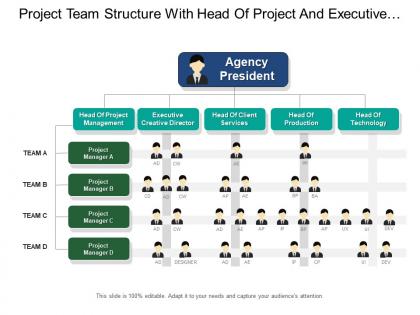
The image is a PowerPoint slide titled "Project Team Structure With Head Of Project And Executive..." illustrating an organizational chart for a project-based agency. At the top is the "Agency President," followed by key leadership roles including "Head Of Project Management," "Executive Creative Director," "Head Of Client Services," "Head Of Production," and "Head Of Technology." Beneath these roles are the various teams (A, B, C, D), each led by a Project Manager. Team members are indicated by role abbreviations like AD (Art Director), CW (Copywriter), AE (Account Executive), PP (Production Planner), UX (User Experience Designer), UI (User Interface Designer), and DEV (Developer). This visual structure helps clarify the hierarchy and reporting relationships within the project teams.
Use Cases:
This type of slide is beneficial for visualizing team structures and can be applied across different industries to define clear roles and responsibilities.
1. Advertising:
Use: Clarifying agency roles and creative project teams.
Presenter: COO or Agency Director
Audience: Agency Staff, New Employees
2. Software Development:
Use: Organizing development team structures around projects.
Presenter: CTO or Development Lead
Audience: Developers, Product Managers
3. Construction:
Use: Displaying project management and operational teams.
Presenter: Head of Operations
Audience: Site Managers, Construction Teams
4. Healthcare:
Use: Structuring administrative and healthcare delivery teams.
Presenter: Hospital Administrator
Audience: Medical and Administrative Staff
5. Education:
Use: Organizing academic projects and department responsibilities.
Presenter: Dean or Academic Coordinator
Audience: Faculty, Educational Project Teams
6. Finance:
Use: Laying out teams for financial projects and initiatives.
Presenter: CFO or Finance Project Manager
Audience: Analysts, Investment Teams
7. Event Planning:
Use: Outlining the hierarchy of roles in event organization.
Presenter: Event Director
Audience: Event Coordinators, Suppliers, Stakeholders
Project team structure with head of project and executive creative directors with all 5 slides:
Increase the amount of impact you have with our Project Team Structure With Head Of Project And Executive Creative Directors. It will create a dramatic effect.
FAQs for Project team structure with head of project and
You definitely need a project manager - they're the ones keeping deadlines from becoming a complete disaster. Get a solid technical lead too, someone who can actually make the hard development calls when things get messy. Obviously you need people doing the actual work, but here's what most teams miss: find a product owner who can approve stuff fast. Seriously, I've seen projects die because everyone's waiting around for some executive to respond to emails. Oh, and make sure people know what they're responsible for. Nothing worse than three people thinking someone else is handling the critical bug fix.
Oh man, team size is huge for how smoothly things go. 3-5 people? You'll make decisions fast and actually talk to each other. But once you hit 8+ people, suddenly everyone's just trying to stay on the same page instead of doing actual work - it's like herding cats honestly. Bigger teams do bring more skills though, which is nice when you need it. I'd say figure out what expertise you absolutely can't live without, then keep it as small as possible. Don't add people just because you think it'll go faster. Start lean, add later if you're missing something critical.
Honestly, it's like having different tools in your toolkit - everyone brings something unique. Technical people dig into the nitty-gritty details. Creative types come up with wild solutions nobody else would think of. Then you've got analytical minds spotting patterns that fly right past everyone else. A designer might crack a UX problem your developer would stare at for hours (been there). Different backgrounds mean people actually push back on bad ideas instead of everyone just agreeing. Oh, and definitely mix up your brainstorming sessions with different disciplines - the weird combinations always surprise me.
Honestly, just pick a day for weekly check-ins and stick to it. Get everyone on the same project management tool - Asana's pretty solid. Also set up specific Slack channels for different stuff instead of letting everything turn into endless email threads (seriously, email kills momentum). Make sure it's crystal clear who decides what and when people need to give updates. I'd probably start with writing down how you'll all communicate - sounds formal but it actually helps. The biggest thing is staying consistent with timing and making sure everyone can see what's happening. Short meetings beat long confused ones every time.
Honestly, your leadership style pretty much dictates everything about how your team functions. When you're collaborative and open, people actually speak up and get creative with solutions. But go full autocrat? Everyone just shuts down and waits to be told what to do - which is death for innovation, obviously. People feel way safer taking risks under supportive leaders, so team bonds get stronger too. Inconsistent leadership though... that's where things fall apart fast. Trust dies, confusion takes over. I'd say just be deliberate about your approach and actually ask your team how it's working for them.
Dude, cross-functional teams are seriously where it's at. When you mix marketing, engineering, design, whatever - everyone's working together instead of passing stuff back and forth like hot potato. You'll catch problems way earlier. Decision-making gets so much faster too since nobody's waiting around for approvals from three different departments. Your team members pick up skills from each other, which is pretty cool. Oh, and the solutions you come up with? Way more creative when different brains are actually talking to each other. Try it on your next project - just grab 2-3 different departments and watch the magic happen.
Your team setup totally depends on what methodology you're using. Waterfall needs those hierarchical, specialized groups - like separate design, dev, and testing teams that hand stuff off between phases. Agile's the opposite though. Cross-functional teams stick together through sprints and collaborate constantly instead of working alone. I learned this the hard way when I first switched methodologies. Keep teams small during planning so decisions happen faster, then add people for execution. Really just match however your team structure is to how info flows in whatever approach you picked.
Honestly, it depends on what's driving you crazy right now. Communication issues? Slack's pretty much everywhere, though fair warning - you'll probably get addicted to checking it. For project stuff, I'd go with Asana or Trello to keep track of who's doing what. Google Workspace is clutch for sharing files and working on docs together. Miro's awesome if your team does any brainstorming or visual stuff. Here's the thing though - don't try to fix everything at once. Figure out your biggest headache first, then grab one tool for that specific problem.
Ugh, cultural stuff can totally mess with team dynamics if you're not careful. Like, Japanese teams usually want that relationship-building phase first and speak way more indirectly. Germans? They'll just tell you exactly what's wrong with your idea, no sugar-coating. Some cultures expect the boss to make all decisions while others get weird if you're too hierarchical. Time zones already suck without adding communication styles to the mix! I'd definitely do some kind of team assessment upfront to spot where people might clash. Maybe get someone from each culture to help bridge gaps when things get confusing.
Don't let conflicts sit around getting worse - tackle them early. Create a space where people actually feel safe speaking up (I've watched so many projects crash because everyone was too scared to say anything). Skip the personal attacks and stick to the actual problems. Make it crystal clear who decides what and who's doing what. When drama does pop up, focus on fixing things instead of pointing fingers. Oh, and do regular team check-ins - you'll catch tension way before it blows up into something messy.
Try making a RACI matrix - sounds boring but it actually works. You mark people as Responsible (does it), Accountable (owns it), Consulted (gives feedback), or Informed (just needs updates) for each task. The decision-making part is crucial though - that's where most drama starts. Get everyone to review their role descriptions upfront and actually sign off on them. I learned this the hard way on a project last year. Be super specific about boundaries instead of vague job duties. Short sentences prevent the whole "wait, I thought you were handling that" mess later.
Honestly, team cohesion makes or breaks your deadlines. When people actually trust each other, they catch issues early and don't waste time arguing about stupid stuff. I've watched teams burn weeks just fighting over the approach - it's painful. Good teams share the load naturally and have each other's backs during crunch time. Bad ones? Everyone's working in their own little bubble, then scrambling when things fall apart. If you're constantly missing deadlines, check your team dynamics first. Are people really collaborating or just pretending? Start doing regular check-ins to get everyone connected.
Yeah, you'll want to switch up your team as the project moves along. Start with strategists and planners to figure out what you're actually building. Once execution kicks in, swap most of them out for the people doing the work - devs, designers, that kind of thing. Here's where it gets tricky though - you need to plan these transitions ahead of time or you'll be stuck frantically hunting for people. Honestly, I've seen teams keep planners around way too long when they should've already moved to builders. Near the end, bring in testers and stakeholders for feedback. Just don't wing the timing.
Track sprint completion rates and how long stuff actually takes vs estimates - that'll show if you're hitting your deadlines. Quality wise, look at bug rates and customer feedback scores. Honestly though, don't sleep on the team happiness metrics. Burnout is real and you'll see it in velocity drops before people even mention it. Surveys help but just asking works too. Oh, and cycle time is huge - shows bottlenecks fast. Pick maybe 3-4 that match your goals. I wouldn't track everything or you'll go crazy with data.
Buddy systems work really well - pair newbies with someone who actually knows what's going on. Don't just dump them in random meetings (I've watched that disaster happen). Check in regularly those first few weeks, not just day one then radio silence. Write down your team's weird unspoken rules because honestly, every workplace has them and new people shouldn't have to decode everything. Give them a real project early on - something meaningful but not overwhelming. Oh, and make sure the onboarding feels personal, not like they're going through some corporate assembly line. People remember how you made them feel those first days.
-
Unique and attractive product design.
-
Designs have enough space to add content.