


Business Model Canvas Healthcare Company Profile Ppt Powerpoint Presentation Gallery Ideas




Try Before you Buy Download Free Sample Product
 Impress Your
 Audience
 100%
100% Editable
 Save Hours
 of Time


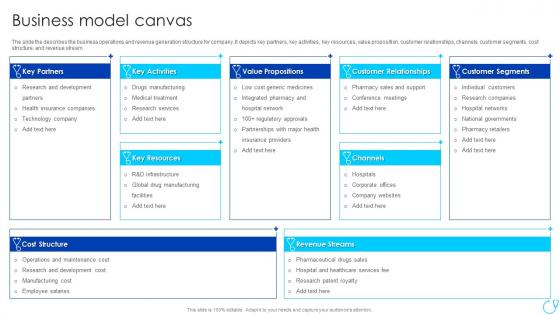
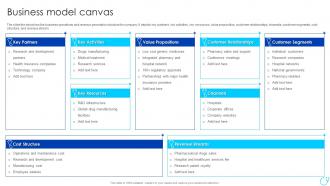
The slide the describes the business operations and revenue generation structure for company. It depicts key partners, key activities, key resources, value proposition, customer relationships, channels, customer segments, cost structure, and revenue stream
People who downloaded this PowerPoint presentation also viewed the following :
Business Model Canvas Healthcare Company Profile Ppt Powerpoint Presentation Gallery Ideas with all 6 slides:
Use our Business Model Canvas Healthcare Company Profile Ppt Powerpoint Presentation Gallery Ideas to effectively help you save your valuable time. They are readymade to fit into any presentation structure.





FAQs for Business Model Canvas Healthcare Company Profile Ppt Powerpoint
So there are nine boxes you need to fill out. Customer stuff goes on the right - segments, value props, channels, relationships, revenue streams. Left side covers your operations: key resources, activities, partnerships. Cost structure sits at the bottom (because duh, everything costs something). What I love about it is how it makes you see connections between all these pieces. Like, your channels have to match your customer segments, you know? I'd start with the value proposition in the middle - that's your anchor. Then work outward from there. It's way less overwhelming than trying to tackle everything at once.
Honestly, the Business Model Canvas is a game-changer because it gets your whole team looking at the same visual map instead of talking past each other. You can literally point at sections and go "okay, this part sucks" or "we need to test this assumption." Marketing handles customer segments, ops focuses on activities - everyone owns their piece. Use sticky notes though (trust me on this) because moving stuff around physically keeps people engaged. Way better than those soul-crushing meetings where you debate strategy for hours and get nowhere. It's like having training wheels for strategic planning, but actually useful ones.
Honestly, customer segmentation is where everything starts with your Business Model Canvas. Get this wrong and you're basically building on quicksand. Don't just say "small businesses" - that's way too vague. Think more like "tech startups with 10-50 employees in Seattle or Austin." The specificity matters because it shapes literally everything else. Your value prop, how you reach them, pricing, all of it. I learned this the hard way lol. Once you nail down exactly who you're serving, the rest of the canvas actually makes sense. It's like having a roadmap instead of just wandering around.
Honestly, value props change completely depending on your industry because you're tackling totally different problems. Tech companies obsess over efficiency - like how Slack made team communication way less painful. Retail? That's all about convenience and pricing. Healthcare has to focus on safety first, obviously. Manufacturing usually goes for reliability and keeping costs down. But here's the thing - even competitors in the same space can have wildly different approaches. Luxury brands sell status while budget options just want to save you money. Figure out what specific pain point you're solving for your customers, and boom - that's where your unique angle lives.
Oh totally! The canvas is super adaptable - that's honestly why I love it. When new tech hits, you just swap out the relevant boxes. Like if you're suddenly using AI everywhere, update your key resources and value props. Companies pivot their whole canvas when they go subscription or digital-only. It's only nine boxes but they're all connected, so you can spot ripple effects fast. Oh and definitely check yours every quarter - I learned that the hard way when we missed a trend shift last year!
Honestly, the worst thing you can do is fill it out once and call it done - this thing needs to stay flexible. Keep everything high-level at first instead of diving into tiny details. I learned this the hard way, but you've gotta actually talk to customers about your assumptions before you fall in love with your idea. Also, don't just fill each box separately. The nine sections should connect and make sense together. Oh, and that perfect canvas you're imagining? Yeah, reality's gonna mess with it pretty quick. Start rough, test fast, and don't get too attached to your first version.
Honestly, the Business Model Canvas is perfect for this stuff. Just sketch out your assumptions for each section - who your customers are, what value you're bringing, how you'll make money, all that. Then actually go talk to people and test if you're right. Way better than those massive business plans that just sit in a drawer collecting dust! I love how you can just erase and rewrite sections when you learn something new. Your canvas will look totally different after a few weeks of customer interviews - that's the point though. Start with your best guesses, figure out which assumptions are make-or-break, then test those first.
Dude, just use the Business Model Canvas as your main slide during pitches. Way better than boring investors with 20 dense slides - this shows your whole business logic in one visual. Start with your value prop, then walk through how customer segments connect to channels and revenue streams. Honestly, investors eat this stuff up because they can see you've actually thought through partnerships, costs, all that stuff. I mean, some people still do traditional decks but whatever. Print it huge or make it your centerpiece slide. Just practice the flow between sections so you don't sound choppy.
Pick metrics that test your biggest business model assumptions - don't try to track everything or you'll go crazy with data overload. Customer acquisition cost and lifetime value are solid starting points. Retention rates tell you if people actually stick around after trying your product. I'd also watch conversion rates by channel and how efficiently your cost structure works. Honestly though, the sweet spot is 3-5 KPIs max. Figure out which parts of your canvas you're least confident about first. Then choose metrics that'll prove or disprove those assumptions fast.
Your partners basically determine what you actually need to own vs. what you can borrow. Strong supplier relationships? You don't need huge inventory sitting around. Good tech partners mean you're not building everything yourself - honestly, why would you? It's that whole build vs buy thing but way more strategic. The better your partnerships, the less stuff you need to hoard, which leaves more cash for what actually makes you different. I'd map out what each partner gives you, then see what gaps you can fill through smart alliances instead of buying everything.
For Business Model Canvases, I'd go with Miro first - the free version is pretty solid and your team can all edit at once. Mural's similar if you want an alternative. There's also Canvanizer which is made just for this stuff, so it's dead simple. Lucidchart works if you like things more structured. Honestly though? Sometimes I just use Google Slides because everyone already knows how it works. Draw.io is decent too. Pick whatever your team won't complain about using. Nothing worse than fighting the tool while you're trying to brainstorm.
The Business Model Canvas is perfect for this - it shows you exactly which parts of your model are broken. Like if customers aren't biting on your value prop, maybe you're targeting the wrong segment or solving the wrong problem entirely. I've seen people completely flip from product to platform models just because their partnerships were crushing it while revenue sucked. Don't go nuclear though. Pick your weakest section first, brainstorm three alternatives for just that piece. Way better than throwing everything out and starting over. The canvas basically becomes your pivot playbook.
Look, key activities are literally what make your business run - the stuff you absolutely can't mess up. Without doing these things well, your whole value proposition falls apart. They're directly tied to how you make money and what resources you'll need. Honestly, most people overcomplicate this part. Just figure out the 3-5 things that, if you stopped doing them tomorrow, would kill your business. Those are your key activities. Everything else is just... nice to have, I guess? Focus on mapping out what you truly can't survive without operationally.
Customer feedback is basically your BS detector for the whole canvas - especially value props and customer segments. Map what they're actually saying they want against what you thought they wanted. The gaps? Yeah, they'll humble you real quick. Their pain points should directly reshape your value propositions. Plus their behavior tells you way more about segmentation than any fancy demographics will. Don't sleep on what they say about channels either - customers will straight up tell you where they want to talk to you. I'd update the canvas every quarter based on real conversations, not just those generic surveys everyone ignores.
Look at Airbnb - started with literal air mattresses, now it's this massive accommodation thing. Netflix did something similar, ditching DVDs for streaming. Uber completely flipped transportation on its head (messy lawsuits aside, but whatever). The thing is, these companies didn't just set their business models once and call it done. They kept tweaking their value props and revenue streams as things changed. Your business model canvas shouldn't be this sacred document you never touch. I'd say check yours every few months - markets move fast and you don't want to get left behind.
-
SlideTeam is very efficient when it comes to saving time. I am happy that I chose them for my presentation.
-
I looked at their huge selection of themes and designs. They appeared to be ideal for my profession. I'm sure I'll grab a few of them.