Swot Analysis Healthcare Company Profile Ppt Powerpoint Presentation File Slides
Try Before you Buy Download Free Sample Product
Audience
Editable
of Time
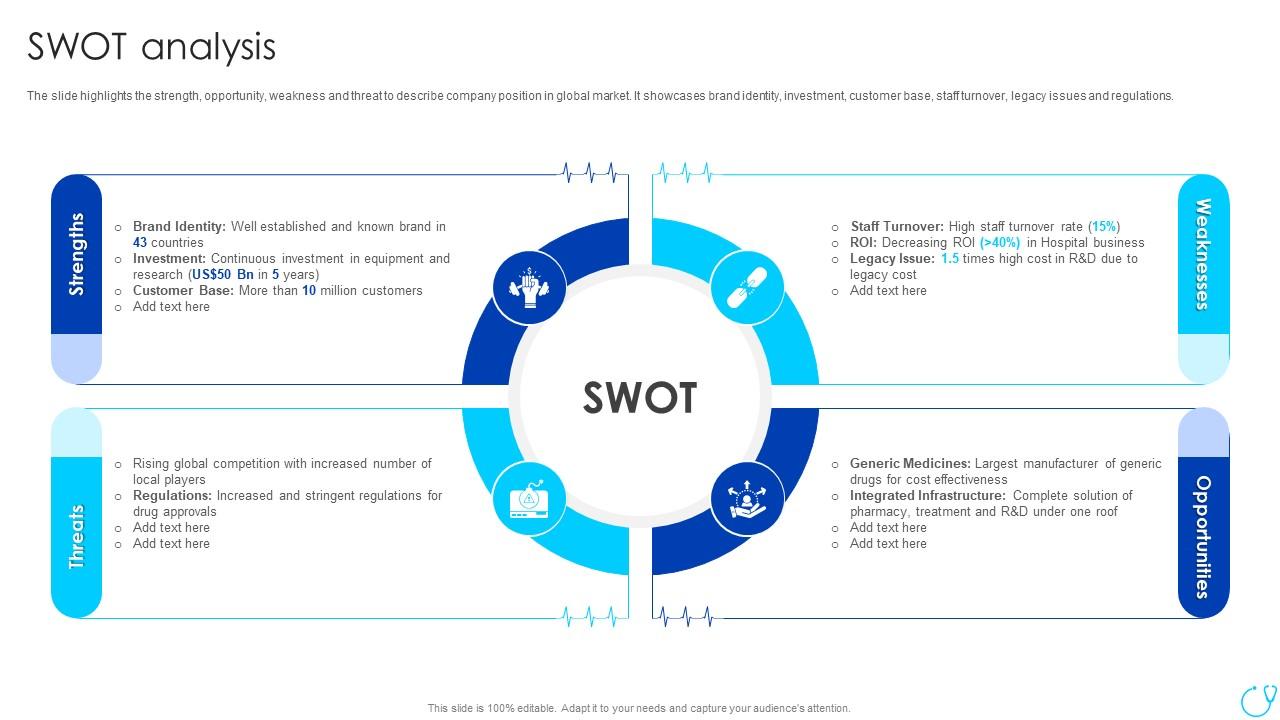
The slide highlights the strength, opportunity, weakness and threat to describe company position in global market. It showcases brand identity, investment, customer base, staff turnover, legacy issues and regulations.
People who downloaded this PowerPoint presentation also viewed the following :
Swot Analysis Healthcare Company Profile Ppt Powerpoint Presentation File Slides with all 6 slides:
Use our Swot Analysis Healthcare Company Profile Ppt Powerpoint Presentation File Slides to effectively help you save your valuable time. They are readymade to fit into any presentation structure.
FAQs for Swot Analysis Healthcare Company Profile Ppt Powerpoint
Healthcare organizations typically demonstrate strengths including advanced medical technology and equipment, highly skilled clinical staff, strong patient safety protocols, established community reputation, and comprehensive service offerings. These core capabilities enable institutions to deliver quality patient care, maintain competitive positioning in increasingly complex healthcare markets, and build sustainable revenue streams while adapting to evolving regulatory requirements and patient expectations.
Technology significantly addresses healthcare's core weaknesses through electronic health records reducing medical errors, telemedicine bridging access gaps, and AI-powered diagnostics minimizing human oversight limitations. While implementation costs and cybersecurity concerns present challenges, hospitals and clinics increasingly find that strategic technology adoption streamlines operations, enhances patient outcomes, and ultimately delivers competitive advantage in an increasingly digital healthcare environment.
Healthcare growth opportunities include telemedicine expansion, AI-driven diagnostics, personalized medicine, mental health services, and aging population care solutions. These emerging sectors enable organizations to streamline patient experiences, reduce operational costs, and enhance treatment outcomes, with many healthcare institutions finding that strategic technology adoption delivers competitive advantage in an increasingly digital healthcare landscape.
External threats disrupting healthcare facilities include cyberattacks targeting patient data, regulatory changes affecting compliance costs, economic downturns reducing patient volumes, natural disasters damaging infrastructure, and competitive pressures from telemedicine providers. These challenges increasingly require strategic risk management, with many hospitals finding that diversified service offerings, robust cybersecurity investments, and emergency preparedness protocols ultimately deliver operational resilience and sustained competitive advantage.
Healthcare providers can leverage their strengths by optimizing clinical expertise through specialized care teams, utilizing advanced medical technologies for faster diagnoses, and enhancing operational efficiency through streamlined workflows. Strategic combinations of these strengths enable hospitals and clinics to deliver personalized treatments, reduce wait times, and improve patient outcomes, ultimately creating competitive advantages in an increasingly patient-centered healthcare landscape.
Healthcare system weaknesses directly compromise patient outcomes through delayed diagnoses, inadequate resource allocation, fragmented care coordination, and limited access to specialized services. These deficiencies create cascading effects across patient journeys, with many hospitals finding that operational inefficiencies ultimately lead to longer recovery times, increased readmission rates, and reduced patient satisfaction scores.
Data analytics enables healthcare organizations to identify opportunities by analyzing patient outcomes, operational inefficiencies, market trends, and resource utilization patterns. Through predictive modeling and performance metrics, hospitals and clinics can uncover new service lines, optimize staffing models, and enhance patient care delivery, ultimately driving revenue growth and competitive advantage in an increasingly data-driven healthcare landscape.
Regulatory changes can significantly alter healthcare threats by introducing new compliance requirements, operational restrictions, and market barriers that impact cost structures and service delivery. These modifications often create cascading effects across organizations, with hospitals and medical practices finding that evolving regulations can transform competitive landscapes, ultimately requiring strategic pivots to maintain operational efficiency and patient care standards.
Smaller healthcare facilities offer personalized patient care, faster decision-making processes, community-focused services, operational agility, and direct physician-patient relationships that larger systems often struggle to maintain. These organizations can quickly adapt treatment protocols, implement new technologies, and respond to local health needs, with many community hospitals and clinics finding that their intimate scale delivers superior patient satisfaction and more responsive healthcare experiences.
Healthcare organizations can address resource allocation weaknesses through strategic workforce planning, technology optimization, and data-driven decision making systems. By implementing predictive analytics for demand forecasting, cross-training staff for flexibility, and adopting automated scheduling platforms, hospitals and clinics streamline operations while reducing costs, ultimately delivering improved patient care and enhanced operational efficiency.
Emerging technologies creating healthcare innovation opportunities include artificial intelligence for diagnostics, telemedicine platforms, wearable health monitors, robotics for surgery, and blockchain for secure data management. These technologies streamline patient care by enabling remote consultations, automating routine processes, and enhancing diagnostic accuracy, with hospitals and clinics finding that strategic implementation delivers improved patient outcomes and operational efficiency.
Patient feedback directly influences SWOT analysis by revealing service quality strengths, operational weaknesses, care gaps, and staff performance insights through surveys, reviews, and satisfaction scores. Healthcare organizations leverage this feedback to identify competitive advantages like exceptional nursing care, address weaknesses such as wait times, and enhance patient experiences, ultimately improving outcomes and market positioning.
Healthcare organizations should consider threats including emerging competitors, regulatory changes, technology disruption, talent shortages, and funding constraints in their strategic planning. These challenges particularly impact hospitals, clinics, and health systems through increased competition from telehealth providers, evolving compliance requirements, and rising operational costs, ultimately requiring adaptive strategies to maintain market position and deliver quality patient care.
Partnerships with technology firms enable healthcare organizations to accelerate digital transformation, access cutting-edge innovations like AI diagnostics and telemedicine platforms, and reduce development costs through shared expertise. These strategic collaborations streamline patient care delivery, enhance operational efficiency, and improve health outcomes, with many hospitals and health systems finding that technology partnerships ultimately deliver competitive advantages in an increasingly digital healthcare landscape.
Healthcare organizations should address data breach vulnerabilities, ransomware attacks, medical device security gaps, patient privacy compliance risks, and third-party vendor vulnerabilities in their SWOT analysis. These cybersecurity threats can significantly impact operational efficiency, patient trust, and regulatory compliance, with many hospitals and healthcare systems finding that proactive threat assessment ultimately delivers enhanced security protocols and competitive advantage.
-
The website is jam-packed with fantastic and creative templates for a variety of business concepts. They are easy to use and customize.
-
Innovative and Colorful designs.