

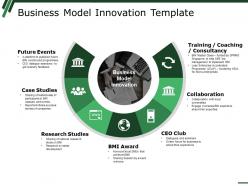
Business model innovation template ppt summary introduction





Try Before you Buy Download Free Sample Product
 Impress Your
 Audience
 100%
100% Editable
 Save Hours
 of Time


Involve the journalists with our Business Model Innovation Template Ppt Summary Introduction. Get them interested in digging up facts.
People who downloaded this PowerPoint presentation also viewed the following :
Business model innovation template ppt summary introduction with all 5 slides:
Give folks assurance of huge gains with our Business Model Innovation Template Ppt Summary Introduction. It will attract investors.
FAQs for Business model innovation template
Look, you gotta nail three main things: what makes you special, how you'll actually make money, and who's gonna pay you. Figure out your unique value first. Then map out realistic revenue streams - I swear, so many cool ideas die because founders ignore this boring part. Know your exact customer segments too. Oh, and don't forget the operations side - like how you'll deliver everything without losing your mind. Test these assumptions early before you fall in love with your idea. When all these pieces click together, that's when things get interesting.
Honestly, you've gotta get out there and talk to your customers way more than you probably are right now. Surveys are fine, but watching people actually use your stuff? That's where the gold is. I swear, they'll do things you never imagined - like weird workarounds that show what's really broken. Your support tickets are basically a treasure map too. Start with the loudest customers first though - yeah they're annoying sometimes, but they'll straight up tell you what sucks and how to fix it. Those cancellation emails hit different when you actually read them.
Honestly, tech is the biggest game-changer for business models right now. Netflix ditched DVDs for streaming, Uber flipped transportation with an app - you can completely rethink how you make and deliver value. The speed is wild too. Test ideas fast, reach customers directly, optimize with real-time data. Here's what I'd do though - don't just make your current model more efficient with tech. Actually question if your whole approach needs to change. Sometimes the best innovation is scrapping what you're doing entirely and starting fresh.
Okay so you'll want to track the obvious stuff first - revenue, profit margins, how much it costs to get customers, that whole deal. But honestly, the financial numbers are slow to show up. That's why you need the other metrics too - like how happy your customers actually are, whether your team's being productive, process efficiency rates. I'd set up monthly tracking for all of it. The key thing is starting measurements *before* you change anything - otherwise you're just guessing if it worked. Give it at least 6-12 months to see real patterns emerge.
Honestly, you gotta throw out what everyone else is doing. Target customers nobody's paying attention to yet. Try subscription models or freemium - there's tons of ways to make money beyond the obvious ones. Cut out the middlemen whenever possible. Uber's genius because they just connect people instead of buying a fleet of cars, you know? Build cheap prototypes first before dumping serious cash into anything. And don't fall in love with your first concept - I've seen too many people stick with bad ideas. Map out like 3-5 different approaches and test whichever feels most promising.
Honestly, you gotta start super small. Pick some low-stakes area and run a tiny pilot there - somewhere that won't blow up if things go sideways. Results are everything. People won't buy into your vision until they can actually see it working, not just hear about it in meetings. Find a few people internally who actually get excited about this stuff and let them spread the word for you. I swear, half the innovation projects I've watched crash and burn because someone tried to transform everything at once. Document even the tiniest wins and use those to slowly expand. Way less risky that way.
Honestly, start with the Business Model Canvas - it's like having all nine pieces of your business laid out so you can actually see what's missing. Lean Canvas is solid too, especially if you're still figuring things out or it's super early stage. I bounce between both depending on what I'm working on. Three Horizons is good when you need to dig into whether something will actually make money long-term vs just right now. Oh, and scenario planning helps when you want to see how your idea holds up if things go sideways. Don't overthink which framework is "right" though - just pick one and stick with it.
Your customers basically control everything about your business model. When their habits change, you've gotta change too or you're screwed. Look at Blockbuster - they ignored how people wanted to stream movies and boom, dead. Same with retail going mobile-first. The smart companies? They watch for these shifts early instead of scrambling later. Honestly, most businesses are terrible at this. You need direct feedback from customers so you can spot trends before everyone else jumps on them. It's all about adapting fast.
Honestly, redesigning your business model is the perfect time to build in sustainability from the ground up. Way better than slapping green stuff on later. Look at Patagonia - their whole repair-don't-replace thing wasn't an add-on, it was a complete shift in how they do business. Same with Interface going carbon-negative. The smart move? Map out your current model first, then spot where sustainability could actually make your value proposition stronger. Not just feel-good stuff, but real competitive advantages. Circular economy approaches often cut costs while opening new revenue streams - though I'll admit the upfront thinking takes some work.
Working with other industries is honestly where the cool stuff happens. You can steal ideas that work great elsewhere and twist them for your space. Uber basically took taxi dispatching and slapped it on everything. Subscriptions went from magazines to Netflix to dollar shave club - same model, totally different products. The best part? Your competitors probably aren't looking outside their bubble yet. You'll spot customer problems from fresh angles and find new ways to make money. Just find industries solving similar problems but doing it completely different than you. Then mix their approach with what you already know works.
Netflix completely destroyed Blockbuster by ditching DVDs for streaming - that was brutal to watch. Then you've got Uber connecting drivers straight to passengers, no taxi companies needed. Airbnb basically turned everyone into potential hotel owners, which is wild when you think about it. Amazon's probably the craziest though - books to literally everything plus those AWS cloud services that print money. These companies didn't just make things better, they rewrote the rules entirely. Hunt for spots where you can cut out the middle guy or create something people didn't even know they wanted.
Honestly, start by mapping out your key metrics and see what the data's actually telling you. Numbers don't lie like our gut instincts sometimes do! Look at which customer segments bring in real money vs. the ones that just feel important. Pricing experiments can show you what actually works too. I'd dig into where you're bleeding money operationally - that stuff adds up fast. You can even test new model tweaks without going all-in. The cool thing is you'll spot trends you never noticed and figure out which revenue streams are worth keeping. Data beats guessing every time.
Honestly, the scariest part is when customers just don't get your new direction and bail. Plus your team gets totally lost trying to figure out the new way of doing things while money flies out the door. I've watched companies pivot so aggressively they completely lost what made them special to begin with - it's painful to see. Start with tiny pilot tests first. Get feedback before you go crazy with changes. Don't kill your main money-makers while you're experimenting either. Keep everyone on the same page about why you're switching things up. Test small stuff first instead of risking everything.
Honestly, culture is everything when it comes to innovation. People won't take risks if they're scared of getting fired for failing - doesn't matter how much your CEO preaches about "thinking outside the box." You need teams to feel safe experimenting with crazy ideas. Most will bomb, obviously, but that's how breakthroughs happen. The companies crushing it right now? They celebrate smart failures just as much as wins. Cross-department collaboration helps too. Oh, and psychological safety isn't just some HR buzzword - it's what separates teams that innovate from ones that just play it safe forever.
Look, metrics are basically your early warning system - they'll tell you if you're onto something or just lighting money on fire. Focus on the stuff that actually matters: customer acquisition costs, lifetime value, how much users are worth. Don't get caught up in vanity metrics that look cool but mean nothing (learned that one the hard way). Pick maybe 3-5 numbers that directly connect to your main assumptions. Track them every week, religiously. Even if your numbers are embarrassingly small at first, start measuring immediately. You'll spot patterns way earlier and save yourself from nasty surprises down the road.
-
Innovative and Colorful designs.
-
Top Quality presentations that are easily editable.