


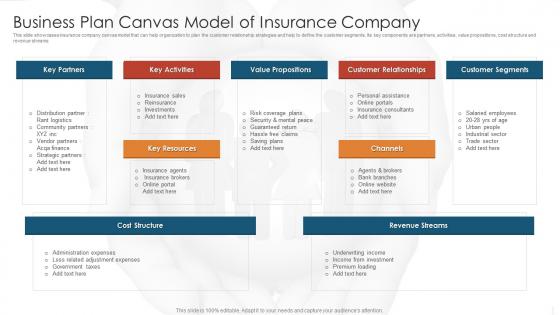
Business plan canvas model of insurance company




Try Before you Buy Download Free Sample Product
 Impress Your
 Audience
 100%
100% Editable
 Save Hours
 of Time


Our Business Plan Canvas Model Of Insurance Company are topically designed to provide an attractive backdrop to any subject. Use them to look like a presentation pro.
People who downloaded this PowerPoint presentation also viewed the following :
Business plan canvas model of insurance company with all 6 slides:
Use our Business Plan Canvas Model Of Insurance Company to effectively help you save your valuable time. They are readymade to fit into any presentation structure.





FAQs for Business plan canvas model
So the Business Model Canvas breaks down into nine building blocks - stuff like Customer Segments, Value Propositions, Channels, Revenue Streams, all that. Way more useful than those massive business plans that just sit on a shelf collecting dust, honestly. Each block shows how you create and deliver value to customers. They all connect to each other too, which is kinda the whole point. I'd start with Value Propositions and Customer Segments first since those are your foundation. Then fill in the rest - Key Resources, Activities, Partnerships, Cost Structure, Customer Relationships. It's like having your entire business on one page.
Think of the Business Model Canvas like a bunch of educated guesses you need to test out. Map your assumptions across those nine boxes, then actually go validate them - customer interviews, surveys, little experiments, whatever works. Here's the thing: it makes you think about revenue and partnerships way earlier than you normally would, which is honestly pretty smart. I'd hit your value prop and customer segments first since that's where most people totally whiff it. Oh, and don't treat it like some sacred document. You'll be updating that thing constantly as you figure out what actually works.
So the Business Model Canvas is way more visual and flexible than those traditional business plans. Instead of some massive 40-page document nobody actually reads, you just map everything out on one page with nine building blocks. Honestly, it's perfect for brainstorming. You can test different ideas by moving sticky notes around - way easier than updating a static document that takes forever to change. The canvas shows how your business creates value right now, not those financial projections that are basically wild guesses anyway (I mean, who really knows what'll happen in year three?). I'd start with the canvas first, then write the formal plan if investors demand it.
Dude, the Business Model Canvas is clutch for getting your whole business on one page. Makes it super easy to spot gaps or new opportunities you might've missed. I always use it in our quarterly meetings now - gets everyone on the same page so much faster than those endless PowerPoints we used to do. What's cool is you can play around with "what if" scenarios before you actually spend money on anything. Map out what you're doing now first, then mess around with different versions. Shows you how changing one thing (like adding new customers) affects everything else. Honestly saves so much headache down the road.
Look, customer segments are honestly where everything starts. You can't figure out your channels, relationships, or value prop without knowing who you're actually serving. It's like trying to plan a party without knowing who's coming - total mess, right? Once you nail down your segments, the rest of the canvas just flows better. Your revenue streams make more sense. Your partnerships become clearer. Even your key activities align properly. I've seen people try to skip this step and they always end up backtracking later. Start here first - it'll save you so much headache down the road.
Honestly, partnerships can completely flip your Business Model Canvas in the best way. You'll get access to stuff you're weak at - maybe their distribution channels or tech capabilities. Costs go down when you share resources too. I've watched companies totally change their revenue streams just by teaming up with the right people. The trick is mapping out what you suck at versus what they're amazing at. That's where things get interesting. Focus on your strengths while they fill your gaps. It's like puzzle pieces clicking together, but for business strategy.
Ugh, the worst thing people do is being super vague - like saying "everyone" is their target customer. Makes zero sense. Also cramming way too much detail into each box when it should be high-level stuff. I've seen teams fill these out solo in some meeting room instead of actually talking to people who know the customers. That's backwards tbh. Don't treat it like homework you finish once either - it needs to change as you learn new things. Keep it specific, get different perspectives, and actually refer back to it when making decisions.
Your value prop has to match what people actually want right now, not what they wanted two years ago. Like if everyone's obsessing over sustainability, you better highlight those eco benefits. Digital transformation, convenience, whatever's hot in your space. Trends basically answer the "why does this matter now" question for customers. I'd honestly set up quarterly reviews to check if your messaging still hits - markets move fast and you don't want to be that company still talking about features nobody cares about anymore. Just keep asking yourself: does this still resonate?
Honestly, there are so many good options for this. Miro is my go-to - it's genuinely amazing for remote teamwork. Canva works great too if you want something more visual. Lucidchart and Draw.io are solid choices, or just use PowerPoint if you're keeping things basic. Oh, and Strategyzer has the "official" version if you're into that sort of thing. My take? Just pick whatever your team's already comfortable with. You'll probably end up tweaking this canvas like fifty times anyway with different people, so don't overthink the tool choice.
Quarterly is usually a good baseline, but it really depends on your situation. Early-stage or fast-moving markets? I'd check it monthly. More established business? Every 3-6 months is probably fine. Watch for red flags though - customer feedback shifts, new competitors, or when your assumptions start feeling stale. Those mean update time regardless of your schedule. Oh, and definitely set a calendar reminder because you'll totally forget otherwise. Make it a team thing too rather than doing it solo - way more useful that way.
Yeah, totally works for nonprofits! You'll just need to adjust a couple sections. Replace "Revenue Streams" with your funding sources - grants, donations, events, that kind of stuff. Your value prop becomes the actual impact you're making. The tricky part is "Customer Segments" because you're dealing with two groups: donors who give money and the people you're actually helping. Everything else stays pretty much the same - partnerships, activities, resources, costs. Honestly, I think it's one of the better ways to see how everything in your org connects. Worth trying it out with your current setup.
Honestly, the Canvas is a game-changer because you get all nine pieces of your business model on one page. No more hunting through random documents or trying to remember what Sarah said in that meeting last week. Everything connects visually, so you'll catch problems right away - like realizing your customer segments don't actually match your revenue streams (awkward). The best part? Your whole team can crowd around it with sticky notes and just start tweaking things. I'd start by mapping what you're doing now, then use it to play around with new ideas. Way better than PowerPoint hell.
Honestly, track the basics first - customer acquisition costs, revenue per segment, partnership ROI. But here's what really matters: are you actually using the damn thing? I've seen so many beautiful canvases just collecting dust on office walls. When you're making big decisions, do you pull it up? That's the real test. Set up quarterly check-ins where you validate your assumptions with actual data (not just gut feelings). If certain blocks keep failing, scrap them and try something new. The whole point is making better business calls, not having a pretty poster.
Honestly, tons of big companies have nailed this. Airbnb mapped out their host-traveler connection model early on - helped them spot partnerships they'd totally missed. Spotify's the best example though when they ditched paid downloads for that freemium streaming thing. Smart as hell. Uber used the canvas too for their whole transportation disruption. Oh, and definitely grab Alexander Osterwalder's book if you want the full breakdown of these cases. Way better than me trying to explain all the details over text - he actually shows you how to apply it to whatever you're working on.
Customer feedback is like a reality check for your Business Model Canvas. You think your value prop is amazing? Let customers tell you if they actually care. Same goes for your revenue streams - will people really pay what you're asking? Honestly, I've watched so many "perfect" canvases crash and burn after real customer interviews. Feedback helps you pivot when needed. Maybe there's a customer segment you totally missed, or your marketing channels aren't hitting the right crowd. Build those feedback loops in early so you're working with real insights instead of just guessing what might work.
-
Good research work and creative work done on every template.
-
Designs have enough space to add content.