

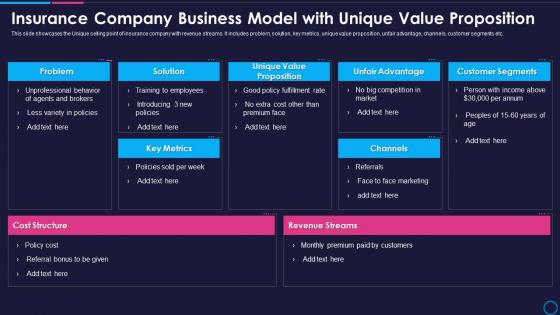
Insurance Company Business Model With Unique Value Proposition




Try Before you Buy Download Free Sample Product
 Impress Your
 Audience
 100%
100% Editable
 Save Hours
 of Time


This slide showcases the Unique selling point of insurance company with revenue streams. It includes problem, solution, key metrics, unique value proposition, unfair advantage, channels, customer segments etc.
People who downloaded this PowerPoint presentation also viewed the following :
Insurance Company Business Model With Unique Value Proposition with all 6 slides:
Use our Insurance Company Business Model With Unique Value Proposition to effectively help you save your valuable time. They are readymade to fit into any presentation structure.





FAQs for Insurance Company Business Model With
A successful insurance business model comprises risk assessment and underwriting capabilities, diversified product portfolios, robust claims management systems, effective distribution channels, and strong capital reserves. These components work synergistically to enable insurers to accurately price policies, minimize losses, and deliver seamless customer experiences, with many companies finding that strategic integration of technology and data analytics ultimately enhances operational efficiency and competitive positioning.
Technology enhances customer engagement in insurance through AI-powered chatbots, mobile apps, personalized policy recommendations, automated claims processing, and real-time communication platforms. These digital solutions streamline interactions by providing 24/7 support, faster claim resolutions, and tailored coverage options, with many insurers finding that enhanced digital experiences significantly improve customer satisfaction and retention rates.
Data analytics revolutionizes risk assessment by enabling insurers to analyze vast datasets, identify patterns, predict future claims, and calculate precise premiums based on individual risk profiles. Through machine learning algorithms and predictive modeling, insurance companies streamline underwriting processes, reduce fraudulent claims, and enhance customer segmentation, ultimately delivering more competitive pricing and improved profitability.
Insurers balance premium pricing and claim payouts through advanced actuarial modeling, risk segmentation, diversified product portfolios, strategic reinsurance partnerships, and data-driven underwriting processes. These approaches enable companies to optimize risk assessment while maintaining competitive pricing, with many insurers finding that predictive analytics and dynamic pricing models ultimately deliver improved loss ratios and sustainable profitability.
Innovative insurance distribution channels include digital-first platforms, embedded insurance through e-commerce sites, peer-to-peer networks, insurtech partnerships, and AI-powered brokerages. These channels streamline customer acquisition by reducing friction, personalizing offerings, and integrating seamlessly into existing purchase journeys, with many insurers finding that omnichannel approaches significantly enhance market reach while lowering distribution costs.
Insurers can leverage customer feedback to refine service offerings through digital surveys, claims experience analytics, mobile app reviews, social media monitoring, and direct consultation programs. These feedback mechanisms enable insurers to streamline claims processing, enhance digital experiences, and develop targeted products, with many companies finding that responsive service improvements significantly boost customer retention and competitive positioning.
Regulatory compliance fundamentally shapes insurance operations by mandating specific capital reserves, risk assessment protocols, claims processing procedures, and customer protection standards. These requirements drive insurers to establish dedicated compliance departments, implement robust data governance systems, and maintain transparent reporting mechanisms, while many companies find that strong compliance frameworks ultimately enhance customer trust, operational efficiency, and competitive positioning in regulated markets.
Subscription-based insurance models offer predictable revenue streams, enhanced customer retention, simplified pricing structures, and improved cash flow management for insurers. While this approach enables better risk assessment through continuous data collection and strengthens customer relationships, it also presents pricing complexity challenges and requires significant technology infrastructure investments, with many insurers finding that successful implementation ultimately delivers competitive differentiation and operational efficiency.
Social insurance operates through government-sponsored programs funded by mandatory contributions from employers, employees, and taxpayers, differing from traditional insurance's voluntary, premium-based approach. While traditional models focus on individual risk assessment and profit generation, social insurance emphasizes broad coverage and social welfare, with programs like Medicare and Social Security demonstrating how collective funding delivers universal benefits and societal protection.
Macroeconomic factors significantly impact insurance profitability through interest rates affecting investment returns, inflation increasing claim costs, economic cycles influencing premium demand, and regulatory changes altering operational requirements. While economic downturns present challenges through reduced premium volumes, they also create opportunities for strategic insurers to capture market share and enhance competitive positioning through refined risk assessment and product innovation.
Insurers can integrate sustainability by developing green insurance products, investing in renewable energy portfolios, implementing ESG risk assessment frameworks, and offering premium discounts for eco-friendly behaviors. Through sustainable underwriting practices, many insurance companies streamline operations while reducing environmental impact, ultimately delivering competitive advantages and enhanced customer loyalty in an increasingly environmentally-conscious market.
Insurance companies can enhance customer retention through personalized policy offerings, proactive customer service, digital self-service platforms, loyalty rewards programs, and transparent claims processing. These strategies streamline customer experiences by reducing friction, anticipating needs, and building trust, with many insurers finding that combining technology-driven personalization with responsive human support ultimately delivers higher satisfaction rates and stronger long-term relationships.
Partnerships and collaborations revolutionize insurance by enabling risk sharing, expanding market reach, accelerating innovation, and enhancing customer experiences through integrated services. Through strategic alliances with insurtech companies, banks, and technology providers, insurers streamline operations, access new distribution channels, and develop personalized products, ultimately delivering competitive advantages and improved operational efficiency.
Claims management serves as the critical touchpoint that directly impacts customer satisfaction, retention rates, and brand reputation within insurance models. Through streamlined digital processing, transparent communication, and faster settlement procedures, insurers enhance customer experiences while reducing operational costs, with many companies finding that efficient claims handling significantly increases policy renewals and customer loyalty.
Emerging risks like cyber threats are driving insurers to develop specialized coverage products, invest in advanced risk assessment technologies, and form strategic partnerships with cybersecurity firms. Many insurers are integrating real-time monitoring systems and predictive analytics to better understand these evolving exposures, while also offering risk mitigation services alongside traditional coverage, ultimately transforming from reactive claim payers to proactive risk management partners.
-
Great quality slides in rapid time.
-
Best Representation of topics, really appreciable.