

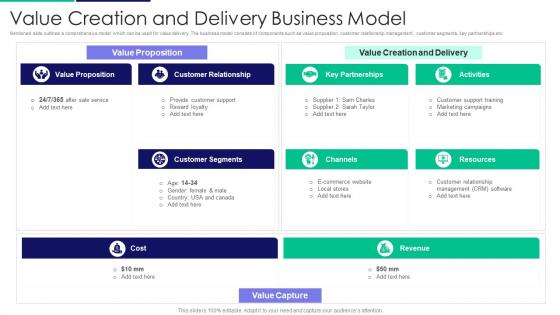
Value Creation And Delivery Business Model




Try Before you Buy Download Free Sample Product
 Impress Your
 Audience
 100%
100% Editable
 Save Hours
 of Time


Mentioned slide outlines a comprehensive model which can be used for value delivery. The business model consists of components such as value proposition, customer relationship management, customer segments, key partnerships etc.
People who downloaded this PowerPoint presentation also viewed the following :
Value Creation And Delivery Business Model with all 6 slides:
Use our Value Creation And Delivery Business Model to effectively help you save your valuable time. They are readymade to fit into any presentation structure.





FAQs for Value Creation And
Businesses can enhance stakeholder value through operational efficiency improvements, strategic innovation initiatives, sustainable practices adoption, customer experience optimization, and employee development programs. These approaches streamline processes, reduce costs, and accelerate service delivery, with many organizations finding that combining technology integration with stakeholder engagement ultimately delivers competitive advantage and measurable returns.
Customer involvement significantly enhances value creation by providing direct market insights, reducing development risks, and ensuring products meet actual user needs rather than assumptions. Through co-creation workshops, feedback loops, and iterative testing, companies like software developers and consumer goods manufacturers streamline product-market fit, minimize costly revisions, and ultimately deliver solutions with higher adoption rates and customer satisfaction.
Innovation drives value creation in competitive markets by enabling companies to differentiate products, streamline operations, reduce costs, and deliver superior customer experiences. Through strategic innovation initiatives, organizations across sectors like technology, healthcare, and financial services develop new revenue streams, capture larger market share, and build sustainable competitive advantages, with many finding that continuous innovation becomes essential for long-term market positioning.
Value creation measurement varies by industry but commonly includes financial metrics like ROI and revenue growth, operational indicators such as efficiency improvements and cost reductions, and customer-focused measures including satisfaction scores and retention rates. Through strategic combination of quantitative data and qualitative assessments, organizations across sectors from manufacturing to financial services can track performance improvements, resource optimization, and competitive positioning, ultimately delivering comprehensive insights that enhance decision-making and sustainable growth.
Sustainable practices contribute to long-term value creation through cost reduction via energy efficiency, enhanced brand reputation attracting conscious consumers, improved regulatory compliance, and reduced operational risks from environmental factors. These initiatives enable companies to secure competitive advantages, access green financing opportunities, and build resilient supply chains, with many organizations finding that sustainability investments ultimately deliver measurable returns and stakeholder loyalty.
Cultural and social factors significantly impact value creation by shaping consumer preferences, purchasing behaviors, communication styles, and business relationship dynamics across different markets. These influences determine product positioning, service delivery approaches, and stakeholder engagement strategies, with companies in sectors like retail, hospitality, and financial services finding that culturally-adapted offerings deliver enhanced customer loyalty and competitive advantage.
Key performance indicators for value creation include revenue growth rate, customer lifetime value, return on investment, profit margins, and operational efficiency metrics. These KPIs enable organizations to measure strategic progress by tracking financial performance, customer satisfaction, and resource utilization, with many companies finding that consistent monitoring across these areas ultimately delivers sustainable competitive advantage and long-term profitability.
Technology and digital transformation drive value creation in traditional industries by automating manual processes, enhancing data analytics capabilities, and improving customer experiences through personalized services. Manufacturing companies leverage IoT sensors for predictive maintenance, while banks use AI for faster loan approvals, ultimately delivering operational efficiency and competitive advantage.
Employee engagement directly drives value creation through increased productivity, reduced turnover costs, enhanced customer satisfaction, and improved innovation rates. Engaged employees deliver superior performance, with companies like Southwest Airlines and Google demonstrating that highly engaged workforces generate significantly higher revenue per employee, stronger profit margins, and sustained competitive advantage in increasingly demanding markets.
B2B value propositions emphasize operational efficiency, cost reduction, and strategic competitive advantages, while B2C focuses on personal benefits, convenience, and emotional satisfaction. B2B buyers evaluate solutions based on ROI, scalability, and integration capabilities, whereas B2C customers prioritize user experience, brand connection, and immediate value, with B2B requiring longer-term relationship building.
Collaborative partnerships enhance value creation by combining complementary strengths, sharing resources and expertise, and accessing new markets or technologies that individual organizations cannot achieve alone. Through strategic alliances, companies streamline operations, reduce costs, and accelerate innovation, with many businesses finding that partnerships ultimately deliver competitive advantages and sustainable growth.
Businesses balance short-term profits with long-term value creation through strategic resource allocation, reinvesting earnings into innovation and infrastructure while maintaining operational efficiency. This approach enables sustainable growth by delivering immediate stakeholder returns, building competitive advantages through research and development, and creating market differentiation, with many organizations finding that balanced investment strategies ultimately enhance both current profitability and future market position.
Common value creation pitfalls include misaligned strategic priorities, inadequate stakeholder engagement, poor resource allocation, insufficient performance measurement, and lack of cross-functional collaboration. These challenges often arise when organizations focus solely on short-term gains rather than sustainable growth, with many finding that balancing immediate results with long-term strategic vision ultimately delivers more consistent competitive advantage.
Value creation frameworks adapt to emerging trends by incorporating real-time market analytics, sustainability metrics, digital transformation indicators, and customer experience measurements into traditional assessment models. These enhanced frameworks enable organizations across retail, healthcare, and financial services to identify new revenue streams, optimize resource allocation, and anticipate consumer shifts, ultimately delivering competitive advantage in increasingly dynamic markets.
Data analytics enables organizations to identify value creation opportunities by analyzing customer behavior patterns, operational inefficiencies, market trends, and resource allocation gaps across business units. Through predictive modeling and real-time insights, companies in sectors like retail, healthcare, and financial services can optimize pricing strategies, enhance customer experiences, and streamline operations, ultimately delivering measurable revenue growth and competitive advantage.
-
I’ve been your client for a few years now. Couldn’t be more than happy after using your templates. Thank you!
-
Professional and unique presentations.