


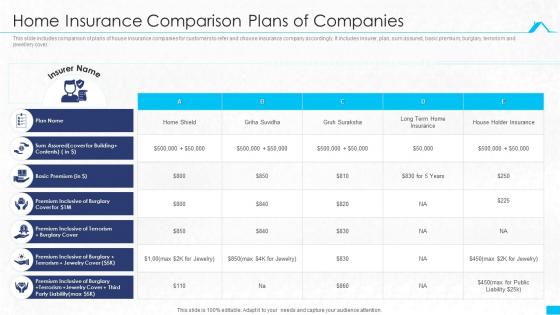
Home Insurance Comparison Plans Of Companies




Try Before you Buy Download Free Sample Product
 Impress Your
 Audience
 100%
100% Editable
 Save Hours
 of Time


This slide includes comparison of plans of house insurance companies for customers to refer and choose insurance company accordingly. It includes insurer, plan, sum assured, basic premium, burglary, terrorism and jewellery cover.
People who downloaded this PowerPoint presentation also viewed the following :
Home Insurance Comparison Plans Of Companies with all 6 slides:
Use our Home Insurance Comparison Plans Of Companies to effectively help you save your valuable time. They are readymade to fit into any presentation structure.





FAQs for Home Insurance Comparison
Okay so definitely compare coverage limits and deductibles first. Don't just pick the cheapest one though - trust me on that! Check what they actually cover for your specific area, like flooding or earthquakes or whatever. Dwelling coverage should cover full rebuilding costs, not just what you paid for the house. Personal property and liability matter too. Oh and see if they'll pay for hotels if you get displaced - that stuff adds up fast. Customer service ratings are huge because dealing with claims already sucks. Get quotes from 3-4 companies and actually read the exclusions part.
Yeah, more coverage = higher premium. Basic math there. But honestly? Don't just go for the cheapest option - you'll regret it if something happens. If you bump dwelling coverage from $200k to $300k, your monthly payment's gonna jump too. Same with personal property and liability limits. Construction costs are absolutely insane right now though, so you actually need enough to rebuild your place at today's prices. Get a realistic replacement cost estimate first, then shop around with that number. Makes comparing quotes way easier. Trust me on this one - being underinsured sucks more than paying a bit extra monthly.
So there's basically four types you need to know about. HO-3 is for regular houses - covers most stuff except what they specifically exclude. If you're in a condo, get HO-6 since it focuses on your unit's interior and belongings (the building coverage is handled separately). Renters need HO-4, which is just for your personal stuff. Then there's HO-5 for fancy houses - way more coverage but costs more obviously. Oh and mobile home policies exist too if that applies. Honestly, just make sure you're comparing the same policy types or the pricing won't make any sense.
So higher deductibles mean lower monthly payments because you're basically saying "I'll cover more damage myself before you step in." Instead of the insurance company paying after $500, now they don't pay until you've spent $2,500. Pretty good deal for them, right? But when something actually happens, you're stuck paying way more upfront. I'd honestly just do the math first - figure out your annual savings versus what you could realistically afford if your car gets totaled or whatever. It's kinda like betting on yourself to be a good driver.
Dude, don't just look at the monthly cost - the exclusions will bite you in the ass later. My first policy seemed great until I realized they wouldn't cover water damage. Basement flooded and I was totally screwed. Each company excludes weird stuff too. Some hate pit bulls, others won't touch your Etsy business or that expensive watch collection. Oh, and check the payout limits! You might think you're covered for 50k but really it's capped way lower. I always compare the fine print now, not just premiums. Takes forever but saves your wallet.
Yeah, bundling's usually worth it! Most companies give you 5-25% off when you combine home and auto insurance. It's way less of a headache too - one company to call, one payment, you know? The savings really stack up over the years. But here's the thing - sometimes the "discount" company is still more expensive overall than going with separate insurers. I learned this the hard way with my first house actually. So definitely get quotes both bundled and separate to see which saves you more money in the end. Don't just assume bundling's automatically cheaper.
Oh man, location is HUGE for insurance rates. Crime stats, flood zones, hurricane paths - insurers basically stalk your neighborhood's risk profile. Living near the coast? Expect higher premiums. Wildfire country? Same deal. They even check how far you are from fire stations, which seems kind of random but whatever. Different companies weigh these risks differently though, so definitely shop around. I got quotes that varied by like $400 just for the same coverage. Worth the hassle to call a few places and see who's got the best rate for your area.
Definitely get scheduled personal property coverage for your expensive stuff - jewelry, electronics, whatever. Water backup is huge too, basements flood way more than people realize. Extended replacement cost is smart since construction prices are insane right now. Identity theft protection is pretty standard these days. Got significant assets? Umbrella liability is worth it. Older house? You'll probably want ordinance/law coverage since building codes change constantly. Honestly though, just focus on your biggest risks first - like if you're anywhere near water, get that backup coverage ASAP.
So most policies give you 50-70% of your dwelling coverage for personal stuff. But here's what really matters - some use "actual cash value" which totally screws you over because of depreciation. Your laptop from 3 years ago? They might only give you $200 instead of what a new one costs. Others do replacement cost, which is way better. Also watch out for limits on expensive stuff like jewelry - usually capped around $1,000-$2,500 per item. Honestly, just sit down and actually add up what it'd cost to replace your things before you decide.
Dude, liability coverage is huge when you're shopping around. If someone slips on your driveway or you accidentally flood your neighbor's basement, you're covered. Most policies start at like $100k but that's honestly nothing nowadays - lawsuits are crazy expensive. I'd go for at least $300k, maybe $500k if you've got assets worth protecting. One thing that tripped me up: some policies include legal defense costs in that limit, others don't. Makes a big difference if you're actually getting sued. Don't just pick the cheapest option and pray nothing bad happens.
Yeah, so basically if the previous owners filed a bunch of claims, you're gonna pay more even though you had nothing to do with it. Super annoying, I know. Insurance companies think homes with claims history are riskier - water damage, theft, whatever it was makes them nervous. You're looking at maybe 10-25% higher rates depending on what happened. Here's the thing though - different insurers care about different stuff. Some freak out more about lots of small claims, others about one big expensive one. Definitely shop around and have your agent run quotes with multiple companies. It's weird how much the rates can vary for the same house.
Dude, those online comparison tools are a lifesaver. You can get quotes from like 5-6 companies in minutes instead of spending your whole afternoon on the phone. I honestly wish I'd known about them when I bought my place - would've saved me so much hassle. They're perfect for seeing different coverage options and deductibles side by side. Most are totally free too, which is nice. Just double-check you're comparing the same coverage amounts though, because that can get confusing. Oh, and they'll catch coverage gaps you might not think about. Way better than dealing with salespeople calling you nonstop.
Definitely ask about coverage limits - dwelling, personal property, and liability are the main ones that change a ton between companies. The exclusions matter more than most people think, honestly some policies are basically useless for certain things. Check what your deductibles are for different claims since wind and water damage usually have separate ones. Also figure out if they cover replacement cost or just what your old stuff was worth when it breaks. Oh and ask how long claims actually take to process - that varies like crazy. Get quotes in writing so you can actually compare them properly instead of trying to remember everything.
Dude, definitely check customer service reviews before picking home insurance. You don't want to get stuck on hold for hours when your basement floods, you know? Google and BBB reviews are solid - look specifically for people talking about actual claims, not just the sales pitch stuff. Cheap isn't worth it if they disappear when you need them most. I'd skip anyone with tons of complaints about dragging their feet on payouts or denying everything. Response time matters too. My cousin dealt with this nightmare company last year and it was brutal.
So yeah, your credit score totally affects home insurance rates - except in a few states like California, Hawaii, and Massachusetts where they banned that practice. Pretty annoying that it matters for insurance honestly, but whatever. In most places though, better credit means lower premiums. We're talking hundreds of dollars difference per year between great and terrible credit scores. Definitely worth checking your credit report before you start shopping around - improving your score could save you some real money. Just depends on which state you're looking at houses in.
-
Satisfied with the way SlideTeam resolved my query regarding the right business PPTs that I was having difficulty finding. I found the perfect match with their assistance.
-
Unique and attractive product design.