

Life insurance policies and plan




Try Before you Buy Download Free Sample Product
 Impress Your
 Audience
 100%
100% Editable
 Save Hours
 of Time


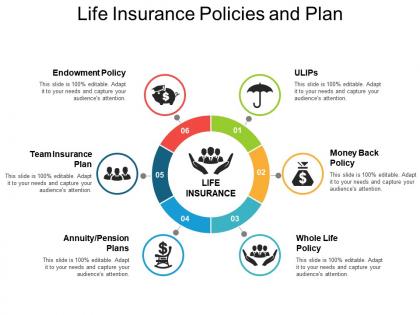
Protect yourself and your family from the losses with the help of this Life Insurance Policies And Plan slideshow. Showcase the need for life insurance which is for protection, liquidity, tax relief, money when you need it by taking the advantage of this PPT visual. Also, describe three types of life insurance which are traditional whole life, universal life, and variable universal life with the help of insurance policy PPT slideshow. Explain the type term life insurance, endowment insurance, and permanent life insurance with the assistance of readily available PowerPoint graphics. Discuss when to claim the policies by describing maturity, death claims, and survival benefits. Take the advantage of agreement PPT layout to describe the types of term life insurance which are increasing term insurance, decreasing term insurance, convertible term insurance policy, etc. Showcase how to choose the best life insurance policy plan. This slide is fully adaptable to your needs so you can easily replace your content in the placeholder. Describe the unit-linked plan by giving its classification in order to make your presentation knowledgeable. Thus, ensure the financial well being of your loved ones by downloading this insurance claim PPT presentation.
People who downloaded this PowerPoint presentation also viewed the following :
Life insurance policies and plan with all 5 slides:
Our Life Insurance Policies And Plan don't allow falsehoods to get across. They can act as a good filter.

FAQs for Life insurance
So there's basically term and permanent life insurance. Term's super cheap but only covers you for like 10-30 years - kinda like renting. Permanent stuff (whole life, universal, whatever) costs way more but builds cash value and lasts forever. Honestly? Most people don't need the fancy permanent stuff unless you're rich and doing estate planning or something. I'd figure out how much coverage you actually need first, then just go with term if you're on a budget. Way easier than people make it sound.
So basically term life is just straight protection - you pay for coverage over like 10-30 years and that's it. Whole life though? It's insurance mixed with a savings thing where you build cash value you can borrow from later. But honestly, whole life costs WAY more - like 10-15 times what you'd pay for term. If you just need something while the kids are little or you've got a mortgage hanging over you, term's probably fine. Whole life makes sense if you want coverage forever and don't mind shelling out the extra cash for that investment piece.
Start with what you owe - mortgage, credit cards, student loans, all that stuff. Then tack on maybe 5-10 years of your current salary so your family doesn't scramble financially if something happens to you. That whole "10x your salary" thing? Pretty much garbage now. What you actually need depends on whether your partner works, how much you've already saved, kids' college plans - basically your whole situation. Those online calculators are decent for a rough estimate. After that, definitely worth chatting with an agent who can dig into the details.
Honestly, the underwriting process is basically identical for both. Same medical exams, health questions, financial stuff - the whole nine yards. Whole life does get picked apart more on the money side though, since you're committing to those higher premiums forever. They really want to see you can handle the payments and aren't over-insuring yourself. Term is usually quicker to get approved because there's less risk involved for them. Oh, and definitely apply when you're feeling healthy - that's when you'll lock in the best rates regardless of which type you pick.
Yeah so age is basically everything with life insurance. Get it young and you'll pay way less forever - like, the difference between applying at 25 vs 35 is wild. Insurance companies figure younger people are healthier, so they're betting you won't die anytime soon (morbid but true). Wait too long and you're looking at higher premiums plus potential medical exams if they find something concerning. My cousin waited until his 40s and now pays double what he could've. Honestly? Apply in your 20s or 30s if you can swing it. Every year makes it pricier.
Hey, so first thing - don't automatically grab the lump sum without looking at other options. Sometimes installments or leaving it with the insurance company to earn interest works out better long-term. The payout itself won't get taxed (thank god), but any interest you earn will be. Oh and definitely update your beneficiary info regularly - I know someone whose ex-wife got everything because he never changed the paperwork after their divorce. Pretty brutal. Just call the insurance company first and ask about all your choices before you decide anything.
So basically, suicide's excluded for the first two years - that's pretty standard across the board. Crime-related deaths are out too, along with war/terrorism stuff. If you lied about health issues when applying, they can deny your claim (insurance companies are annoying like that). High-risk hobbies like skydiving usually aren't covered unless you pay more upfront. Drug and alcohol deaths might be excluded depending on your specific policy. Honestly, just read through all the exclusions when you get it because every company's different and you don't want your family dealing with surprises later.
So life insurance payouts are basically lifesavers for families - they come tax-free too, which is amazing. The money can replace lost income, knock out your mortgage, cover the kids' college fund, plus handle funeral expenses and stuff. Most people totally ignore this until it's too late though. You really want coverage that'll actually let your family keep living how they do now. Oh, and definitely check your policy every year or so because your needs change - like when you have another kid or buy a bigger house. It's one of those boring adult things that's actually super important.
Think of riders as extras you can tack onto your life insurance - kinda like options on a car. Waiver of premium is probably the most useful one since it covers your payments if you get disabled. Accidental death benefit makes sense if your job's risky. Terminal illness rider's another solid choice. Honestly, insurance agents love pushing every rider under the sun, but that stuff adds up quick. I'd focus on disability waiver for sure, then maybe one or two others that actually fit your situation. Don't let them talk you into the whole menu.
Honestly, it's all about money and mindset. People with higher incomes buy more coverage because they've got bigger financial responsibilities to protect. Meanwhile, folks struggling paycheck to paycheck are focused on rent and groceries - not something that might help their family later. Age matters a ton too since younger people think they're bulletproof. Cultural stuff plays into it as well - some families see life insurance as a must-have, others think it's just weird to plan for death. Education level is huge because you can't buy what you don't understand, you know? Bottom line: know your audience.
Yeah, your beneficiaries won't get taxed on life insurance payouts - it's one of the few breaks the IRS actually gives people. There are some weird exceptions though. Like if you sold the policy for cash before dying, or if your estate is huge enough to trigger estate taxes. Oh, and here's something most people don't realize - any interest that builds up while the money sits with the insurance company? That part gets taxed. So tell whoever's getting it to grab the money quickly. Don't let it sit there earning interest they'll have to pay taxes on later.
Call the insurance company right away and ask for a claim form. Most companies are pretty flexible with timing, but don't drag your feet. Get certified copies of the death certificate - photocopies won't cut it. You'll also need the original policy and maybe medical records if it was sudden. Honestly, if the policy was current and premiums were paid, it's usually pretty smooth sailing. Oh, and write down everything - who you talked to, what you sent them, dates. Trust me on this one, it'll save you headaches later if something gets "lost" in their system.
So there's tons happening right now with insurance. Digital stuff is everywhere - companies are using wearables and health apps to give you discounts if you're actually staying healthy, which is pretty cool. AI is handling claims way faster now too. Personalized pricing is getting crazy sophisticated with all the data they collect. Oh, and everyone wants that smooth Amazon experience when they're dealing with their insurance company (can't blame them). Mental health coverage is finally getting more attention. Plus you're seeing these weird hybrid products that mix life insurance with investments. Honestly might be worth checking if any of this affects your rates.
Yeah, whole life or universal life policies are pretty decent for tax-advantaged savings. The cash value builds up and you can borrow against it tax-free - super handy for big purchases or emergencies. Growth is tax-deferred too. Honestly, I kinda like that it's harder to access than a regular savings account because I'd probably blow through it otherwise lol. Returns aren't spectacular but they're steady. Just don't stretch yourself thin on the premiums - that's where people mess up.
So the coolest thing happening right now is AI underwriting - they can assess your risk in minutes instead of making you wait weeks. Wild, right? Your Fitbit data can actually change your premiums now too. Some companies are getting super creepy and checking your social media and satellite images of your house. There's also these parametric policies that just automatically pay out when certain things happen. Blockchain's speeding up claims too, though honestly I don't totally get how that works. Everything's moving toward real-time pricing based on your actual lifestyle. Definitely shop around for insurers using this tech - you'll get better rates.
-
Easily Understandable slides.
-
Great product with highly impressive and engaging designs.