


Health insurance policy presentation




Try Before you Buy Download Free Sample Product
 Impress Your
 Audience
 100%
100% Editable
 Save Hours
 of Time


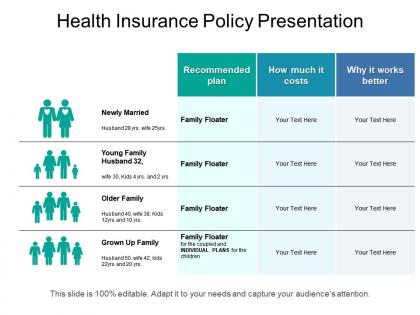
Showcase the benefits of reimbursement of medical expenses by using Health Insurance Policy Presentation. Mention different types of health insurance companies by including claims ratio and grievances resolved. Also, mention what is not covered in health insurance. Describe the types of health insurance such as traditional health insurance, managed care, fee-for-service, etc. Showcase the tips to improve the billing insurance claim in this medical billing workflow. You can also, discuss the need for health insurance such as to make quality treatment affordable, cashless service, tax benefits, etc. Highlight the steps to plan health insurance by utilizing this policy PPT layout. Also, list down the steps for getting life insurance. Discuss what to look for in a life insurance policy like policy benefits, pricing, and premiums, additional services, and customer support. Showcase the advantages of life insurance and make your presentation attention-grabbing. Thus, understand the process of claiming health insurance by downloading this ready to use agreement PPT presentation.
People who downloaded this PowerPoint presentation also viewed the following :
Health insurance policy presentation with all 5 slides:
Highlight causes of fixation with our Health Insurance Policy Presentation. Advise folks to avoid a dogged approach.
FAQs for Health
So basically PPOs let you see whoever you want without jumping through hoops, plus you get some out-of-network coverage. But you're gonna pay more in premiums and deductibles. HMOs are way cheaper but you're stuck with their network of doctors, and don't even get me started on needing referrals for everything - even just seeing a dermatologist becomes this whole process. I'd honestly check if your current doctors are covered first because switching providers sucks. PPOs = more freedom but pricier. HMOs = budget-friendly but restrictive.
Honestly, first figure out how much you actually use healthcare - doctor visits, meds, any ongoing stuff. The phone plan comparison is so real though! Check if your current doctors are in the network because switching sucks. Then there's the whole deductible vs premium game - can you handle a big upfront cost or do smaller monthly payments work better? Oh and mental health coverage matters more than people think. I'd literally make a list of what you absolutely need versus what would just be nice to have. Makes the whole thing way less overwhelming when you're comparing plans.
So preventive care is all that routine stuff - checkups, vaccines, screenings, you know the drill. Your insurance has to cover most of it 100%, no copay or anything. Pretty sweet deal honestly. The whole point is catching problems early instead of dealing with expensive disasters later. I know going to the doctor when you feel fine seems weird, but definitely use your free annual physical. Same with mammograms, colonoscopies, whatever's recommended for your age. My mom always says it's like free money just sitting there waiting for you.
Yeah, so age is the big one - premiums go up as you get older since you'll likely need more care. Where you live makes a huge difference too. NYC vs some small town in Ohio? Totally different costs. The good news is insurers can't jack up your rates for pre-existing conditions anymore thanks to the ACA - honestly such a relief for people. They can still charge smokers more though. Your zip code and age are basically what determine your premium now. Oh, and definitely shop around when you're looking because prices vary like crazy between companies for similar plans.
Ugh, high-deductible plans are such a mess for patient care. People straight up avoid treatment because of those crazy upfront costs. They'll skip preventive stuff, put off procedures they actually need, or ration their meds - which is honestly backwards since that's literally what insurance should prevent. Then everything gets worse and costs more down the road. Weirdly, ER visits go up because patients wait until they're basically dying. If you're seeing lots of these plans in your practice, maybe bring up cost worries early so you can help them figure out what's actually urgent vs what can wait.
So the ACA changed things pretty significantly. Now you can buy insurance through Healthcare.gov even without employer coverage, and they can't reject you for pre-existing conditions anymore - which is huge. Income-based subsidies are a thing too, might make it way cheaper than you think. Oh, and you can stay on your parents' plan until 26 now. Honestly saved my butt after graduation lol. Definitely look into those subsidies first when you're shopping around. The whole system's still kinda messy but at least there are more options now.
The usual suspects are pre-existing conditions (ACA helped with this though), cosmetic stuff, and experimental treatments. Alternative medicine like acupuncture gets the boot too. Dental and vision? Separate policies - found out the expensive way when I needed contacts. Mental health coverage improved but still has session limits sometimes. Fertility treatments and weight loss surgery often aren't covered either. Oh, and certain prescription drugs get excluded too. Honestly, insurance companies are sneaky about hiding this stuff in your Summary of Benefits, so actually read through it or you'll get screwed later.
Okay so first thing - check if your doctors are actually in-network because getting hit with surprise bills is literally the worst thing ever. Compare the obvious stuff too: monthly premiums, deductibles, max out-of-pocket costs. Don't automatically pick the cheapest option though. Sometimes paying more monthly actually saves you money if you see doctors a lot. Oh and definitely look at prescription coverage if you take any meds regularly. Most insurers have these calculator tools where you can plug in your expected doctor visits and stuff - super helpful for seeing what you'd actually spend over the whole year.
Yeah so short-term plans are super cheap and you can get them like immediately. But they're basically garbage coverage tbh. No pre-existing conditions covered at all, and they skip stuff like maternity or mental health entirely. Oh and they can straight up reject you if you're not healthy enough. I mean, they work fine if you just need something between jobs or whatever. But seriously read everything because I've seen people think they had decent coverage only to find out it covered basically nothing when they actually needed it.
You can't have an HSA without a high-deductible health plan - they're basically married to each other. Since you're stuck paying more upfront costs with the high deductible, the HSA lets you stash away pre-tax dollars to handle those expenses. For 2024 it's $4,300 for individuals, $8,550 for families. Money rolls over every year and grows tax-free. Oh, and after 65 you can raid it for whatever without penalties, which is honestly pretty sweet. If you've got the cash flow, definitely max that thing out - it's one of the better tax breaks out there.
Ugh, that sucks! First thing - read that denial letter super carefully to see what their actual reason is. Call your doctor's office too, sometimes it's literally just a stupid coding mistake they can fix in 2 minutes. You'll probably need to file an appeal though. Check your policy for the deadline (usually around 60 days). Keep copies of everything because insurance companies are sneaky like that. Don't give up after one appeal - they have multiple levels and honestly seem to hope you'll just quit. If they keep being jerks about it, your state insurance commissioner can actually put some real pressure on them.
Honestly, it's such a pain figuring out mental health coverage. Your plan might be decent or it might suck - there's no way to know without digging into it. Yeah, they're supposed to cover mental health the same as regular doctor visits, but good luck with that lol. Some let you see a therapist for like $20, others make you pay everything until you hit your deductible (which could be thousands). The worst part? Half the good therapists aren't even in your network. Do yourself a favor and call them now to ask about benefits. Trust me, you don't want to be googling this stuff when you actually need help.
So insurance companies are finally catching up with telehealth - it's not just pandemic stuff anymore, it's here to stay. Most plans now cover virtual visits permanently, plus mental health apps and remote monitoring for things like diabetes. Honestly, it's pretty convenient once you get used to it. Your insurance might cover way more telehealth services than you realize now. The thing is, people expect these options - my mom does all her follow-ups virtually now and loves it. Just double-check what your specific plan covers before you actually need a virtual appointment, because coverage varies quite a bit between insurers.
So basically insurance networks are just lists of doctors/hospitals where you'll pay way less. In-network usually means you're only paying like a copay or whatever. Out-of-network though? You're gonna get hit with the full bill or close to it. I learned this the hard way lol. Bigger networks give you more options obviously, but even then your favorite specialist might not be included. Super annoying when you finally find a doctor you actually like. Before you pick any plan, definitely check if your current doctors are covered first. Nobody wants to start doctor shopping just because they switched insurance.
Honestly, start with your budget - what can you actually spend on premiums without going broke? Then survey your employees about what they actually want. Different age groups care about totally different stuff. Get quotes from maybe 3-4 companies and compare the basics first. Don't dive into all the fine print right away or you'll lose your mind. Coverage-wise, medical is obvious but think dental, vision, mental health too. I know it seems overwhelming but most people overthink this process way more than they need to.
-
Use of icon with content is very relateable, informative and appealing.
-
Easily Understandable slides.