

Buy Side M And A Pitch Book Ppt Template





Try Before you Buy Download Free Sample Product
 Impress Your
Audience
 100%
Editable
 Save Hours
of Time


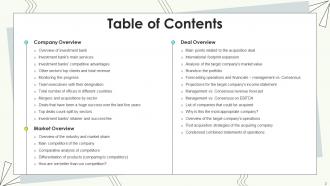
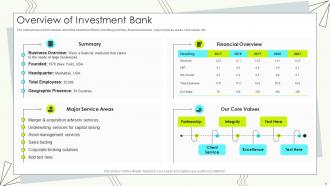
The merger and acquisition M and A process may either be lengthy or short. It is common for it to take several years for transactions involving two major organizations with global operating footprints. The buying side applies broadly to fund managers, often referred to as institutional investors. They collect capital from investors and spend the money using various trading strategies across different asset classes. Our Buy Side M and A PitchBook provides various slides related to the acquisition of one company by another. It includes slides associated with the introduction of the company, such as the introduction of the investment bank, primary services provided, competitive advantages, significant clients, measuring the progress, top management team, and many more. This ppt shows the major successful deals done by the company in the past five years, and it also includes the retainer and success fee of investment banks. The presentation also covers the market overview in which various slides include the industry overview, top competitors of the company, comparison with the competitors, product differentiation, and how the investment bank is better than its competitors. In the end, this module highlights the business overview of the target company, post-acquisition plans, and Pro-forma condensed combined statements of operations. Get access now.
People who downloaded this PowerPoint presentation also viewed the following :
Content of this Powerpoint Presentation
Slide 1: This slide introduces Buy Side M&A (Pitch Book). State your company name and begin.
Slide 2: This slide shows Table of Content for the presentation.
Slide 3: This slide highlights title for topics that are to be covered next in the template.
Slide 4: The slide shows a brief overview about the Investment Bank.
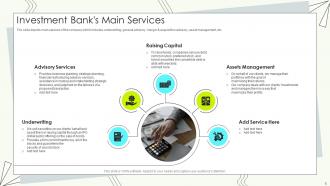
Slide 5: This slide presents Investment Bank's Main Services.
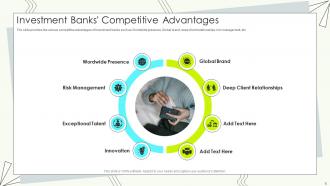
Slide 6: This slide displays Investment Banks' Competitive Advantages.
Slide 7: This slide represents Other Sectors' Top Clients and Total Revenue.
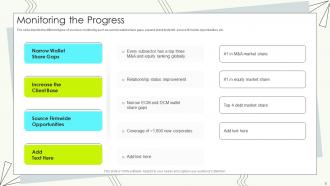
Slide 8: The slide depicts the different types of success monitoring.
Slide 9: This slide showcases Team Executives with their Designation.
Slide 10: This slide shows Total Number of Offices in Different Countries.
Slide 11: This slide presents Mergers and Acquisitions by Sector.
Slide 12: This slide displays Deals that Have Been a Huge Success Over the Last Five Years.
Slide 13: This slide represents Current Deals Count by Sectors.
Slide 14: This slide showcases Investment Banks' Retainer and Success Fee.
Slide 15: This slide highlights title for topics that are to be covered next in the template.
Slide 16: This slide shows Overview of the Industry and Market Share.
Slide 17: This slide presents Main Competitors of the Company.
Slide 18: This slide displays Comparative Analysis of Competitors.
Slide 19: The slide shows the product's primary distinguishing features (product differentiation) in comparison to its competitors.
Slide 20: The slide compares the company's primary strengths.
Slide 21: This slide highlights title for topics that are to be covered next in the template.
Slide 22: This slide presents Main Points Related to the Acquisition Deal.
Slide 23: This slide displays International Footprint Expansion.
Slide 24: This slide represents Analysis of the Target Company's Market Value.
Slide 25: The slide lists the brands that are part of the company's portfolio.
Slide 26: The slide shows the company's operations and financial forecasts from management and Consensus.
Slide 27: This slide presents Projections for the Target Company's Income Statement.
Slide 28: This slide displays Management vs. Consensus Revenue Forecast.
Slide 29: This slide represents Management vs. Consensus on EBITDA.
Slide 30: This slide showcases List of Companies that Could be Acquired.
Slide 31: The slide outlines the important considerations for selecting the best firm for purchase.
Slide 32: This slide shows Overview of the Target Company's Operations.
Slide 33: This slide presents Post Acquisition Strategies of the Acquiring Company.
Slide 34: This slide displays Condensed Combined Statements of Operations.
Slide 35: This slide contains all the icons used in this presentation.
Slide 36: This slide is titled as Additional Slides for moving forward.
Slide 37: This is Our Mission slide with related imagery and text.
Slide 38: This slide presents Bar chart with two products comparison.
Slide 39: This is Our Team slide with names and designation.
Slide 40: This slide contains Puzzle with related icons and text.
Slide 41: This is a Timeline slide. Show data related to time intervals here.
Slide 42: This slide provides 30 60 90 Days Plan with text boxes.
Slide 43: This is a Thank You slide with address, contact numbers and email address.
Buy Side M And A Pitch Book Ppt Template with all 48 slides:
Use our Buy Side M And A Pitch Book Ppt Template to effectively help you save your valuable time. They are readymade to fit into any presentation structure.










FAQs for Buy Side M And A Pitch
So basically you need an exec summary with your investment thesis, company overview with all the financials, market analysis showing growth potential, and solid valuation using different methods. The strategic rationale is huge - explain why this actually makes sense beyond just the numbers. Oh, and don't cheap out on the risk section like everyone does. Buyers love when you're upfront about potential issues. Throw in some comparable deals to back up your valuation range. Charts and visuals are your friend here - nobody's reading dense paragraphs when they're trying to decide on deals. Finish with clear next steps and timeline.
Honestly, it's all about knowing your audience. Investors want the money stuff upfront - ROI, valuations, all those deal metrics that prove they'll make bank. Management teams? They're sweating the operational stuff like integration plans and cultural fit (let's be real, they mostly just want to know if they'll still have jobs). Board members are different - hit them with the big picture strategy first. Why now? How does this fit our long-term plans? Same presentation, just flip the order around depending on who you're talking to. Oh, and don't bury the lead with whatever group you're presenting to.
Market analysis is what makes your whole M&A pitch actually believable. Without it, you're basically guessing at valuations and hoping nobody calls you out (spoiler: they will). It shows you understand the industry, competition, and where your target fits. Plus it backs up your strategic reasoning and pricing decisions. Growth trends, risks, market dynamics - all that stuff needs to connect to why this deal makes sense right now. Oh and make sure it tells a coherent story, not just random data points thrown together.
Look, visuals will save your ass in M&A pitch books. Nobody wants to stare at endless spreadsheets - trust me on this one. Use process flows for deal timelines and comparison charts to show synergies. Market maps work great for competitive stuff too. I've literally watched executives flip right to the infographics and ignore everything else. Makes sense though, right? They're slammed with meetings all day. Focus on maybe 2-3 really solid visual pieces that tell your story: market opportunity, why this deal makes sense, and how you'll create value. Way more effective than walls of text.
Dude, the two big things that kill these presentations: cramming way too much shit in there, and using those boring templates that look like every other deck. Nobody wants to sit through 50 slides of every single metric you found. Focus on what actually matters for THIS specific deal - the real value drivers and why it makes sense strategically. Also, please don't use outdated comparables from 2019 or whatever. Makes you look sloppy. Your valuation methods need to actually fit the company's business model too. I've seen people try to comp a SaaS company with manufacturing firms - just doesn't work. Keep it tight and make it custom.
Start with your three scenarios - base, upside, downside - right at the top. Waterfall charts work great for showing revenue, EBITDA, and FCF flow. Trust me, double-check that everything ties out properly (I've been burned by sloppy math before). Bridges and sensitivity tables help illustrate your key drivers. Don't go crazy optimistic with projections. Buyers will shred anything unrealistic. Oh, and throw in some visual elements to break up all the numbers - makes it way easier to follow. Finish with a side-by-side comparison table so they can see the full range quickly.
Your DD findings are literally what make or break your M&A pitch book. Without them, you're just asking people to "trust me bro" on a million-dollar deal. The findings back up your valuation, spotlight the big risks and wins, and prove you actually know what you're talking about. They help you tell a solid story about synergies and justify why you're pricing things the way you are. Plus you'll anticipate buyer pushback before they even open their mouths. Don't just stick the good stuff in an appendix though - weave those insights throughout the whole presentation.
Think of it like telling a story that actually makes sense. Executive summary first, obviously. Then paint the big picture with market overview and industry stuff. After that, dig into the target company - their financials, where they stand competitively, what's driving growth. Here's where most people mess up - they jump straight to valuation, but you need that foundation first. Deal rationale and synergies come next, then financing structure. Wrap it up with timeline and next steps. Honestly, clear headers are your best friend here. You don't want anyone getting lost halfway through wondering why this deal isn't completely insane.
Focus on revenue growth, EBITDA margins, and return on invested capital first - those are your bread and butter. Customer retention and lifetime value are huge too since buyers go crazy for predictable revenue. Cash conversion cycle shows how well operations actually run. Honestly depends on your industry, but mix historical numbers with forward-looking stuff. Market share data helps put everything in context against competitors. Oh, and working capital efficiency matters more than people think. Just pick metrics that actually back up your valuation story. No point throwing in random KPIs that don't support your thesis.
Look, you can't just wave around huge synergy numbers and expect people to buy it. Break them down into buckets - revenue gains, cost cuts, maybe tax stuff. Then get specific with real examples. Instead of saying "cross-selling worth $50M," actually show which products you're talking about and what customer segments make sense. Honestly, everyone's seen synergies fail to materialize, so be conservative with your estimates. Map out exactly how you'll capture each one with timelines. Oh, and assign confidence levels to each bucket - that shows you're being realistic about execution risk.
Your pitch book needs to be clean and scannable - stick with consistent fonts and give it breathing room with white space. One key message per slide, that's it. Charts should be dead simple with clear labels. For colors, go professional: navy, gray, white. Honestly, I've seen way too many that look like someone threw up a rainbow on PowerPoint and clients just roll their eyes. Hit them hard with your exec summary upfront since half the time that's all they'll actually read. Bullet points beat paragraph walls every time. Oh, and definitely print a test copy first - screen formatting can look awful on paper.
Honestly, the biggest time-saver is automating all that repetitive crap. Data viz tools can pull your financial models straight into charts without you rebuilding everything from scratch. Template builders keep your formatting consistent - saves you from that annoying back-and-forth with formatting fixes. AI writing tools help knock out first drafts of content sections too. Oh, and collaborative platforms are clutch since your whole team can work on different slides at once instead of emailing versions back and forth (nightmare fuel). I'd figure out what part of your process takes forever, then find something that specifically fixes that pain point first.
Comp analysis is huge for M&A pitches - it's how you show where the target sits versus its peers on margins, growth, all that stuff. Clients love seeing the full competitive landscape laid out. Those comps feed directly into your trading and transaction multiples, which obviously drives your whole valuation. Just don't be lazy about picking comparables though. I've seen people grab random companies from CapitalIQ that aren't even close to similar. Takes like 10 extra minutes to find actual peers but makes your pitch way more credible.
Honestly, stories work because people buy with their gut first, then justify with logic later. Start with the problem everyone's feeling right now. Then show how your deal fixes everything. Paint that post-merger picture where life is suddenly amazing - like the acquisition literally saves the company from disaster. Skip the endless spreadsheets for a sec and use real examples people can actually picture. I mean, every single slide should push this story forward somehow. Structure the whole thing so they're practically nodding along, thinking "yeah, we've gotta make this happen" by the end. It's way more convincing than just dumping data on them.
Dude, watch out for any non-public info - only use stuff that's already out there publicly. All your financial data and research needs to come from legit sources you can actually cite. Forward-looking statements? Better slap some disclaimers on those or the lawyers will have a field day. Don't make it sound like investment advice either - you're just analyzing, not telling people what to buy. Honestly, I'd probably show it to legal first. The SEC stuff can get messy fast, and nobody wants that headache.
-
Designs have enough space to add content.
-
“The presentation template I got from you was a very useful one.My presentation went very well and the comments were positive.Thank you for the support. Kudos to the team!”