

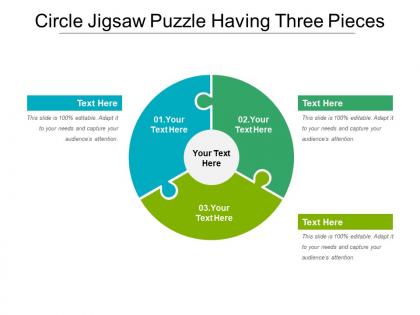
Circle jigsaw puzzle having three pieces





Try Before you Buy Download Free Sample Product
 Impress Your
 Audience
 100%
100% Editable
 Save Hours
 of Time


We present to you this simple yet eye - catching Circle Jigsaw Puzzle Having Three Pieces to show any process with three stages. This template has a wide application as it can be used aptly for presenting a process where all the three stages are inter – connected and work in tandem to each other. A jigsaw puzzle arouses curiosity in the mind of the audience. This design will help you get the attention of your audience effortlessly. Half the battle won, putting your point across will no longer remain a challenge for you with the effective template. This puzzle diagram can be used to show a production process, sales plan, marketing strategy or any such process in the organization. So, click the download button now! Folks enjoy having a good grin due to our Circle Jigsaw Puzzle Having Three Pieces. It helps add a comic angle.
People who downloaded this PowerPoint presentation also viewed the following :
Circle jigsaw puzzle having three pieces with all 5 slides:
Judge from every angle with our Circle Jigsaw Puzzle Having Three Pieces. Investigate every facet of the issue.

FAQs for Circle jigsaw puzzle
Honestly, circle puzzles are way better than regular ones for kids! The curved pieces make them think totally differently about how everything fits together. My students who normally work solo suddenly start teaming up when they hit those weird curved sections - it's pretty cool to watch. They're definitely harder though, which actually helps with patience and fine motor stuff. I'd start small with younger kids since they can get frustrated easily. The spatial reasoning benefits are legit - way better than rectangular puzzles for building those skills.
Oh, circle puzzles are awesome for kids! The curved pieces make them way harder than regular puzzles - your kid's brain has to work differently since there's no straight edges to rely on. Really builds up their spatial skills and problem-solving. Plus the fine motor stuff from handling all those weird-shaped pieces. Honestly, I think they're more satisfying to finish than square ones? Something about that circular completion feels really good. Start with like 50 pieces for little kids though - don't jump straight into the crazy detailed ones. They'll get frustrated and give up. But once they get it, their confidence shoots up.
Okay so you'll want consistent piece sizes and some kind of center reference point to start from. I tried one of these last month and honestly they're way harder than regular puzzles! Your cutting pattern needs tabs that curve with the circle - none of that straight-edge stuff. Color gradients help too, or maybe pattern markers at different distances from the center. The edge pieces should obviously look curved so people know they're outer pieces. Oh, and forget corner-hunting strategies since there aren't any corners. Give people visual anchors they can actually spot and work with instead.
Oh man, circle puzzles are wild! You can't use corners or edges like normal, so you're stuck relying on colors and patterns. My brain definitely works harder without those reference points. Honestly pretty frustrating when you first try one – I may have cursed at mine a few times. But that's what makes them way more challenging than regular puzzles. The cool thing is there's no "right way up" so it feels more meditative somehow? You just flow with it. Start with fewer pieces though, trust me on that one.
Sort by color and edges first - gives you some easy wins to start. The curved pieces are weird at first but honestly once you figure out the subtle differences it's pretty satisfying. Look for faces, text, or distinctive objects since those become your anchor points. You'll need way better lighting than normal puzzles because of how the pieces curve. I like setting up little piles around my workspace so I'm not constantly reaching over everything. Oh and definitely work in shorter sessions - your eyes will thank you later. The circular thing messes with your depth perception more than you'd think.
Circle puzzles are perfect for little kids (like 3-8) and seniors, honestly. Kids find them way less scary than regular rectangular ones - no hunting for corner pieces! The round shape just naturally draws them to work from the center out, which actually helps them get spatial stuff better. Seniors love them too because they're not overwhelming but still give their brains a good workout. Oh, and they're amazing for people with dementia or anyone who has trouble with fine motor skills. My aunt does them all the time now. Just grab ones with bigger pieces if you're starting out - makes everything easier.
Honestly, circle puzzles are amazing for stress relief! Without corners to anchor you, your brain has to focus way harder on colors and patterns - which basically shuts up all that anxious mental chatter. Working toward the center feels weirdly satisfying too. The whole sorting and piecing thing is super repetitive in a good way, plus you get those little wins when sections click together. I'm telling you, it's like meditation but actually fun. Start with maybe 500 pieces next time you're stressed. You'll probably crash and sleep like a rock afterward!
Dude, circle puzzles are actually perfect for this! Everyone has to talk and work together constantly since you can't just hide in a corner doing your own section. Way less intimidating than those giant landscape ones too - honestly who has time for 1000 pieces? You'll spot your natural leaders pretty quick, and the quieter people usually surprise you. There's something cool about everyone working toward the same center point. Grab like a 400-piece one for your next team thing. Trust me, it beats awkward icebreakers any day.
Oh man, circular puzzles are so fun to design! Mandala patterns work amazingly well, or you could do clock faces, solar systems, aerial shots of places like the Colosseum. I'm obsessed with seasonal ones - picture spring flowers in the center that gradually shift to winter snow at the edges. Food themes are weirdly perfect too... pizza slices, layered cakes, or looking down at a dinner plate. The best part? You can tell a visual story from the center outward. Just sketch something with a strong focal point first, then figure out how everything else radiates from there.
Oh man, circle puzzles are SO much harder! You lose all those straight edges that usually save your life. No corners, no clear borders - it's honestly brutal at first. The curved edge pieces all look weirdly similar too, which is just cruel. I'd skip trying to build the border first like you normally would. Instead, jump into the obvious stuff - bright colors, faces, weird patterns, whatever stands out. You'll end up relying way more on tiny details and piece shapes. It's frustrating but kind of addictive once you get the hang of it!
Honestly, thick cardboard is your best bet - go for at least 2mm or recycled chipboard. The pieces actually snap together nicely instead of feeling cheap. Wood's obviously amazing if you can swing the cost, birch plywood especially, but man it gets expensive to produce. I'd probably start with 2mm chipboard and see what people think. Oh, and for the image part - laminated paper or direct UV printing work great. Just don't go with thin cardboard, that stuff warps like crazy and you'll end up with sad floppy pieces. Trust me on that one.
Dude, there's actually some pretty cool tech stuff for circle puzzles now. AR apps let you scan pieces for hints - honestly kind of feels like cheating but whatever works, right? Some puzzle boxes have QR codes that unlock videos showing how it all comes together. There are even these hybrid things where you solve part digitally first, then they mail you the physical version. Weird but neat concept. Oh, and puzzle tracking apps help you time yourself and share pics with other puzzle nerds. Just search "AR puzzle helper" if you want to try it out on your next one.
Oh man, circle puzzles are amazing for spatial skills! You can't rely on those usual straight edges anymore. Everything's curved, so you're basically doing mental gymnastics trying to figure out how pieces connect. Honestly, it messes with your head at first - I remember staring at pieces forever. But that's the whole point! Your brain has to work differently when you're dealing with radial patterns instead of typical grid stuff. You'll find yourself rotating pieces mentally way more than normal puzzles. Start with something around 500 pieces though - don't jump into the crazy big ones right away.
Oh definitely go with mandalas - they're everywhere right now with the whole meditation craze. Celestial stuff works great too, like moon phases or star maps. Nature scenes are solid choices. Honestly though, avoid anything that's obviously meant to be rectangular, like landscapes - they just look forced when crammed into a circle. Abstract geometric patterns are pretty cool if you're into that. Pro tip: pick something with a clear center point that radiates outward. Makes the whole solving process way more satisfying when everything flows from the middle out.
Oh, circle puzzles are actually perfect for this! The round shape feels way more meaningful to complete than regular rectangular ones - there's something almost spiritual about it. I'd start with 100-piece ones so people don't get overwhelmed. What's cool is you can have clients pick images that speak to their current emotions or goals, then talk through what comes up while they're working. The whole process is super meditative too, which anxious clients really need. Honestly, I've even seen therapists have people make their own circular puzzles from personal artwork, though that might be getting a bit fancy for beginners.
-
Great product with highly impressive and engaging designs.
-
Great quality slides in rapid time.