


Civil engineering contractors powerpoint presentation slides




Try Before you Buy Download Free Sample Product
 Impress Your
 Audience
 100%
100% Editable
 Save Hours
 of Time


To become a leading construction company in the global market, to attain excellence in the quality and complete value-added projects on time use our Civil Engineering Contractors PowerPoint Presentation Slides. Use the construction company PPT template to showcase an overview of your company, explain mission, vision, values and milestones. Ensure the presence of important construction documents like engineering license, health and safety policy, and environment management policy with this real-estate PowerPoint layout. The building company PPT graphic provides the crucial challenges faced by the company like limited skills capabilities, delays in construction time, lack of proper organization, and financial problems along with the solutions to overcome them. Elucidate a detailed presentation preconstruction services, construction and infrastructure services and post-construction services to build an edge over the competitors and analyze the construction cost structure with our PowerPoint slideshow. Help your workforce with this project timeline PPT design by giving them a weekly work schedule planning, construction project Gantt chart, project budget schedule, subcontractor documentation tracker.
People who downloaded this PowerPoint presentation also viewed the following :
Content of this Powerpoint Presentation
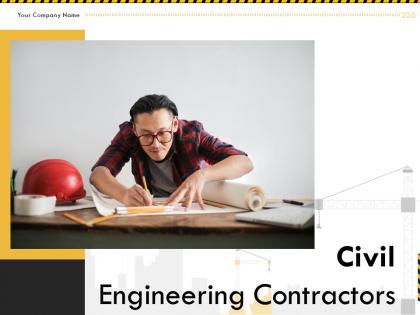
Slide 1: This title slide introduces the Civil Engineering Contractors. Add the name of your company here.
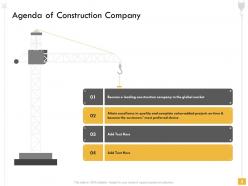
Slide 2: This is the Agenda slide of the Construction Company. It includes - Become a leading construction company in the global market, Attain excellence in quality and complete value-added projects on time, etc.
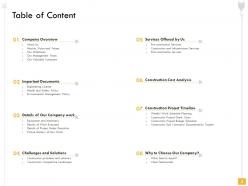
Slide 3: This slide contains the Table of Content. It includes - Company Overview, Important Documents, Details of Our Company work, etc.
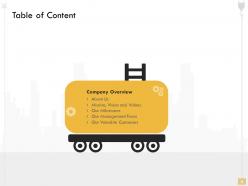
Slide 4: This is a table of content slide showing the Company Overview
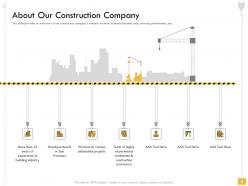
Slide 5: This slide presents About Our Construction Company. It provides an overview of our construction company’s wherein we have covered founded year, services, achievement, etc.
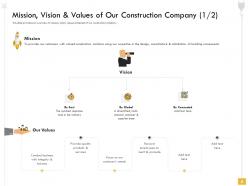
Slide 6: This slide presents the Mission, Vision & Values of Our Construction Company (1/2). It provides an overview of the mission, vision, values statement of our construction company.
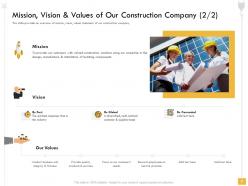
Slide 7: This slide presents the Mission, Vision & Values of Our Construction Company (2/2).
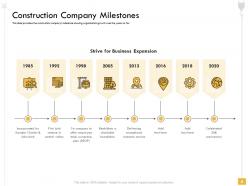
Slide 8: This slide presents the Construction Company Milestones. It provides the construction company’s milestone showing organizational growth over the years so far.
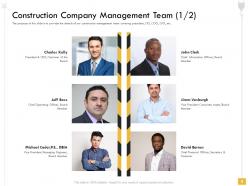
Slide 9: This slide presents the Construction Company Management Team (1/2). It provides the details of our construction management team covering the president, CIO, COO, CFO, etc.
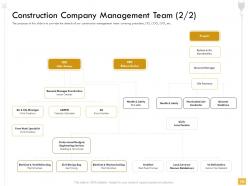
Slide 10: This slide presents the Construction Company Management Team (2/2).
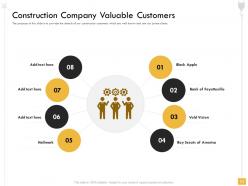
Slide 11: This slide presents the Construction Company Valuable Customers. It provides the details of our construction customers who are well known and are our prime clients.
Slide 12: This is a table of content slide showing the Important Documents.
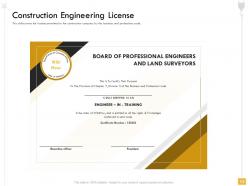
Slide 13: This slide presents the Construction Engineering License. It covers the license permitted to the construction company by the business and professions code.
Slide 14: This slide presents the Company Health & Safety Policy. It provides the list of health and safety commitment policies offered by our construction company such as special training to managers and foremen, regular safety meetings, etc.
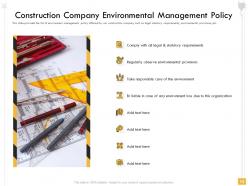
Slide 15: This slide presents the Construction Company Environmental Management Policy. It provides the list of environment management policies offered by our construction company such as legal statutory requirements, environmental provisions, etc.
Slide 16: This is a table of content slide showing the Details of Our Company work.
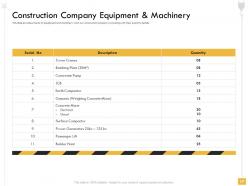
Slide 17: This slide presents the Construction Company Equipment & Machinery. It provides the list of equipment and machinery which our construction company owns along with their quantity details.
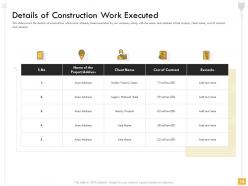
Slide 18: This slide presents the Details of the Construction Work Executed. It covers the details of construction which have already been executed by our company along with the name and address of the project, client name, cost of contract and remarks.
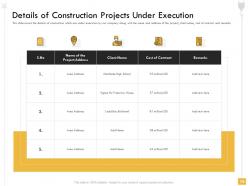
Slide 19: This slide presents the Details of Construction Projects Under Execution. It covers the details of construction which are under execution by our company along with the name and address of the project, client name, cost of contract and remarks.
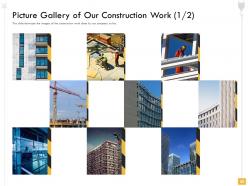
Slide 20: This slide presents the Picture Gallery of Our Construction Work (1/2). It showcases the images of the construction work done by our company so far.
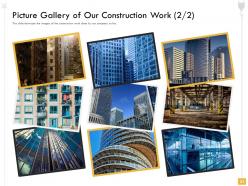
Slide 21: This slide presents the Picture Gallery of Our Construction Work (2/2).
Slide 22: This is a table of content slide showing the Challenges and Solutions.
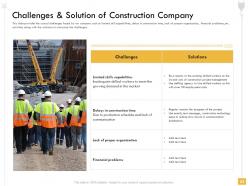
Slide 23: This slide presents the Challenges & solutions of Construction companies.
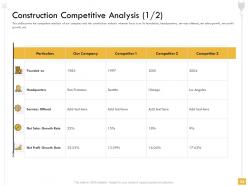
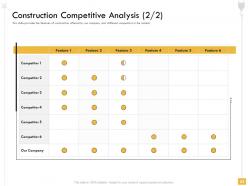
Slide 24: This slide presents the Construction Competitive Analysis (1/2). It covers the competitor analysis of our company and the construction industry wherein focus is on its foundation, headquarters, services offered, net sales growth, net profit growth, etc.
Slide 25: This slide presents the Construction Competitive Analysis (2/2).
Slide 26: This is a table of content slide showing the Services Offered by Us.
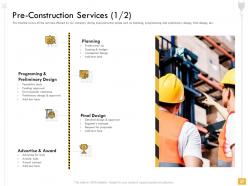
Slide 27: This slide presents the Pre-Construction Services (1/2). This timeline covers all the services offered by our company during the preconstruction phase such as planning, programming, and preliminary design, final design, etc.
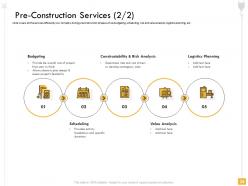
Slide 28: This slide presents the Pre-Construction Services (2/2).
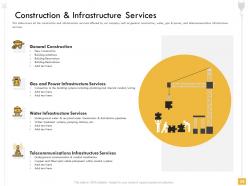
Slide 29: This slide presents the Construction & Infrastructure Services. It covers all the construction and infrastructure services offered by our company such as general construction, water, gas & power, and telecommunication infrastructure services.
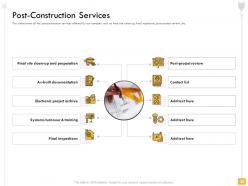
Slide 30: This slide presents the post-project review. It covers all the postconstruction services offered by our company such as final site clean-up, final inspection, post-project review, etc.
Slide 31: This is a table of content slide showing the Construction Cost Analysis.
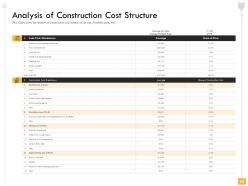
Slide 32: This slide presents the Analysis of the Construction Cost Structure. It covers the details of construction cost based on lot size, finished area, etc.
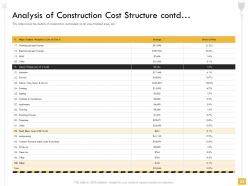
Slide 33: This slide presents the Analysis of Construction Cost Structure continued.
Slide 34: This is a table of content slide showing the Construction Project Timeline.
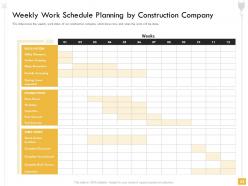
Slide 35: This slide presents the Weekly Work Schedule Planning by Construction Company. It covers the weekly work status of our construction company which shows how and when the work will be done.
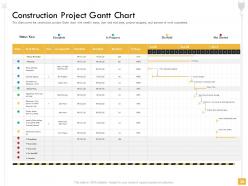
Slide 36: This slide presents the Construction Project Gantt Chart. It covers the construction project Gantt chart with weekly status, start and end date, project assigned, and percent of work completed.
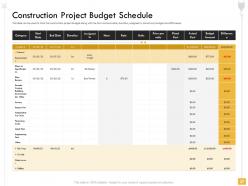
Slide 37: This slide presents the Construction Project Budget Schedule. It can be used to track the construction project budget along with the start and end date, duration, assigned to, actual cost, budget and difference.
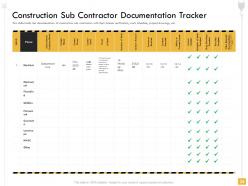
Slide 38: This slide presents the Construction Sub Contractor Documentation Tracker. It tracks the documentation of construction sub-contractors with their license verification, work schedule, project drawings, etc.
Slide 39: This is a table of content slide showing Why to Choose Our Company?
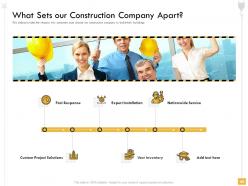
Slide 40: This slide presents What Sets our Construction Company Apart? It provides the reasons why customers must choose our construction company to build their buildings.
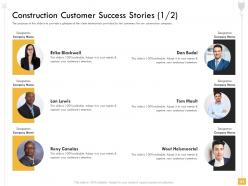
Slide 41: This slide presents the Construction Customer Success Stories (1/2). It provides a glimpse of the client testimonials provided by the customers for our construction company.
Slide 42: This slide presents the Construction Customer Success Stories (2/2).
Slide 43: This is the Icons Slide for Civil Engineering Contractors.
Slide 44: This slide introduces the Additional Slides.
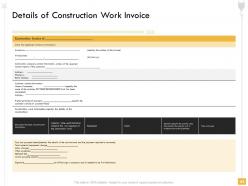
Slide 45: This slide presents the Details of Construction Work Invoice.
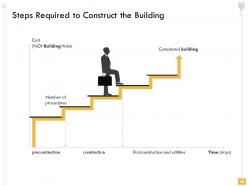
Slide 46: This slide presents the Steps Required to Construct the Building.
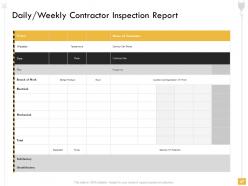
Slide 47: This slide presents the Daily/Weekly Contractor Inspection Report.
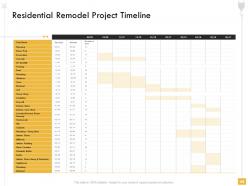
Slide 48: This slide presents the Residential Remodel Project Timeline.
Slide 49: This slide presents Our Goal.
Slide 50: This slide provides the Mission for the entire company. This includes the vision, the mission, and the goal.
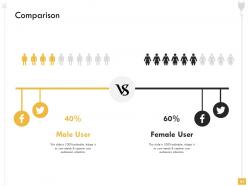
Slide 51: This slide presents the Comparison between male and female users of Facebook and Twitter.
Slide 52: This slide contains the information about the company aka the ‘About Us’ section. This includes Creative, Talented, and Professional.
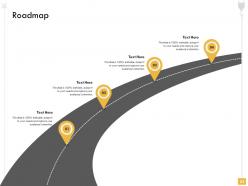
Slide 53: This slide is a Roadmap template to showcase the stages of a project, for example.
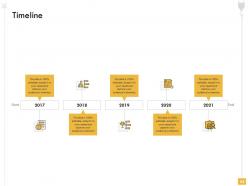
Slide 54: This slide is a Timeline template to showcase the progress of the steps of a project with time.
Slide 55: This is a Thank You slide where details such as the address, contact number, email address are added.
Civil engineering contractors powerpoint presentation slides with all 55 slides:
Use our Civil Engineering Contractors Powerpoint Presentation Slides to effectively help you save your valuable time. They are readymade to fit into any presentation structure.

FAQs for Civil engineering contractors
So first thing - make sure they've done stuff like your project before. Experience counts big time. Double check their licensing and insurance because nobody wants that headache later. Honestly, I've watched people go with the cheapest guy and totally regret it. Call their past clients, see how swamped they are right now, and check out their safety stats. Oh and pay attention to how they communicate during those first meetings - if they're flaky now, you're screwed when problems hit. Get three solid bids and actually compare the details, not just the bottom line.
Look for contractors who pull permits before starting anything - that's non-negotiable. Good ones hire code specialists and stay tight with local inspectors (seriously, those relationships can make or break a project). They build compliance checks into their schedule from day one instead of scrambling later. Most invest in ongoing training to keep up with regulation changes. Oh, and they'll gladly show you their permit history upfront - sketchy contractors get weird about that stuff. Municipal engineers become their best friends on bigger jobs. Smart money's on finding someone who treats inspectors like partners, not obstacles.
Dude, resource coordination is gonna be your biggest nightmare. Labor shortages, equipment issues, materials showing up late - it's like whack-a-mole. Weather kills your timeline. Permit delays? Even worse. Then clients change their minds halfway through and you're scrambling. Oh, and managing everyone's different expectations is exhausting. Honestly, the only thing that saves me is padding schedules with extra time upfront. Set clear communication rules from day one too, or you'll be putting out fires constantly. Trust me on this one.
Start with a risk register during planning - weather delays, soil issues, supply chain problems, all that fun stuff. Use a probability vs impact matrix to figure out what actually matters because honestly, you'll go crazy trying to plan for everything. For the big risks, have backup plans ready. Extra suppliers, weather buffers in your timeline, more soil testing if needed. Update your assessment as things change throughout the project - and trust me, they will change. Just document everything and keep your client and team in the loop about potential issues.
Dude, the tech stuff is completely changing construction right now. Drones knock out site surveys in hours instead of taking forever. BIM software spots design problems before you even start digging - which honestly saves so much headache later. Project management apps keep everyone on the same page, and GPS equipment basically drives itself now. Pretty wild to watch. IoT sensors track concrete curing and structural stress while AI handles scheduling optimization. Oh, and contractors who actually use this tech? They're crushing it compared to the old-school clipboard guys. Bigger projects, faster timelines.
So contractors basically tackle environmental stuff in two phases - planning upfront, then babysitting everything during construction. They'll do impact assessments first, grab permits, all that fun paperwork. Once they start building, it's constant monitoring: erosion control, waste management, air quality checks, making sure they're not messing with wildlife habitats. Honestly, the regulatory side is annoying but saves you from getting slammed later. Most crews have someone dedicated to tracking compliance now - they handle inspections and keep everything legit. My advice? Factor this stuff into your timeline from the start instead of scrambling later.
Honestly, you gotta break everything down super granular - materials, labor, equipment, all that stuff. Add at least 10-15% contingency because trust me, weird shit always pops up. Historical data from similar jobs will save your ass here. Walk the actual site before you price anything - I've been burned by relying on just photos and plans. They never show you the random pipe sticking out of the ground or whatever. Don't forget the boring stuff like permits and project management fees. Oh, and write down all your assumptions so when they inevitably change the scope, you can point back and say "well, this is what we agreed on."
So most contractors split quality control into two parts - preventing problems upfront versus catching them later through testing. They'll have dedicated QA/QC people who aren't actually building anything (keeps them honest). Everything gets documented like crazy because lawsuits are expensive. Testing happens at specific milestones, not just randomly. Honestly, if you're hiring someone, ask to see their quality plan before signing anything. Good contractors won't hesitate to show you - sketchy ones will make excuses. It's actually a pretty reliable way to separate the pros from the wannabes.
Performance bonuses work great - tie them to deadlines, safety goals, that stuff. Daily toolbox talks keep everyone on the same page. I'd do team rewards over individual ones honestly, since construction's all about working together anyway. Regular feedback sessions are huge too. Workers get pissed off fast when they feel ignored, so keep that communication flowing both ways. Oh and whatever system you pick, actually stick to it - nothing tanks morale like promising bonuses you don't deliver on.
Dude, communication literally makes or breaks everything. I can't stress this enough - keeping clients updated on progress and delays builds crazy amounts of trust. Construction's always full of surprises (we both know this), so when you're upfront about changes, you avoid those awful moments where what they expected is totally different from reality. Quick decisions on modifications become way easier too. Honestly, it saves you from expensive do-overs later. Your clients feel way more confident in you, plus it covers your ass legally. Just set up regular check-ins from the start and figure out how they prefer to communicate.
So when delays happen (and trust me, they always do), contractors have a few go-to moves. They'll look at the critical path first - what can be done faster or at the same time? Moving crews around helps too. Pull people from slower jobs to catch up where you're behind. Honestly, the best contractors already pad their schedules because they know something's gonna go wrong. Bringing in extra subs or equipment works if you've got the budget. Oh, and document everything! Keep everyone in the loop about new timelines or you'll just create more headaches later.
Honestly, most contractors I know keep about 3-5 solid vendors per trade that they trust, but they'll still shop around for big purchases because why wouldn't you? Timing's everything though - they order just enough ahead to avoid delays without paying for storage (learned that one the hard way). Payment terms are huge too, gotta match your cash flow or you're screwed. Always have backup suppliers. Seriously. Materials get delayed, vendors flake out, weird stuff happens. Oh and build those relationships early - when you're in a crunch, those connections save your ass.
Dude, contracts control literally everything in your project relationships. Payment terms, deadlines, who's screwed when stuff goes wrong - it's all in there. You're stuck delivering exactly what you promised or they can come after you for damages or kill the whole project. Every spec and change order becomes legally binding once you sign. Honestly? This is where so many contractors get totally screwed over by crappy contracts. Read every single clause before signing - especially the delay stuff and scope changes. Oh, and indemnification is huge. Get a lawyer for anything complicated because those things are written to protect them, not you.
So most civil contractors are getting into the sustainability thing now - they're using recycled materials, local stuff to cut down on shipping emissions, that kind of thing. Green infrastructure is huge too, like permeable pavements and low-carbon concrete. Some even run solar equipment which is pretty cool. They'll also design water systems that don't mess with local ecosystems as much. Honestly, when you're looking to hire someone, just ask them straight up about their green practices. The decent ones will have actual project examples and data to back it up, not just talk.
Honestly, sustainability stuff is becoming mandatory now - can't ignore it anymore. Digital twins and BIM are totally changing how projects get planned. Modular construction is finally having its moment too. AI's starting to help with scheduling, though half the "AI" tools out there are just fancy spreadsheets if we're being real. IoT sensors are making maintenance contracts way easier to manage. The labor shortage thing is pushing everyone toward automation faster than expected. Oh, and you'll definitely want to get up to speed on digital collaboration tools and green certifications to stay relevant.
-
Nice and innovative design.
-
Easily Understandable slides.
-
Enough space for editing and adding your own content.
-
Illustrative design with editable content. Exceptional value for money. Highly pleased with the product.
-
Out of the box and creative design.
-
Content of slide is easy to understand and edit.
-
Unique research projects to present in meeting.