


Commercial loan proposal powerpoint presentation slides




Try Before you Buy Download Free Sample Product
 Impress Your
 Audience
 100%
100% Editable
 Save Hours
 of Time


You can never have a second chance to build a good first impression on someone. Nowhere is that more important than the situation of you presenting a business loan proposal to a lender. Business loans are of great importance if an individual wants to establish a startup or extend an existing business. Plan in advance the steps you will follow to convert the opportunity in positive, as planning and preparation are essential to business loan success. Convince your investors to increase the working capital, acquire new machinery, build new infrastructure, and meet operational costs. It may take you several credit unions to fine-tune your presentation. Cut short the process, by developing a document as a prospective borrower and apply for a commercial loan with our Commercial Loan Proposal Powerpoint Presentation Slides. With our business loan proposal PPT slideshow, highlight your previous work experience and outline how the borrowed money would be utilized in the cover letter. Outline the project context and objectives and assure your investors that the investment is being utilised to pay returns. Gain the trust of the investors, by showcasing basic company overview, detailed description and partners history for a commercial loan proposal. A proper budget allocation and loan repayment plan can convince the investors exponentially. By using our loan proposal PowerPoint presentation elucidate the operational information like product, management, employee, facilities, marketing and distribution. Bring the clients attention to the financial historical information of your company. Along with this, you can also elaborate your company’s reputation with suppliers and customers in terms of the company’s reliability, credit-worthiness and fair business practices with this personal loan PPT layout. Submit a glitch-free presentation to your client by downloading our simple-to-use Commercial Loan Proposal Powerpoint Presentation Slides and increase your chances of getting a business loan.
People who downloaded this PowerPoint presentation also viewed the following :
Content of this Powerpoint Presentation
Slide 1: This slide introduces Commercial Loan Proposal. State Applicant name, Lender company name.
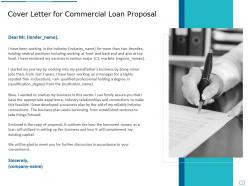
Slide 2: This slide displays Cover Letter for Commercial Loan Proposal
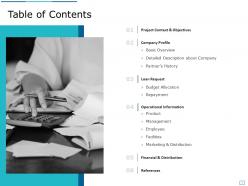
Slide 3: This slide shows Table of Contents of the presentation.
Slide 4: This slide depicts Table of Contents with- Project Context & Objectives
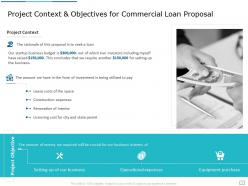
Slide 5: This slide showcases Project Context & Objectives.
Slide 6: This slide displays Table of Contents with- Company Profile, Basic Overview, Detailed Description about Company, Partner’s History.
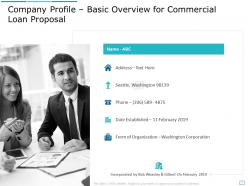
Slide 7: This slide depicts Company Profile – Basic Overview.
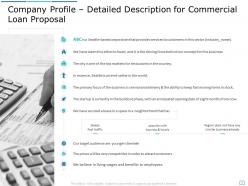
Slide 8: This slide showcases Company Profile – Detailed Description.
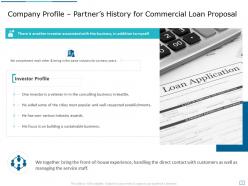
Slide 9: This slide showcases Company Profile – Partner’s History.
Slide 10: This slide displays Table of Contents
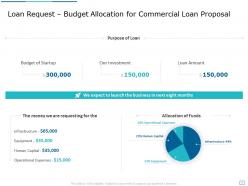
Slide 11: This slide showcases Loan Request – Budget Allocation for Commercial Loan Proposal
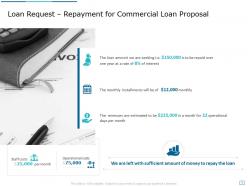
Slide 12: This slide showcases Loan Request – Repayment for Commercial Loan Proposal
Slide 13: This slide presents Table of Contents
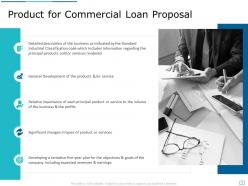
Slide 14: This slide displays Product for Commercial Loan Proposal. Detailed description of the business as indicated by the Standard Industrial Classification code which includes information regarding the principal products sold or services rendered
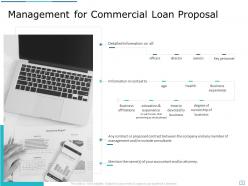
Slide 15: This slide shows Management for Commercial Loan Proposal
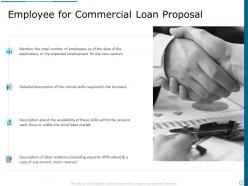
Slide 16: This slide shows Employee for Commercial Loan Proposal. Mention the total number of employees as of the date of the application, or the expected employment for the new venture
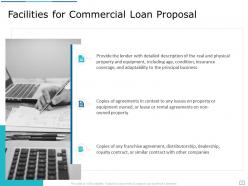
Slide 17: This slide displays Facilities for Commercial Loan Proposal
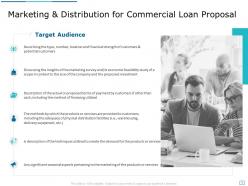
Slide 18: This slide presents Marketing & Distribution.
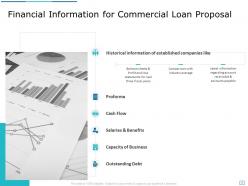
Slide 19: This slide showcases Table of Contents containing- Financial Information
Slide 20: This slide explains Financial Information.
Slide 21: This slide depicts Table of Contents
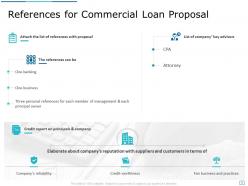
Slide 22: This slide showcases References. Depict the list of the Company's key advisor
Slide 23: This is Contact Us slide with Address Email address and Contact number.
Slide 24: This is Icons Slide for Commercial Loan Proposal.
Slide 25: This slide is titled as Additional Slides for moving forward.
Slide 26: This is About Us slide to showcase Company specifications.
Slide 27: This is Our Mission slide with Vision, Mission and Goal.
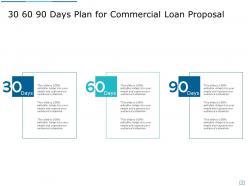
Slide 28: This is 30 60 90 Days Plan slide.
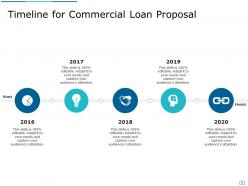
Slide 29: This slide depicts 5 years Timeline slide.
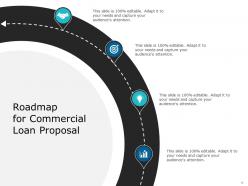
Slide 30: This slide shows Roadmap process.
Commercial loan proposal powerpoint presentation slides with all 30 slides:
Use our Commercial Loan Proposal Powerpoint Presentation Slides to effectively help you save your valuable time. They are readymade to fit into any presentation structure.




FAQs for Commercial loan proposal
So you'll need five main things for your loan proposal. Start with an executive summary and your specific loan request - what you need the money for. Financial statements from the last 3 years are mandatory, plus tax returns and cash flow projections (boring but they eat that stuff up). Throw in a solid business plan with management bios and some industry analysis to show you actually know your market. Oh, and don't forget collateral info. The whole thing should flow like one story about why lending to you makes sense. Put your best stuff first since some loan officers honestly just skim the rest.
Your cash flow forecasts and revenue projections are what make or break your loan application. Bankers will dig into those numbers to figure out if you can actually pay them back. Don't go crazy with overly optimistic estimates - they've seen every trick in the book. Keep it conservative and realistic. Show them you'll generate enough cash to cover payments without choking your operations. Oh, and document everything with clear assumptions. It makes you look like you actually know what you're doing instead of just winging it. Trust me, solid projections can save even mediocre proposals.
Dude, first thing - be super specific about what you need the money for. Lenders roll their eyes at vague "working capital" stuff. Your projections can't be totally unrealistic either (I've seen people way underestimate costs and it's obvious). Make sure your cash flow actually proves you can pay them back, not just scrape by. Don't try hiding existing debt or being sketchy about collateral - they'll find out anyway. Keep your personal finances organized too. Honestly, messy paperwork kills more deals than bad credit sometimes. Just be upfront about everything and triple-check before you submit.
Look, market analysis basically shows lenders you're not just throwing darts at a wall. You need solid data on your target customers, who you're competing against, and what's happening in your industry overall. Anyone can make up rosy sales projections, but research makes your numbers actually credible. Include demographic info, market size, competitive positioning - that stuff matters. Oh, and industry trends too, obviously. The whole point is proving market conditions support your ability to pay back the loan. Honestly, it's one of those things that separates serious applications from wishful thinking.
Okay so your credit history is huge for commercial loans - it's literally how they decide if you're worth the risk. Good credit gets you better rates and approval chances. Bad credit? You'll need killer financials and maybe more collateral to make up for it. Here's the thing though - sometimes strong business numbers can save you even with meh personal credit. I'd pull your credit reports now so you can fix any weird stuff before applying. Trust me, surprises during the application process suck.
Look, your executive summary is make-or-break time with lenders. Most of them decide in those first couple pages if they're gonna keep reading or toss your proposal aside. Hit the big stuff right away - how much you need, why your business rocks, and your payback plan. Keep it under 3 pages max. I always think of it like speed dating honestly - you've got minutes to impress before they move on. Lead with your strongest points and don't ramble. A tight, confident summary shows you know your stuff and aren't just winging it.
Okay so lenders basically want to see you know your numbers inside and out. Retail? Show them sales per square foot and how fast you turn inventory. Manufacturing guys need gross margins and capacity rates. Healthcare is weird but they love patient volume and reimbursement stuff - makes them feel like you actually get the business side. SaaS is all about monthly recurring revenue and what you spend to get customers. Pick maybe 3-4 metrics that prove you can generate steady cash flow. That's literally what they care about for repayment.
Dude, trust me on this - charts and graphs are a game changer when you're pitching to lenders. Those loan officers don't want to squint at spreadsheets all day. Bar charts show revenue comparisons super clearly, line graphs are perfect for growth trends, and pie charts break down your expenses or revenue streams. I bombed my first pitch because I just brought a stack of numbers (rookie mistake). Keep your visuals simple though - no crazy colors or effects that scream "I spent too long on this." Three or four solid charts that highlight your best financial story? That'll do it.
Break down every single dollar you're asking for - lenders absolutely hate when you throw out vague round numbers. Get quotes from vendors if you can and show detailed costs for equipment, inventory, whatever you're buying. Your cash flow projections need to prove the loan will generate enough revenue to cover payments plus some buffer. I've watched so many people crash and burn because they didn't back up their numbers. Oh, and explain your assumptions clearly - like why you think you'll hit those sales targets. Basically, prove you've actually thought this through instead of just winging it.
Cash flow docs are what they'll scrutinize most - bank statements, P&Ls, financial statements from the last 2-3 years. Your debt service coverage ratio calculations matter too since they want proof you can handle new payments on top of what you already owe. Oh, and cash flow projections obviously. More transparency = better odds, honestly. If your business has seasonal swings, definitely explain that upfront. I learned this the hard way - letting lenders figure out your revenue patterns themselves just makes them nervous for no reason.
Personal guarantees are honestly a game-changer for loan approval. Banks see it as you putting your money where your mouth is - literally staking your own assets on the business succeeding. Reduces their risk big time. You'll probably get better rates and quicker decisions because of it. The downside? You're personally on the hook if things go south, which can be scary as hell. But if you really believe in your business (and most of us do, right?), it's often worth it. Just don't sign anything you can't sleep on.
Dude, lenders are super picky about this stuff. You can't just write "business expansion" and expect them to hand over money - I've literally watched people crash and burn doing that. Break it down with real numbers: how much for equipment, inventory, working capital, whatever. They want to see you actually thought this through instead of just winging it. Oh, and make sure however you're planning to spend it connects to how you'll pay them back. Banks hate surprises, especially expensive ones.
Yeah, so banks want collateral worth about 100-125% of whatever you're borrowing. Real estate works great, equipment too - basically anything they can actually sell if you default. The appraisal process is honestly such a pain but you gotta do it. Don't try to guess what stuff is worth yourself - get the professional appraisals done early or you'll just waste time going back and forth later. Oh, and they'll definitely want personal guarantees from anyone who owns a decent chunk of the business. Accounts receivable counts as collateral too if it's solid. The paperwork is brutal but that's just how commercial loans work.
Put your best wins right up front - lenders want proof you can actually pull this off. Show them real numbers from past projects: profit margins, how you stayed on schedule, revenue bumps, whatever shows you know your stuff. Skip the generic "we're experienced" nonsense. Instead, tell them about that 15% market share increase or how you came in under budget three times running. Find similar deals you've closed, especially ones with comparable loan amounts. Honestly, the underwriter basically needs to think "okay, these folks have done this before" when they see your track record section.
Yeah, absolutely it matters. Lenders are super picky about this stuff - if your proposal looks messy, they'll assume that's how you handle everything else. Professional formatting shows you're organized and actually care about details. I mean, would you lend money to someone who can't even format a document properly? Clean fonts, good spacing, logical order - it's basically like dressing up for an important meeting. Your executive summary especially needs to look sharp since that's their first impression. Honestly, it's kind of shallow but that's just how they think.
-
Excellent products for quick understanding.
-
Presentation Design is very nice, good work with the content as well.
-
Understandable and informative presentation.
-
Much better than the original! Thanks for the quick turnaround.