


Lease Proposal Sample Powerpoint Presentation Slides




Try Before you Buy Download Free Sample Product
 Impress Your
 Audience
 100%
100% Editable
 Save Hours
 of Time


Presenting your property in the best possible way is crucial for convincing prospective tenants to take up the lease contract. The first impression of any business is formed when a customer first enters the office site. The area, the locality, and the infrastructure of a company workspace are the first indicators of quality and efficiency. Slideteam brings you our latest Lease Proposal Sample PowerPoint Presentation Slides to help you put your best foot forward in your next client meeting. Clearly state the details of the property site and the identities of yourself and the client in the introduction slide to set a professional pace for your meeting. Explain in detail all the agreement clauses and sections through multiple well-designed slides. The table of contents included at the beginning of your presentation proposal provides a birds-eye view of your site’s merits to your customers. With specific spaces for entering the commencement and conclusion dates of the lease contract on each clause description page, keep a track of the timelines of your deal. The bullet points have been aesthetically chosen to place your contract clauses in concise and easy to understand format. Detail the particulars of both the dealing parties and the landlord in the form included in this rental agreement PPT deck. An official form is included to enter the name and credential details of both the parties in this real estate acquisition PowerPoint proposal module. Introduce your team and company details to all of your potential lease consumers to boost their confidence in your credibility. Strengthen your customer relationship by showcasing previous client experience as well as their testimonials for your services. In an official layout, inform your customers of your contact details and addresses to hook them into your firm’s site rental proposal PPT. Remember, first impressions last. So make your best impression by using our corporate site lease proposal PowerPoint template.
People who downloaded this PowerPoint presentation also viewed the following :
Content of this Powerpoint Presentation
Slide 1: This slide introduces Lease Proposal Sample. State Client details and User details.
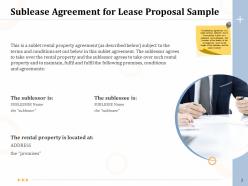
Slide 2: This slide displays Sublease Agreement for Lease Proposal Sample.
Slide 3: This slide displays the Content of the presentation.
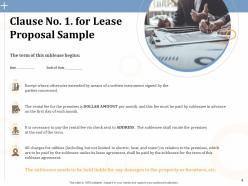
Slide 4: This slide shows Clause No. 1. for Lease Proposal Sample.
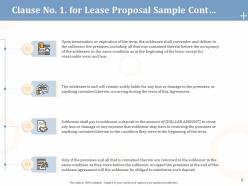
Slide 5: This slide is continued with Clause No. 1. for Lease Proposal Sample.
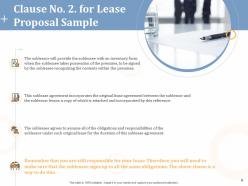
Slide 6: This slide depicts Clause No. 2. for Lease Proposal Sample.
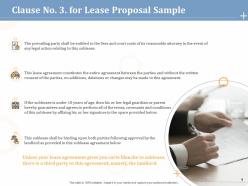
Slide 7: This slide represents Clause No. 3. for Lease Proposal Sample.
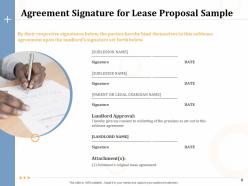
Slide 8: This slide shows Agreement Signature for Lease Proposal Sample. By their respective signatures below, the parties hereby bind themselves to this sublease agreement upon the landlord’s signature set forth below.
Slide 9: This is About Us slide to showcase Company specifications.
Slide 10: This is Our Team slide with Names and Designations.
Slide 11: This is Our Team slide for Lease Proposal Sample. Write in brief (4-5 lines) on team member’s education background, past career experience, similar experience in this company, achievements etc.
Slide 12: This slide shows Client Testimonials for Lease Proposal Sample.
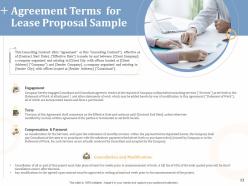
Slide 13: This slide shows Agreement Terms for Lease Proposal Sample.
Slide 14: This is Icons Slide for Lease Proposal Sample.
Slide 15: This is Contact Us slide with Address, Contact number and Email address.
Slide 16: This slide is titled as Additional Slides for moving forward.
Slide 17: This is Our Vision, Mission & Goal slide.
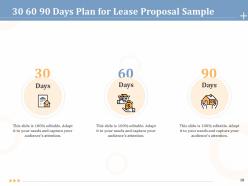
Slide 18: This is 30 60 90 Days Plan slide.
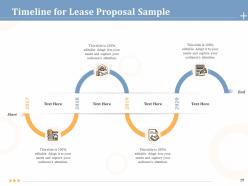
Slide 19: This slide shows Timeline process.
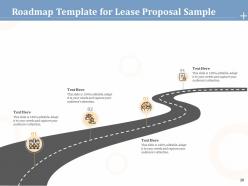
Slide 20: This slide showcases Roadmap process.
Lease Proposal Sample Powerpoint Presentation Slides with all 20 slides:
Use our Lease Proposal Sample Powerpoint Presentation Slides to effectively help you save your valuable time. They are readymade to fit into any presentation structure.


FAQs for Lease Proposal Sample
Start with the basics - rent, lease length, property details. Security deposits and maintenance stuff comes next, plus who's covering utilities. If you're doing tenant improvements, definitely negotiate those upfront (honestly they can make or break a deal). Renewal options matter too, and termination clauses. Special conditions if there are any. I always forget something when I'm rushing through these, so maybe jot down a quick list beforehand? Better to be thorough now than deal with weird surprises six months in.
Look, market conditions basically make or break your negotiating power. High vacancy rates? Landlords are desperate - push for lower rent, better buildouts, whatever you want. But when it's tight out there, you'll probably pay full price and like it. Interest rates and local job market matter too, obviously. Nobody's signing leases when half the businesses are tanking. Honestly, your move is researching comparable properties first. Check vacancy rates in your area before you even walk in there. Don't go in blind - that's how you get screwed.
Landlords basically just want someone who'll pay rent and not cause drama. Start with your best financial stuff right away - steady job, decent credit, or income that's way above what they're asking for. Previous landlord references are gold if you've got them. If your finances are kinda iffy, throw in a bigger security deposit to sweeten the deal. Respond to their messages super fast too - shows you're on top of things. Honestly, most of these people have dealt with enough nightmare tenants that just being normal and responsible makes you look amazing. Make their choice obvious.
Honestly, you can't do anything without nailing the valuation first. It's literally what determines your rent price and backs up all your terms when tenants start questioning stuff. Get good comps and market data or you'll either undercharge (been there, it sucks) or price yourself out completely. Remember that disaster I had with the downtown space? Yeah, learned that lesson the hard way. Once you know what it's actually worth, everything else falls into place - security deposits, improvement money, rent bumps. Just get a decent appraisal done and build from there.
Honestly, just be super upfront about your deal-breakers from day one. Don't dance around it - tell them exactly what you need vs what would just be nice. Like instead of saying "reasonable notice," say "I need 24 hours heads up for inspections because I work nights." Way more specific. Write everything down too, even the casual stuff you discuss. I learned that one the hard way lol. Try to see their side of things and make it feel like you're solving a puzzle together rather than fighting over scraps. Works way better than going in guns blazing.
Check your local landlord-tenant laws first - security deposits, notice periods, rent control stuff. That's boring but crucial. Also verify the zoning allows whatever they want to do with the space. Nothing worse than signing a deal that can't actually happen. If you're not the owner, confirm you can legally lease it out. Liability and maintenance clauses are your friend here - spell out who's responsible for what. I learned that one the hard way with my cousin's rental situation last year. Honestly? Just have a real estate lawyer look it over before sending.
So for lease flexibility, throw in some escalation clauses and renewal options with set terms upfront. Early termination stuff is huge - seriously, you'll both want an out if things go sideways. Subleasing rights help too. Market-rate rent reviews work well for landlords, plus maybe flexible use clauses if the tenant's business shifts (same general category though). Oh, and make everything super specific with clear triggers. Vague language just creates headaches later. I learned that one the hard way! Write it thinking about real scenarios that could actually happen, not just generic "what if" situations.
Okay so the big ones are being way too vague and not thinking about exit strategies. Like, pin down the exact square footage, what's actually included in rent, who fixes stuff when it breaks - vague wording will screw you over every time. Don't lowball like crazy either, landlords can tell when you're desperate. I learned that one the hard way lol. Build in renewal options and break clauses from the start because life gets messy fast. Double-check your math before you submit anything. Oh and leave yourself room to negotiate - going in with your absolute final offer is never smart.
Honestly, automation is a game changer for lease proposals. Those template tools pull property data straight from your database - no more fat-fingering square footage at midnight. Document automation cranks out proposals in minutes, not hours. E-signatures are clutch too since nobody wants to deal with printing and scanning anymore (seriously, it's 2024). Your CRM can track pending proposals and bug people automatically. I'd probably start with just one tool though - don't go crazy trying to automate everything at once. You'll thank yourself later when you're not scrambling to get proposals out.
Honestly, just track a few basic things and you'll know if your proposals are working. Start with acceptance rates - what percentage of landlords actually say yes when you pitch them? Time matters too; good proposals should make negotiations faster, not turn into these endless back-and-forth situations. Are you hitting your target rent or constantly settling for less? That's your rental rate variance right there. Also watch how many counteroffers you're getting - fewer usually means you nailed it from the start. I just use a basic spreadsheet to track this stuff, nothing fancy. Makes it way easier to see what's actually working.
Honestly, longer leases give you way more bargaining power. Landlords hate dealing with turnover - it's expensive and annoying for them. So if you're willing to sign for like 5-10 years, you can usually get lower rent or better build-out money. Short-term leases? You'll pay extra because they know you might bail soon. But here's the thing - don't lock yourself into something crazy long just to save a few bucks. My cousin did that and his business blew up faster than expected, then he was stuck in this tiny space for years. Figure out where you realistically see your business in 3-5 years first, then use that timeline when you negotiate.
So for your lease proposal, definitely push for the obvious stuff - LED lighting, Energy Star appliances, low-flow fixtures. Water conservation is huge right now. Also throw in recycling programs and maybe composting if they're not totally against it. LEED certification sounds fancy and landlords eat that up. Oh, and bike storage or EV charging stations are smart additions - shows you're thinking ahead. The key is framing these as money-savers for both of you, not just feel-good environmental stuff. Start with maybe 2-3 solid sustainability points so you don't overwhelm them.
Start with the money stuff right away - rent, deposit, lease length. Nobody wants to dig for that info. Your proposal needs to look decent, not like you scribbled it on a napkin lol. Throw in property details, who handles maintenance, any perks you're offering. Honestly, being upfront about everything is huge - weird hidden fees will tank your chances fast. Follow up in a day or two max. Oh and be flexible on something, even if it's small. Tenants love feeling like they got a win during negotiations.
So basically, residential is way simpler - focus on tenant screening, deposits, and who handles what maintenance. Most renters aren't real estate experts anyway. Commercial though? Totally different beast. You need all the financial details - CAM charges, percentage rent, improvement allowances, use restrictions. Those tenants expect everything spelled out because it's pure numbers for them. I'd honestly start with separate templates since they're so different. Residential is finding decent people who'll pay rent and not trash the place. Commercial is just business math. Oh and definitely customize based on your local market - what works in NYC won't fly in smaller towns.
Honestly, having competition is like your secret weapon when you're looking for a place. Landlords get way more flexible when they know you're not desperate and have other options lined up. Rent negotiations, lease terms, improvements - suddenly everything's on the table. Do yourself a favor and find 3-4 real backup options before you even walk into that first meeting. Trust me on this one. Without competition? They'll stick to their guns on pretty much everything. It's kinda like job hunting - desperation shows, and nobody wants to deal with that energy. You'll thank me later when you can actually walk away if they're being unreasonable.
-
Use of different colors is good. It's simple and attractive.
-
Much better than the original! Thanks for the quick turnaround.
-
Excellent Designs.