

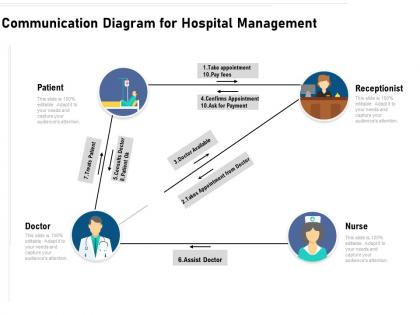
Communication diagram for hospital management




Try Before you Buy Download Free Sample Product
 Impress Your
Audience
 100%
Editable
 Save Hours
of Time


Our Communication Diagram For Hospital Management are topically designed to provide an attractive backdrop to any subject. Use them to look like a presentation pro.
People who downloaded this PowerPoint presentation also viewed the following :
Communication diagram for hospital management with all 2 slides:
Use our Communication Diagram For Hospital Management to effectively help you save your valuable time. They are readymade to fit into any presentation structure.


FAQs for Communication diagram
So you'll want to map out the usual stuff - phone systems, pagers, EMRs, all that. Then identify who's talking: doctors, nurses, admin people, patients. Communication bottlenecks are where I'd start honestly, since those are your biggest pain points. Map the information flows between everyone, plus don't forget escalation paths for emergencies vs routine stuff. These diagrams get super messy once you add all the different departments - fair warning! But really it's just showing who talks to whom and how. Oh, and when they communicate too, that matters more than people think.
So these hospital communication diagrams are basically roadmaps for who talks to who - sounds boring but they actually work really well. When departments know exactly who to contact, you don't get those awkward moments where nobody tells the patient about test results. Response times get faster during emergencies, and medical errors drop because nothing gets forgotten. Honestly, the best part is patients get consistent updates instead of mixed messages from different staff. I mean, anything that prevents coordination disasters is worth trying. Map out your communication flow and you'll thank yourself later.
So EHRs are basically the center of everything in hospital communication diagrams. Think of them as the main hub where all patient info goes. You'll connect them to every single department - doctors, nurses, labs, pharmacy, billing, the works. Honestly it gets messy with all those connection lines everywhere, but that's just how hospitals work now. Everyone needs access to update patient records in real time. My advice? Put the EHR smack in the middle of your diagram first, then just start drawing lines to each department. Makes it way easier to visualize.
Oh yeah, flowcharts work great for this! Start with boxes for each department - ER, radiology, pharmacy, nursing floors, whatever. Then draw arrows showing where info actually goes. Like lab results → doctors, discharge orders → pharmacy, shift handoffs between nurses. Honestly, I'd just pick one patient's whole journey and trace every single touchpoint - it gets messy fast but that's kinda the point. You'll spot where things get stuck or lost way easier when you can actually see those communication paths laid out. Network diagrams work too if you want something fancier, but basic flowcharts do the job.
Honestly, I'd go with Lucidchart or draw.io (they rebranded to diagrams.net but whatever). Both are solid for flowcharts and have healthcare templates already built in. Visio's okay if your hospital's already paying for Microsoft stuff, but it feels pretty outdated compared to the web tools. Lucidchart's my pick though - handles messy workflows way better and everyone can jump in to edit at once. Oh, and definitely start with their healthcare templates instead of building everything yourself. Trust me on that one, it'll save you a ton of time.
So communication diagrams are pretty cool - they map out who talks to who and when in hospitals. Takes all that chaos and makes it visual, you know? Like you can actually see when nursing spots something critical, how it gets to the attending, then back down to bedside staff. Honestly, once you map your unit's patterns, you'll find bottlenecks you never noticed. The visual part is key though - helps catch communication gaps before they turn into safety problems. Shift changes don't become such a nightmare either since everyone knows the flow. Start small with just your unit first.
Honestly, the worst thing you can do is overcomplicate it with a million arrows and boxes - people's eyes just glaze over. Make sure each role is super clear and nobody's stepping on each other's toes responsibility-wise. Feedback loops are crucial too since hospital communication flows both ways. Here's what I learned the hard way though: test it with actual staff first! What seems obvious to you might make zero sense to someone working nights. Also, assume people will miss messages because they always do - build in backup ways to communicate the important stuff. Trust me on this one.
Honestly, communication diagrams are a lifesaver for training new people. Show them who needs to talk to who during actual patient situations - like when someone codes or gets admitted. Way more effective than just talking through it. New hires can see exactly how info flows between nurses, docs, lab techs, the whole crew. I'd set up training sessions where you show the diagram first, then let them practice the steps. Sometimes I think we overcomplicate onboarding, but this visual approach really clicks with people. They'll get the sequence down much faster.
Response times are probably your biggest indicator - how fast staff actually answer pages and patient calls. Message delivery rates matter too, like are critical alerts reaching the right people? Patient satisfaction scores tell the real story though. Technical metrics are whatever if patients feel ignored, honestly. Check escalation patterns to catch when urgent stuff gets stuck in workflows. Staff feedback is clutch here - they'll spot problems before your data does. Oh, and don't just rely on one metric. Mix the hard numbers with what people are actually telling you about communication gaps.
Honestly, those communication diagrams are clutch when everything goes sideways at the hospital. They show you the chain of command super clearly - like who calls who, which departments get looped in first, all that stuff. When you're stressed and can't think straight, having that roadmap right there is huge. Plus they list backup contacts for when your main person isn't around (which always happens at the worst times, doesn't it?). I'd definitely print one out and stick it at your desk. Sure, digital copies work fine until the whole system decides to crash right when you need it most.
Oh man, cultural stuff makes such a difference in hospitals. Some patients won't make eye contact with doctors because that's disrespectful in their culture, while others think you're being shady if you look away. Pain gets expressed totally differently too - some people are super vocal, others stay quiet no matter what. Language barriers are the obvious one, but there's also who gets to make decisions (is it just the patient or the whole family?), whether they want a same-gender caregiver, even how they view time. Honestly, just ask upfront what they prefer. Way easier than guessing.
Dude, good communication literally makes your HCAHPS scores jump up - fewer complaints, happier patients. When you actually explain what's happening and listen, people feel way less anxious and more in control. Honestly, it's such low-hanging fruit that most places still mess up. Bad communication? Patients get confused, don't trust you, and feel ignored (which sucks for everyone). Plus satisfied patients actually follow their treatment plans better and tell their friends good things about you. Oh, and here's something super simple - just ask "Any questions?" after talking to them. Works every time, I swear.
Honestly, you've gotta bake this into your regular routine or it'll never happen. I do quarterly reviews minimum, monthly if I'm being good about it. Split up ownership so different people handle different sections - otherwise it just becomes one person's nightmare. Oh, and any time someone leaves, new tech gets rolled out, or processes change? That should automatically mean diagram update time. Set those calendar reminders and actually follow through. I learned this the hard way - rebuilding everything from scratch is way more painful than just staying on top of it.
Honestly, get your frontline people on board first - they're gonna be stuck using this thing every day. Map your current communication mess before jumping in. Training matters way more than most places think, and I'm talking real training, not some lame email walkthrough. Test it with just one department initially because hospital-wide rollouts usually turn into disasters. Your diagram needs to be super clear for everyone, even the folks who still print emails. Oh, and don't forget feedback loops so you can actually fix what's broken instead of guessing.
Honestly, getting patients involved makes such a huge difference in outcomes. They'll catch medication mistakes you might miss and actually stick to treatment plans when they understand why they're doing something. Plus they give you way better context about their symptoms - like, stuff that completely changes your approach. Short sentences work. Longer ones help explain the reasoning behind why this matters so much for real results. I've seen patients who ask questions and share concerns do measurably better than those who just nod along. Don't just tell them what to do - ask what questions they have first. Works way better.
No Reviews