


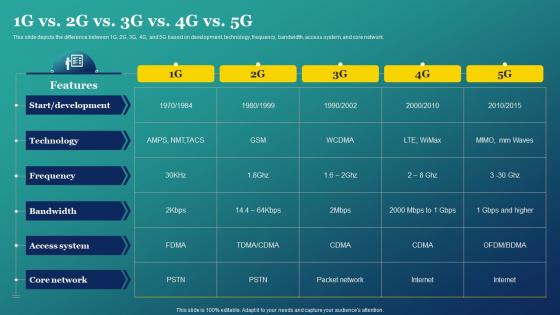
Comparación entre 4G y 5G basada en características y tecnología 1G vs 2G vs 3G vs 4G vs 5G




Try Before you Buy Download Free Sample Product
 Impress Your
 Audience
 100%
100% Editable
 Save Hours
 of Time


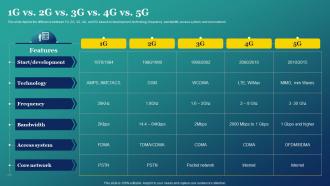
Diferencia entre 1G, 2G, 3G, 4G y 5G según desarrollo, tecnología, frecuencia, ancho de banda, sistema de acceso y red central.
People who downloaded this PowerPoint presentation also viewed the following :
Comparación entre 4G y 5G basada en características y tecnología 1G vs 2G vs 3G vs 4G vs 5G
Nuestra comparación entre 4G y 5G basada en características y tecnología 1G vs 2G vs 3G vs 4G vs 5G le ayudará a ahorrar tiempo valioso. Están listos para adaptarse a cualquier estructura de presentación.





FAQs for Comparison Between 4g And 5g Based On Features And Technology 1g Vs 2g Vs 3g Vs
So basically 1G was just for calls, then 2G added texting and went digital. 3G brought smartphones and web browsing - remember how slow that was? 4G changed everything though, made streaming actually work and enabled all the apps we use now. It's honestly still fine for most people. 5G is the new hotness with insane speeds, but good luck finding decent coverage unless you're in a major city. Each generation didn't just get faster - it unlocked completely different things you could do. For your plan, 4G handles pretty much everything unless you're editing 4K videos on your phone or something crazy.
So basically we went from just making calls with 1G to having everything at our fingertips now. 2G gave us texting, 3G brought the internet (kinda slow though), and 4G made smartphones actually worth having. Now with 5G we've got instant everything - streaming Netflix on the train, working from literally anywhere, GPS that I'm honestly way too dependent on. It's wild how each upgrade unlocked stuff we didn't even know we needed. Like, we used to actually have to plan where to meet up before leaving the house! These days when my video call glitches I try to appreciate how far we've come.
So latency is just the delay between sending something and getting it back. 3G was pretty rough at 100-500ms, but 4G brought it down to like 30-50ms. Now 5G can hit under 10ms which is wild. You'll really feel this with video calls - nobody wants that awkward lag where you're both talking over each other. Gaming becomes a nightmare with high latency too. For work stuff, remote desktop sessions and real-time collaboration tools get so much smoother on newer networks. Honestly once you experience low latency it's hard to go back.
So basically, each generation is way faster than the last. 3G was like 1-3 Mbps, 4G jumps to 20-100 Mbps, and 5G can hit crazy speeds like 1-10 Gbps when everything's perfect. Honestly, upgrading your phone feels like magic - stuff just loads instantly. The newer networks also don't get bogged down when everyone's using them at once, which is why 5G areas feel so much snappier. Check what your carrier supports where you live though. If you're still rocking an older phone, that might be why everything takes forever to load.
So 5G is crazy fast - like 100x faster than 4G. Latency drops under 1ms too, which is wild. You can connect way more devices at once since they're using higher frequency bands and this fancy antenna stuff called massive MIMO. The coolest part though? Network slicing lets them basically carve up the network for different purposes. Your downloads will be lightning quick, but honestly the bigger deal is what it unlocks - remote surgery, self-driving cars, massive IoT deployments. If you're working on any connected device stuff, definitely worth thinking about how this changes things. Game changer for sure.
So mobile networks are what make IoT devices actually functional. 3G was the start but honestly pretty rough for most IoT stuff. 4G LTE changed everything - faster speeds, better latency, which is why smart homes took off. Now 5G is where things get crazy good. It handles insane device density like thousands of sensors in a small area, plus the latency is so low it can run autonomous cars. I'd probably go with 5G if you're setting anything up now since older networks might hold you back performance-wise.
Yeah, so 5G rollout is pretty rough environmentally. Most old 4G towers can't handle the upgrade, so they're building brand new infrastructure on top of what's already there. Double the hardware, double the energy use. Everyone's upgrading their phones too which creates tons of e-waste - honestly it's kind of insane how much gets thrown out. The energy from millions of new antennas running constantly is huge. Though I guess newer tech is more efficient per data bit? If you're involved in planning this stuff, definitely push for equipment sharing and solid recycling programs.
Honestly, network speed totally changes what you can even attempt to build. With 3G you're stuck making everything super lightweight and planning for offline mode. 4G is where things get fun - video streaming, real-time stuff, all that good content most apps rely on now. But 5G? That's when AR/VR actually becomes viable, plus downloads happen instantly. I always design for whatever the slowest network is in my target audience, then add the fancy stuff for faster connections later. Check your analytics first though - you might be surprised what networks people are actually using.
So basically each new network generation just creates more ways for hackers to mess with you. 2G had pretty basic encryption issues. Then 3G brought data services, which meant web attacks became a thing. 4G went full internet protocol - suddenly anything that could attack your computer could hit mobile networks too. Honestly feels like we've been playing defense ever since. Now 5G? It's way worse with all the network slicing and IoT stuff everywhere. Your security folks can't just worry about radio signals anymore - there's like a million new entry points to think about.
So here's the deal - countries handle mobile rollouts totally differently depending on what they prioritize. South Korea and China dump tons of government money into being first because it's like a national pride thing. Europe's more coordinated but slower with all their regulations and spectrum stuff. The US? Total mess honestly - carriers just do whatever at their own pace. What's actually clever is how developing countries skip entire generations instead of playing catch-up. But yeah, if you're doing anything international, you'll want to check each country's timeline first since they're all over the place.
So cities always get the fancy new networks first - makes sense since there's way more people per cell tower. Rural areas? They're usually stuck with whatever's 1-2 generations behind. Like you'll find 3G in places where the city has full 5G coverage. Honestly, it's just basic business math for the carriers - they go where the customers are. This whole thing creates a pretty real digital divide though. Streaming sucks, telemedicine barely works, you know the deal. If you're thinking about doing anything rural, definitely check what networks are actually there first, not what Verizon claims on their coverage map.
So basically 5G gets way more interesting when you throw AI and edge computing into the mix. Instead of your data traveling to some server farm across the country, it gets processed right nearby - like having tiny data centers sprinkled around your neighborhood. Your phone can handle more complex stuff locally now too. The whole setup cuts down lag time like crazy, which is why we're finally seeing decent real-time AR and those instant translation apps that actually work. Honestly, autonomous cars wouldn't even be possible without this combo. You'll probably notice your apps just feel snappier overall.
Ugh, spectrum allocation is gonna be your biggest nightmare - governments have to auction off radio frequencies and that takes forever. Each country has different licensing requirements too, which is annoying. Plus you're dealing with new technical standards, safety regs, all that fun stuff. Infrastructure sharing gets weird when carriers want to upgrade towers together. Honestly, the worst part is just the timing mismatch. Tech moves fast, regulators move like molasses. You'll be sitting there ready to go while waiting months for approval. Start talking to regulatory folks super early - like embarrassingly early. Trust me on this one.
Honestly, just match what you actually need with what each one's good at. 3G's fine for basic stuff - email, simple apps. Most companies are still cruising on 4G and doing perfectly well with streaming, cloud apps, customer service tools. 5G's where it gets interesting though - IoT tracking, AR experiences, crazy fast remote operations. But here's the thing: don't just jump to the shiniest option because it sounds cool. Figure out what problem you're trying to solve first, then pick whatever generation actually fixes it without breaking your budget.
So 6G's probably hitting around 2030 and it's gonna be insane. We're talking holographic calls, brain-computer interfaces, terabit speeds that'll make 5G look ancient. The whole "ambient connectivity" thing means everything around you becomes smart and connected - honestly sounds a bit overwhelming but whatever. AI won't be an add-on anymore, it'll be built right into the network itself. Your phone won't just connect to the internet, it becomes part of this massive intelligent web. Worth thinking about how your stuff could work with truly everywhere, smart connectivity.
-
Their professional templates are very impressive, even my manager was curious about the source. I am very grateful.
-
Well-designed and informative templates. Absolutely brilliant!