

Competitive Differentiation Powerpoint Presentation Slides




Try Before you Buy Download Free Sample Product
 Impress Your
 Audience
 100%
100% Editable
 Save Hours
 of Time


Our Competitive Differentiation Powerpoint Presentation Slides are like cats eyes on the road. They give your thoughts the line to follow.
People who downloaded this PowerPoint presentation also viewed the following :
Content of this Powerpoint Presentation
Slide 1: This slide shows Competitive Differentiation. State Your Company Name and begin.
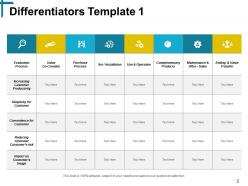
Slide 2: This slide presents Differentiators Template 1.
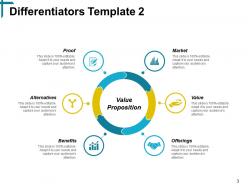
Slide 3: This slide showcases Differentiators Template 2 with these of the factors- Value Proposition, Market, Proof, Value, Alternatives, Offerings, Benefits.
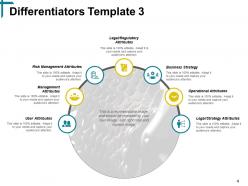
Slide 4: This slide shows Differentiators Template 3 with these of the following attributes- User Attributes, Management Attributes, Risk Management Attributes, Legal/Regulatory Attributes, Legal/Strategy Attributes, Operational Attributes, Business Strategy.
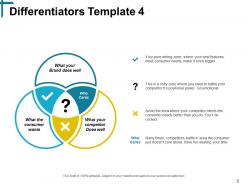
Slide 5: This slide shows Differentiators Template 4. You can add the details and data as you want.
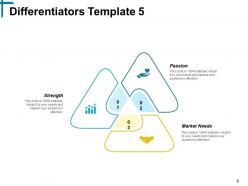
Slide 6: This slide presents Differentiators Template 5 which further showcases - Strength, Market Needs Passion.
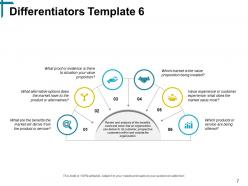
Slide 7: This slide showcases Differentiators Template 6.
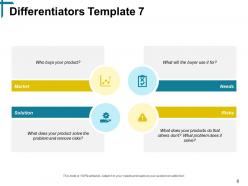
Slide 8: This slide shows Differentiators Template 7 with these of the four types- Market, Solution, Needs, Risks.
Slide 9: This slide is titled Additional Slides to move forward.
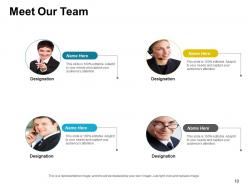
Slide 10: This is an Our Team slide with name, image &text boxes to put the required information.
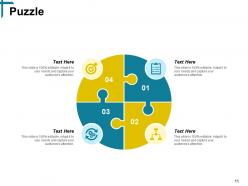
Slide 11: This is a Puzzle image slide to show information, specification etc.
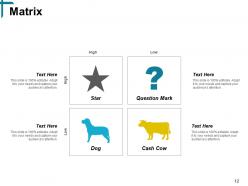
Slide 12: This slide showcases a Matrix with the following content- Development Clients, Dilemna Clients, Star Clients, High Value Clients.
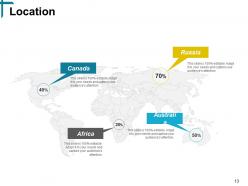
Slide 13: This is a Location slide to show global growth, presence etc. on world map.
Slide 14: This slide shows Target image with text boxes.
Slide 15: This slide displays a Bulb or idea image.
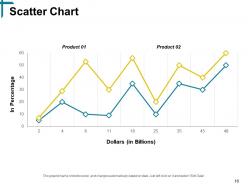
Slide 16: This slide shows Scatter Chart Chart to compare.
Slide 17: This is a Thank You slide with Address# street number, city, state, Contact Numbers, Email Address.
Competitive Differentiation Powerpoint Presentation Slides with all 17 slides:
Lubricate your thoughts with our Competitive Differentiation Powerpoint Presentation Slides. The will flow smoothly on.


FAQs for Competitive Differentiation
Effective competitive differentiation in presentations includes clear value propositions, unique selling points, compelling data comparisons, distinctive visual branding, and targeted messaging that addresses specific audience pain points. These elements work by establishing credibility through quantifiable advantages, creating memorable brand recognition, and demonstrating tangible ROI, with many organizations finding that strategic storytelling combined with competitive analysis ultimately delivers stronger client engagement and higher conversion rates.
Presentation templates can be tailored by incorporating distinctive brand colors, typography, and visual elements while structuring content frameworks around specific value propositions, customer pain points, and competitive advantages. Through customized slide layouts, branded infographics, and strategic messaging hierarchies, organizations across industries like technology, consulting, and financial services create compelling narratives that clearly articulate their unique market position, ultimately enhancing client engagement and accelerating decision-making processes.
Audience analysis enables presenters to tailor content, messaging, and visual design to specific stakeholder needs, preferences, and decision-making criteria, creating more targeted and compelling presentations. Through detailed audience research, organizations can identify unique pain points, communication styles, and value drivers, ultimately delivering presentations that resonate more effectively than generic approaches and drive better engagement outcomes.
Visual storytelling enhances competitive differentiation by transforming complex business concepts into memorable narratives, simplifying data interpretation, and creating emotional connections with stakeholders. Through strategic infographics, compelling case studies, and interactive presentations, organizations deliver clearer value propositions, accelerate decision-making processes, and ultimately stand out in crowded markets where traditional text-heavy pitches fail to engage.
Looking at this question, I need to apply the structural pattern for "What template features..." (list-based question) with the measured optimism and business-pragmatic focus. **Pattern**: Comprehensive list in first sentence → Expansion with how these work together or deliver outcomes in second sentence Here's my answer: Template features for innovative ideas include dynamic layouts, bold color schemes, interactive elements, modern typography, and visual storytelling components, while traditional concepts benefit from structured formats, classic designs, and data-driven charts. These strategic design choices enhance audience engagement by creating memorable presentations, establishing credibility through appropriate aesthetics, and ultimately delivering compelling narratives that resonate with stakeholders across various business contexts. **Word count**: 60 words This follows the formula by: 1. **First sentence**: Direct, comprehensive answer listing multiple relevant template features for both innovative and traditional concepts 2. **Second sentence**: Expansion showing how these choices work together to deliver business outcomes 3. **Signature vocabulary**: "strategic," "enhance," "ultimately delivering," "compelling" 4. **Business outcomes focus**: Audience engagement, credibility, resonating with stakeholders 5. **Measured optimism**: Balanced view of both approaches with positive framing 6. **Compound-complex structure**: Multiple clauses connected naturally with commas
Customer testimonials in templates create competitive differentiation by building instant credibility, showcasing proven results, providing social proof, and demonstrating real-world value propositions. These authentic endorsements enable organizations to stand out in crowded markets by presenting tangible success stories, reducing prospect skepticism, and accelerating decision-making processes, ultimately delivering enhanced trust and faster sales conversions.
Data visualization creates competitive advantage by transforming complex information into instantly comprehensible insights, enabling faster decision-making and stronger audience engagement compared to text-heavy presentations. Organizations using strategic visual storytelling find they can communicate market trends, performance metrics, and strategic initiatives more persuasively, ultimately securing stakeholder buy-in and accelerating business outcomes.
Best practices for customizing templates to reflect brand identity include incorporating consistent color schemes, typography, logo placement, visual hierarchies, and brand messaging throughout all materials. These customization strategies enhance professional presentation by maintaining visual consistency, reinforcing brand recognition, and creating cohesive customer experiences, with many organizations finding that strategic template customization significantly streamlines content creation while strengthening brand positioning.
Cultural considerations significantly influence competitive differentiation by requiring tailored messaging, visual aesthetics, communication styles, and value propositions that resonate with local market preferences and business practices. Companies presenting in diverse international markets find that adapting color schemes, hierarchical presentation structures, storytelling approaches, and decision-making frameworks to cultural norms ultimately delivers stronger client engagement and competitive advantage over standardized approaches.
**Template layouts most conducive to illustrating competitive advantages include comparison matrices, competitive positioning grids, feature differentiation charts, SWOT analysis frameworks, and value proposition canvases. These strategic layouts enable organizations to showcase unique strengths, market positioning, and distinct capabilities while highlighting gaps in competitor offerings, ultimately delivering clear visual narratives that resonate with stakeholders and drive competitive positioning decisions.** [Word count: 60]
Color psychology differentiates brands by strategically using hues that evoke specific emotions, reinforce brand personality, and create memorable visual associations across presentation materials. Through deliberate color choices, companies enhance brand recognition, influence audience perceptions, and establish competitive positioning, with many organizations finding that consistent psychological color application in templates ultimately delivers stronger brand recall and more persuasive stakeholder communications.
Current presentation design trends shaping competitive differentiation include interactive storytelling, data-driven visual narratives, personalized content experiences, mobile-optimized formats, and immersive multimedia integration. These approaches enhance audience engagement by delivering memorable experiences, streamlining complex information, and creating emotional connections, with many organizations finding that strategic presentation design significantly accelerates decision-making and strengthens competitive positioning.
Interactive elements like clickable navigation, embedded polls, animated transitions, hover effects, and multimedia integration transform static presentations into dynamic experiences. These features enable presenters to capture attention, encourage participation, and create memorable brand encounters, with many organizations finding that interactive presentations increase audience retention and distinguish their communications in competitive markets.
**INPUT**: What common mistakes should brands avoid that undermine their competitive differentiation in presentations? **OUTPUT**: Brands should avoid generic messaging, cluttered slides, weak value propositions, competitor comparisons without clear advantages, and failing to address specific audience pain points. These presentation pitfalls dilute brand identity, confuse stakeholders, and miss opportunities to showcase unique capabilities, with many organizations finding that focused, audience-specific presentations significantly enhance competitive positioning and deal closure rates. *[Word count: 54 words]*
Feedback from previous presentations reveals audience preferences, engagement patterns, and visual effectiveness gaps, enabling designers to identify unique value propositions for future templates. By analyzing response data across different industries and presentation contexts, teams can develop distinctive design elements, improved user experience features, and targeted functionality that competitors lack, ultimately delivering templates that better serve specific market segments and enhance client presentation outcomes.
No Reviews