


Complaint handling action plan customer complaint management process ppt slide




Try Before you Buy Download Free Sample Product
 Impress Your
 Audience
 100%
100% Editable
 Save Hours
 of Time


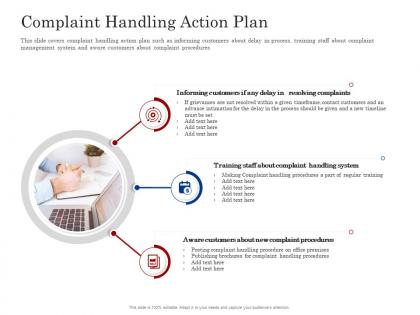
This slide covers complaint handling action plan such as informing customers about delay in process, training staff about complaint management system and aware customers about complaint procedures
People who downloaded this PowerPoint presentation also viewed the following :
Complaint handling action plan customer complaint management process ppt slide with all 2 slides:
Use our Complaint Handling Action Plan Customer Complaint Management Process Ppt Slide to effectively help you save your valuable time. They are readymade to fit into any presentation structure.


FAQs for Complaint handling action plan customer complaint management
Make submitting complaints dead simple - give people multiple ways to reach you. Quick acknowledgment is huge, shoot for 24 hours max. Document everything during your investigation (seriously, future you will be grateful when things go sideways). Keep complainants in the loop about what's happening and realistic timelines. Don't make people hunt you down for updates - that's the worst. Resolve it properly, then circle back to confirm they're actually happy. A basic tracking system saves your sanity so stuff doesn't get lost. Being upfront about communication beats scrambling later.
Focus on three main things: listening skills, empathy, and how to actually solve problems. Role-playing is honestly your best bet - practice common complaints so they don't freeze up when it's real. Train them to acknowledge feelings first, then get the facts. Oh, and make sure they follow up on whatever they promise - that's where most places totally screw up. Give your team clear escalation rules too. They need to know exactly what discounts or solutions they can offer without running to you every time.
Honestly, active listening is a game-changer for handling complaints. When you actually focus on what they're saying instead of planning your response, you catch the real problem. Customers can tell when you're genuinely listening too - it calms them down way faster than jumping straight into solutions. I learned this the hard way lol. You'll pick up on details you'd totally miss otherwise, like what they actually want fixed. Try saying back what you heard in your own words. Confirms you got it right and shows you were paying attention.
Honestly, tech can save you so much headache with complaints. Chatbots handle the basic stuff instantly, and ticketing systems automatically send issues to whoever needs to deal with them. Set up a portal where customers can check their complaint status - trust me, they'll use it constantly at 2am. SMS updates are huge too because people get paranoid their complaint got lost somewhere. AI sorting is pretty solid now, way better than doing it manually (though sometimes it's hilariously wrong). Start with automated updates and tracking at minimum. People don't need perfection, they just need to know you didn't forget about them.
Track resolution time first - basically how fast you fix stuff. Then look at first-contact resolution (did you solve it without going back and forth?). Customer satisfaction scores are huge too, honestly my go-to metric because it shows if people actually felt heard vs just shuffled along. Also watch complaint volumes over time and escalation rates. If everything's getting bumped to managers, something's broken in your frontline process. Oh and those satisfaction surveys? Way more telling than just counting tickets closed. Start there and you'll see what's working.
Dude, complaints are basically free intel on what's broken in your business. I used to just fix each one and move on - huge mistake. Now I track patterns in what people bitch about most. Those themes? That's your roadmap for fixes. Maybe it's a training issue, maybe your process sucks somewhere. Don't just slap band-aids on individual cases. Dig into why this keeps happening. Honestly, customers will spell out problems you're totally blind to. Start small - grab last month's complaints and see what patterns jump out.
Don't get defensive or make excuses - that's the fastest way to make things worse. Listen first before jumping into solution mode. I've seen people get passed around between like 5 different departments and it's infuriating honestly. Never promise stuff you can't actually deliver because then you're dealing with an even angrier customer later. Yeah, it sucks when someone's screaming at you, but try not to take it personally. Generic copy-paste responses are obvious and annoying. Acknowledge they're frustrated, then focus on fixing their actual problem. Work with them, not against them.
Safety stuff and legal issues first - that's non-negotiable. Multiple customers affected? Bump it up the list. Social media complaints are honestly a pain, but they'll blow up if you ignore them so deal with those fast. Then work through individual issues by how long people have been waiting or their customer status. The key is having clear rules for your team about what's urgent vs what can wait. Nobody should be guessing whether something needs immediate attention. Oh, and anything that could actually harm someone obviously jumps the queue immediately.
Honestly, you've gotta make people feel safe about speaking up first. When someone brings you an issue, thank them instead of getting all defensive - I swear, everyone watches how you handle those first complaints. Set up different ways for people to report stuff since some hate face-to-face confrontation. Train your managers to actually listen instead of making excuses. Here's the big one though: always circle back and tell people what happened after they complained. Even if you can't share everything, give them something. Reports that vanish into thin air? That's how you kill trust fast. Maybe try regular check-ins where people can raise concerns openly too.
Write down absolutely everything from the start - dates, who complained, what they said, how you responded. Trust me on this one, I got burned when a customer swore we ghosted them even though we totally didn't! Every phone call, email, action you took needs timestamps. What did you promise them? Did you actually fix it? Put all this stuff in your CRM so your teammates can jump in if you're out sick or whatever. Honestly, being detailed now saves so much drama later. Future you will be grateful when you can actually remember what happened three weeks ago.
Honestly, you've gotta get everyone doing things the same way or it'll be chaos. Write down every step - response times, when to escalate stuff, how to document everything. Then drill it into your whole team so customers don't get totally different experiences depending on who picks up their case. I'd set up templates for the usual questions and maybe some checklists for the really messy situations. Oh, and audit things regularly because nobody wants to be that team where one person takes 2 hours to respond and another takes 2 days! Team meetings help too - people can share weird cases they've handled.
Honestly, complaints can be your secret weapon for building loyalty. Sounds crazy, right? But when you handle them well, customers actually become MORE loyal than if nothing went wrong. Quick responses are huge. Listen without getting all defensive - that's where most people mess up. Follow through on whatever you promise them. Most folks just want to feel heard and see you're actually doing something about it. I've seen this work so many times. Don't run from complaints - they're basically free opportunities to prove you care about your customers.
Honestly, the key is just being fast about it. Set up alerts so you know when people are complaining, then jump on it right away - even just "hey, we see this and we're on it" buys you time. After that initial public response, move the real conversation to DMs or a phone call. Speed beats having the perfect response, trust me. I've watched companies completely turn around pissed-off customers this way - like, they become actual fans afterward. Just make sure someone's checking your socials daily and knows who to escalate the messy stuff to.
Ugh, dealing with angry customers is the worst. First thing - just let them blow off steam without jumping in to defend yourself. I know it's hard! Then throw in something like "I totally get why you're frustrated" so they know you're actually listening. Here's a weird trick that works: talk slower and keep your voice super steady. It somehow calms them down. Don't get stuck explaining policies you can't change - focus on what you CAN actually do for them. And hey, if they're being straight-up abusive, you can totally say "I want to help but let's keep this respectful." Write it all down after and remember they're pissed at the situation, not you.
Here's what I'd do - capture those complaint patterns and bring them straight to your product team meetings. Make sure developers see the actual feedback, not watered-down summaries. Honestly, I've watched so many companies where complaints just vanish into thin air. Turn those pain points into real feature requests and bug fixes. After you ship changes, track if those specific complaints drop off - that's how you know it's working. Oh, and definitely circle back to the customers who complained when you fix their issues. They'll remember that.
-
Best way of representation of the topic.
-
Awesome use of colors and designs in product templates.
-
Easily Understandable slides.