

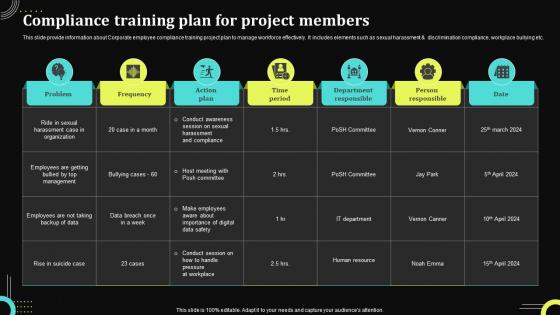
Compliance Training Plan For Project Members




Try Before you Buy Download Free Sample Product
 Impress Your
 Audience
 100%
100% Editable
 Save Hours
 of Time


This slide provide information about Corporate employee compliance training project plan to manage workforce effectively. It includes elements such as sexual harassment discrimination compliance, workplace bullying etc.
People who downloaded this PowerPoint presentation also viewed the following :
Compliance Training Plan For Project Members with all 6 slides:
Use our Compliance Training Plan For Project Members to effectively help you save your valuable time. They are readymade to fit into any presentation structure.





FAQs for Compliance Training Plan
Look, you need five things that actually work: policies people can understand (not legal jargon), training that doesn't suck, regular audits to catch stuff early, anonymous reporting so people aren't scared to speak up, and leaders who practice what they preach. Oh, and get someone whose actual job it is to run compliance - HR already has enough on their plate, trust me. Monitoring is probably the biggest thing because catching problems early saves you from major headaches later. Start by seeing what you've got now, then fix the worst gaps first.
Ugh, regulatory changes are such a pain - you're constantly updating your compliance stuff. Finance gets hit hard with banking rules that mess with entire risk systems. Healthcare? Don't even get me started on patient data requirements. Manufacturing deals with environmental standards that basically flip production upside down. Honestly, the smart move is building flexibility into your framework early on. That way you're just tweaking things instead of panic-rebuilding everything when new rules drop. Each industry gets screwed differently, but the prep work stays pretty much the same.
Honestly, tech saves so much time with compliance stuff. Set up automated systems to track regulation changes and catch violations early. No more pulling data from a million different spreadsheets - thank god. Digital workflows create better audit trails too, and way less room for screwups. The real magic happens when everything integrates and you get real-time visibility into where you stand. I'd start with whatever compliance task eats up most of your day and find tools to automate that first. Makes the whole thing way less painful.
Honestly, ditch the boring PowerPoint marathons that put everyone to sleep. Break everything into smaller chunks and use real situations your team actually deals with. Interactive stuff works way better - quizzes, case studies, maybe some role-playing (I know it sounds cheesy but people actually retain more). Make it relevant to what they do daily, not just random corporate rules. You'll need refreshers since everyone forgets this stuff. Oh, and get different departments talking about their own compliance headaches - that peer learning hits different. First though, figure out what training gaps you've got right now.
Honestly, most companies mess up by thinking compliance is just a box to check once. Wrong move. You can't just dump it all on one team either - everyone needs to own a piece of it. What kills me is when they obsess over the big obvious regulations but completely miss the weird industry-specific stuff that'll wreck you later. Documentation is another nightmare. You might be doing everything perfectly, but if you can't prove it when auditors show up, you're screwed. Best thing? Bake it into how you work from the start instead of trying to jam it in later.
Honestly, risk assessments are like getting your business checked out before something breaks. You'll spot which regulations actually matter for what you're doing - not just every rule under the sun. They show you where you're most likely to screw up compliance-wise, so you can focus your energy there instead of everywhere at once. Plus regulators love seeing you're being proactive about this stuff. I'd start by writing down your current processes (boring but necessary) and figuring out your biggest blind spots. It's way cheaper than dealing with violations later.
Honestly, you've got to get leadership walking the walk first - if executives act like rules don't apply to them, you're screwed from the start. Make compliance everyone's job, not just something legal worries about. Training's important but skip those boring PowerPoint marathons nobody remembers anyway. Write policies people can actually understand without a law degree. Anonymous reporting helps too since people get nervous about calling out issues. Here's what really works though - celebrate when people do the right thing. Build it into performance reviews so it becomes second nature. Oh, and make sure your reporting system is actually anonymous, not "anonymous."
So internal audits are basically your safety net - they spot problems before regulators show up at your door. Having someone independently check if your controls actually work (not just look good on paper) is huge. It's like getting a friend to proofread your essay before turning it in, honestly. They'll find weak spots in your processes, test whether people are actually following policies, and give you real fixes to try. Way better to catch issues internally than during an external audit - or god forbid, an investigation. I'd use those findings to figure out what compliance stuff needs fixing first.
Look, being transparent in compliance reporting is honestly a game-changer. Regulators and stakeholders actually trust you more when you're upfront about mistakes - weird but true. I've seen companies try to hide stuff and it always backfires spectacularly. Document everything thoroughly, even the messy bits. When auditors see you're being real about gaps and concerns, they don't dig as deep. It's way less stressful than playing cover-up games (trust me on this one). Plus transparent reporting helps you spot patterns before they blow up into major violations.
Honestly, I'd start with whatever data you can grab easily - audit findings, incident reports, training completion rates. Those numbers tell a good story over time. But here's what most people miss: employee surveys about compliance culture are gold. They'll tell you if your program actually works or if everyone just thinks it's BS paperwork. Response time to issues matters too, plus whether you're finding problems before regulators knock on your door. Pick maybe 4-5 metrics that make sense for your industry and stick with them. Don't overcomplicate it at first.
Start by mapping out what personal data you actually have and where it's stored - that'll make everything else click. Focus on three things: only collect what you need, set up proper user permissions (audit these quarterly because people never give up access), and document your processing activities. Clear consent forms and easy opt-outs are non-negotiable. Employee training is massive since half the time breaches happen because Karen from accounting clicked a sketchy link. Oh, and make sure your consent mechanisms actually make sense to regular humans, not just lawyers.
Honestly, you're gonna want local compliance teams in each major region - they actually know what's happening on the ground. Set up your global framework with minimum standards, then let the local folks adapt it because EU rules are completely different from APAC (learned this the hard way). One-size-fits-all is basically asking for trouble. Get those cross-regional meetings going so you catch conflicts before they blow up. Local legal counsel isn't optional either - trust me on that. I'd start by figuring out which jurisdictions will cause you the biggest headaches first.
Dude, leadership makes or breaks compliance stuff. If your boss follows the rules and actually talks about why they matter, everyone else will too. But I've worked places where executives just talked a good game then did whatever they wanted - total disaster. People aren't stupid, they notice when there's a double standard. Your team copies what they see from the top, so when leaders cut corners, that attitude spreads like wildfire. The key is making sure leadership visibly cares and calls people out when they mess up. Otherwise you're just wasting everyone's time.
Honestly, just explaining WHY rules exist makes such a huge difference. People aren't robots - they want to understand the point, not just follow blindly. Skip the corporate jargon too. I swear, half the compliance issues I've seen happen because nobody can decode those awful policy docs. One team I know switched to quick videos instead of dense manuals and their compliance shot up. Makes sense though, right? Visual stuff just clicks better. The whole thing works way better when it feels like you're working together instead of being policed. Ask your people what format would actually help them - might surprise you what they say.
Track both your leading and lagging indicators - completion rates for training, audit findings, how fast you respond to incidents. Policy violations are huge too. Time-to-remediation is honestly my favorite metric because auditors eat that stuff up. Employee reporting rates matter more than people think since it shows your culture actually works. Mix the hard numbers with qualitative feedback from your audits. Oh, and don't go crazy - pick like 3-5 metrics that match your biggest risks first. You can always add more later once you've got the basics down.
-
The best and engaging collection of PPTs I’ve seen so far. Great work!
-
Stunning collection! With a wide variety of options available, I was able to find a perfect slide for my presentation. Thank you, SlideTeam!