


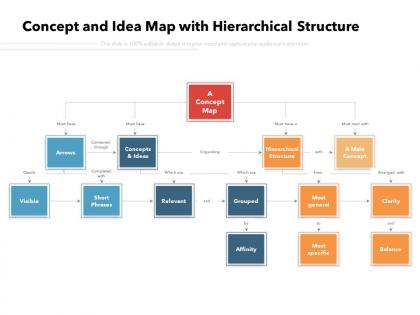
Concept and idea map with hierarchical structure




Try Before you Buy Download Free Sample Product
 Impress Your
 Audience
 100%
100% Editable
 Save Hours
 of Time


Our Concept And Idea Map With Hierarchical Structure are explicit and effective. They combine clarity and concise expression.
People who downloaded this PowerPoint presentation also viewed the following :
Concept and idea map with hierarchical structure with all 2 slides:
Give your audience a fulfilling experience. They will find our Concept And Idea Map With Hierarchical Structure elevating.
FAQs for Concept and idea map
Hierarchical structure concept mapping includes main concepts, subordinate topics, connecting relationships, linking words, and cross-connections between different branches. These components work together by organizing information from general to specific levels, establishing clear knowledge hierarchies, and revealing interconnected relationships, with many educators and businesses finding that this systematic approach enhances comprehension and strategic thinking.
Hierarchical structures enhance clarity by organizing complex information into logical levels, establishing clear parent-child relationships, eliminating information overlap, and creating intuitive navigation pathways. Through systematic categorization, organizations streamline decision-making processes, reduce cognitive load on users, and enable faster information retrieval, with many businesses finding that structured approaches ultimately deliver improved operational efficiency and enhanced user experiences.
Hierarchical concept maps can be used in educational settings for lesson planning, knowledge assessment, curriculum design, student note-taking, and collaborative learning activities. These visual tools enhance comprehension by organizing information from general concepts to specific details, with many educators finding that students demonstrate improved retention, critical thinking skills, and conceptual connections across subjects.
Recommended tools include Lucidchart, MindMeister, Creately, Canva, and Microsoft Visio, each offering drag-and-drop functionality, collaboration features, and professional templates. These platforms streamline concept mapping by enabling real-time collaboration, automated formatting, and seamless integration with business systems, with many organizations finding that digital mapping tools enhance strategic planning and knowledge visualization across teams.
Hierarchical maps significantly enhance information retention compared to traditional linear notes by leveraging visual organization, interconnected relationships, and multi-level categorization that mirrors natural cognitive processing. Through branching structures and spatial arrangements, students demonstrate improved recall, deeper conceptual understanding, and enhanced pattern recognition, while linear notes often limit connections between ideas, ultimately delivering superior long-term knowledge retention and comprehension.
Common challenges include maintaining clear hierarchical relationships, avoiding information overload, ensuring logical flow between levels, managing complex interconnections, and balancing detail with clarity. These structural issues often emerge in organizational planning and educational curriculum design, where teams struggle with overlapping concepts and unclear subordination, ultimately requiring iterative refinement to achieve effective knowledge representation and stakeholder comprehension.
Hierarchical structure concept mapping facilitates collaborative learning by enabling teams to visualize knowledge relationships, organize complex information systematically, and build shared understanding through structured dialogue. Through digital mapping platforms, students and professionals create interconnected knowledge frameworks together, identifying gaps in understanding, clarifying misconceptions, and ultimately developing comprehensive mental models that enhance group problem-solving and decision-making capabilities.
Effective hierarchical concept map organization requires strategic placement of broad concepts at the top, followed by increasingly specific subconcepts, clear linking words between connections, and consistent visual formatting throughout. Organizations should prioritize logical flow from general to specific, use meaningful relationship labels, and regularly review connections for accuracy, with many educational institutions and training departments finding that collaborative mapping sessions enhance comprehension and knowledge retention across teams.
Understanding hierarchical structures benefits project management by enabling clear task delegation, streamlined communication channels, defined accountability levels, and systematic resource allocation across project phases. Through hierarchical frameworks, project managers enhance coordination between teams, minimize role confusion, and accelerate decision-making processes, while maintaining oversight and control, ultimately delivering projects more efficiently and reducing operational bottlenecks.
Hierarchical structure concept mapping proves highly effective for business strategy development by organizing strategic elements into clear parent-child relationships, enabling systematic analysis of market positioning, competitive advantages, and operational dependencies. Through visual hierarchy mapping, organizations streamline complex strategic planning processes, enhance cross-departmental alignment, and identify critical success factors more efficiently, ultimately delivering clearer strategic roadmaps and improved decision-making capabilities.
Best practices for integrating visuals and colors in hierarchical concept maps include using consistent color coding for concept levels, applying visual hierarchy through font sizes and shapes, incorporating meaningful icons and symbols, maintaining adequate white space, and ensuring accessibility through contrast ratios. These design principles enhance comprehension by guiding the eye through logical information flows, reducing cognitive load, and enabling viewers to quickly identify relationships and priorities, with many educators and business analysts finding that strategic visual integration significantly improves map effectiveness and user engagement.
Cognitive load theory relates to hierarchical structure concept mapping by reducing extraneous cognitive burden through organized information presentation, clear visual relationships, and systematic knowledge chunking. This structured approach enables learners to process complex information more efficiently, with educational institutions and corporate training programs finding that hierarchical maps minimize working memory overload while enhancing knowledge retention and comprehension.
Keywords and phrases serve as the foundational building blocks of hierarchical maps, acting as clear labels that define relationships, establish conceptual connections, and guide logical flow between different levels. Strategic keyword selection enhances comprehension by creating intuitive pathways through complex information, with organizations in education, healthcare, and consulting finding that well-chosen terminology significantly improves knowledge retention and decision-making processes.
Hierarchical structure concept mapping supports critical thinking by requiring learners to analyze relationships, categorize information by importance, and identify logical connections between concepts and sub-concepts. This visual organization method enhances problem-solving skills by breaking complex issues into manageable components, enabling systematic evaluation of cause-and-effect relationships, and ultimately delivering clearer analytical frameworks for strategic decision-making.
Healthcare organizations like Mayo Clinic use hierarchical concept mapping for patient care protocols, while manufacturing companies such as Toyota apply it for quality control processes, and financial institutions leverage it for risk management frameworks. These applications demonstrate how structured visual mapping streamlines complex workflows, enhances cross-departmental communication, and ultimately delivers improved operational efficiency and better decision-making capabilities across diverse organizational contexts.
No Reviews