


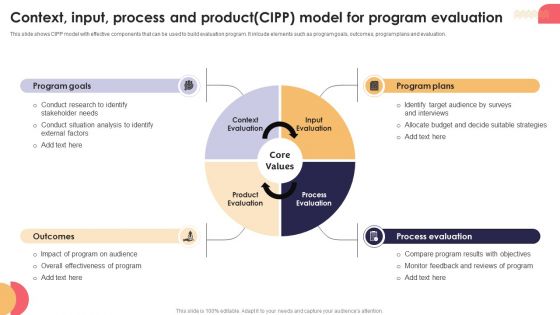
Context Input Process And Product CIPP Model For Program Evaluation




Try Before you Buy Download Free Sample Product
 Impress Your
 Audience
 100%
100% Editable
 Save Hours
 of Time


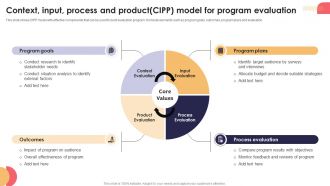
This slide shows CIPP model with effective components that can be used to build evaluation program. It inlcude elements such as program goals, outcomes, program plans and evaluation.
People who downloaded this PowerPoint presentation also viewed the following :
Context Input Process And Product CIPP Model For Program Evaluation with all 6 slides:
Use our Context Input Process And Product CIPP Model For Program Evaluation to effectively help you save your valuable time. They are readymade to fit into any presentation structure.





FAQs for Context Input Process And Product CIPP Model
So CIPP has four parts that flow together - Context (what needs fixing), Input (your resources and game plan), Process (tracking how it's going), and Product (did it actually work?). Start with Context since that's your foundation. Then you kinda move through the others in order, but honestly? You'll bounce back and forth between them constantly. It's not like following a recipe step by step. Input helps you pick the right approach, Process keeps you from going off the rails during implementation, and Product shows your final results. The whole thing's pretty flexible once you get the hang of it.
So CIPP breaks down into four stages. First is Context - figure out what you actually need and what environment you're working with. Input comes next where you check your resources, staff, budget stuff. During Process you're watching how things roll out day-to-day. Product is your final outcomes and impact measurement. Honestly, most evaluation methods just look at the end results which is kinda useless if things go sideways. This catches problems early so you can fix stuff as you go. Maybe make a quick checklist for each stage? That way you won't forget anything important when you're in the weeds.
Honestly, CIPP is a lifesaver because it covers everything - context, input, process, and product. Instead of scrambling at the end when problems show up, you're catching stuff early. Real-time feedback loops let you pivot when needed. I've seen too many projects crash because they only evaluated at the finish line (total nightmare). Your stakeholders get clear visibility into where money's going, plus you're making decisions based on actual data throughout the whole thing. Quick tip: map out what evaluation points you already have vs what's missing - that'll show you where to start.
Honestly, the context phase is where you can't afford to mess up because it sets up literally everything else. You're figuring out the environment, what's actually needed, existing conditions - all before you even touch the program. Kind of like... well, diagnosing before treating, I guess? This part directly shapes your questions later, what data you grab, how you make sense of it all. Skip the deep dive here and you might evaluate completely the wrong stuff. Seriously, invest time upfront or you'll be scrambling to explain why your whole evaluation was off-target.
Input phase is like checking what's actually in your pantry before deciding to make a five-course meal, you know? You're figuring out resources, what stakeholders actually want (not what they say they want), barriers that'll pop up, and whether your org can handle it. This stuff determines scope, timeline, who you need to hire - basically everything. Don't rush it or you'll design something that sounds amazing but totally flops when you try to run it. I've seen programs die because someone skipped this step. Really dig into what you're working with first.
So basically, this is where you figure out if your plan is actually working in real life. Track whether people are doing what they're supposed to do, and watch for where things get stuck. I always think of it like - you know when you're following GPS but traffic is crazy? Same thing here. You'll need to adjust as you go. Set up regular check-ins so you're not just hoping everything's fine. Real-time feedback lets you jump in with extra help or completely change tactics if something's bombing. Don't wait until the end to realize half your strategy didn't work.
Ugh, the data collection part is brutal - you're constantly gathering info for context, input, process, AND product evaluation. Plus timing everything is a nightmare since you can't just evaluate at the end like normal. You have to coordinate throughout the whole program. Stakeholders get annoyed with all the feedback loops too, especially when you're telling them to change course midway through. Honestly, the whole thing feels pretty heavy compared to simpler models. My take? Don't try to do everything at once. Pick one piece and get that working first, then add more later.
So the product phase is basically where you figure out if your program actually worked or not. You're comparing what you hoped would happen against reality - both the good and bad stuff. Honestly, this part can be pretty eye-opening! Collect data, get feedback from people involved, and really dig into whether you hit your goals. Don't sugarcoat the results either. If something flopped, own it. Then use all that info to decide your next move - keep going, change things up, or maybe just call it quits entirely.
Look, stakeholder engagement isn't optional in CIPP - it's everything. You'll need their input from day one or your evaluation becomes totally pointless. Context phase? They tell you what actually matters and what the real problems are. During Process evaluation, they're the ones dealing with implementation headaches firsthand. Product outcomes mean nothing if stakeholders don't care about them. And honestly, Impact assessment is just you guessing unless they define what success looks like. Map out your key players early and - this part's crucial - create tons of check-ins throughout. Otherwise you're just writing reports nobody reads.
So basically, you'll need to tweak the CIPP model based on your specific situation and culture. Like, if you're working somewhere that values group decisions over individual stuff, focus more on team outcomes and getting everyone's input. Hierarchical organizations might need extra approval steps - honestly, some places just love their red tape. Also think about how people communicate where you are. Data collection methods that work great in one culture might totally bomb in another because of different power dynamics or communication styles. But yeah, stick with CIPP's four phases, just adjust how you actually do each part.
So for CIPP evaluation, you'll need different metrics at each stage. Context phase - look at needs assessments and stakeholder surveys. Input covers your resources, budget stuff, staff qualifications. Process is where you track if things are actually running smoothly - participation rates, staying on schedule, that kind of thing. Product measures your real outcomes like test scores or completion rates. Honestly, I'd stick to maybe 2-3 good metrics per phase because otherwise you'll just get overwhelmed with data. Figure out what success actually looks like for your program first, then pick metrics that'll tell you if you're hitting those goals or not.
So CIPP is way more thorough than Kirkpatrick's four levels thing. It looks at your whole program - context, input, process, and outcomes. Kirkpatrick honestly feels pretty dated at this point. Logic Models are solid for connecting theory to results, but they're more about planning and pretty linear. With CIPP, you get this 360-degree view that spots problems Kirkpatrick totally misses. Actually, you can run CIPP and Logic Models together since they work well as a pair. Oh, and CIPP helps you make decisions while the program's running, not just after it's done. Way more useful for real-time adjustments.
So the Chicago Public Schools thing is probably your best bet to look up - they used CIPP for their whole math curriculum mess and it's really well documented. They tracked everything from resources (context) through teacher training (input) to how it actually played out in classrooms (process) and what kids learned (product). NASA does this stuff too but honestly that's way over-complicated for most situations. Chicago's case is great because you can see exactly how each piece helped them figure out what was bombing and what actually worked. Educational programs seem to get the most out of this framework from what I've seen.
Honestly, tech makes CIPP evaluation so much less painful. Digital surveys grab real-time feedback for your Context and Input stuff. Project management tools track Process implementation - basic but works. The Product evaluation though? That's where automated dashboards really shine for visualizing outcomes. I'd probably start with cloud platforms since they centralize everything in one spot. Makes comparing data across phases way easier, plus stakeholders can access findings instantly. Oh, and don't try digitizing all four components at once - pick one tool per component first. You'll thank yourself later.
CIPP's pretty demanding - you need good data collection skills and the ability to handle both numbers and interviews/observations. Managing stakeholders is honestly the worst part because everyone has different agendas. The model covers context, inputs, processes, and products, so there's a lot moving at once. Project management experience really helps since timelines get messy fast. Oh, and you'll be switching between quantitative and qualitative methods constantly. My advice? Start small with a pilot project first. Don't jump into something huge right away or you'll hate yourself later.
-
Mesmerized with the fantastic collection! Super sleek, relevant infographics.
-
They saved me a lot of time because they had exactly what I was looking for. Couldn’t be happier!