

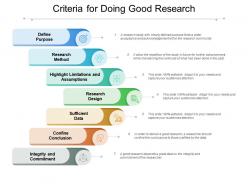
Criteria for doing good research





Try Before you Buy Download Free Sample Product
 Impress Your
 Audience
 100%
100% Editable
 Save Hours
 of Time


Our Criteria For Doing Good Research provide you with a vast range of viable options. Select the appropriate ones and just fill in your text.
People who downloaded this PowerPoint presentation also viewed the following :
Criteria for doing good research with all 5 slides:
Subscribe to our Criteria For Doing Good Research and receive great value for your money. Be assured of finding the best projection to highlight your words.
FAQs for Criteria for
When I'm looking at research, I check the journal's reputation first - impact factor tells you a lot. Sample size and methodology are huge too. Can other researchers actually replicate what they did? That's always a good sign. Citation count helps, but newer studies won't have many obviously. I also look for conflicts of interest disclosures and whether the funding sources seem sketchy. The institution matters some, though I've seen solid work come from smaller places too. Honestly, I'd rather see boring research with rock-solid methods than flashy results that fall apart under scrutiny.
Okay so peer review is basically like having other experts double-check your work before it goes public. They'll poke holes in your methodology, question your data, challenge conclusions - the whole nine yards. It's annoying but honestly? Worth it. People see that peer-reviewed stamp and immediately take your research more seriously. Skip it and even good work gets side-eyed. Yeah, the process takes forever (I'm talking months sometimes), but it catches embarrassing mistakes and makes your arguments stronger. If you want anyone in academia to actually listen, peer-reviewed journals are pretty much your only shot.
So reproducibility is huge when you're trying to figure out if research is legit. Other scientists should be able to follow the same methods and get similar results - that's basically how we know it wasn't just luck or bad science. Look for studies with detailed methods sections and available data. Has anyone else replicated the findings? That's gold. I've seen way too many studies that sound amazing but nobody can actually repeat them, which is sketchy as hell. If you can't reproduce it, don't trust it for your own work.
First thing - figure out what "good" looks like before you even start. I'm talking sample sizes, controls, bias checks, the whole deal. Honestly, get someone else to look at your stuff because you'll miss obvious problems. Use checklists if you have to (I know, sounds boring but whatever works). Citations and whether people can actually replicate your results? That's how you know if you nailed it. Also track if anyone's using your findings in real life - like policy changes or practice shifts. Do mini-audits on yourself before submitting anything. Saves you from looking dumb later.
So quantitative is all about whether you can replicate your results and generalize them - you need big sample sizes, controlled variables, solid statistical testing. Qualitative's totally different though. It's more about credibility and trustworthiness through thick descriptions, triangulation, member checking instead of p-values. Honestly, I think people underestimate how complex qualitative research actually is. The main thing? Quantitative tries to eliminate bias completely. Qualitative accepts that subjectivity exists and works with it. Just pick your quality criteria based on whether you're trying to measure something or really understand it.
Yeah, funding definitely messes with research quality. I always check who paid for studies first – companies love funding research that makes their products look good, while university or government grants are usually more neutral. Even good funders can push bias though, like forcing certain methods or deciding what gets studied. Actually ran into this issue myself reading supplement studies last month – every single one was company-sponsored and shockingly positive lol. Look for studies with mixed funding sources and make sure researchers could publish whatever they found. Transparent conflict disclosures are clutch too.
Okay so first thing - make sure it's peer-reviewed, that's basically mandatory. Then I'd check the impact factor and see how it ranks, but honestly don't stress too much about the numbers since some really solid niche journals score lower. Is it indexed in the big databases like PubMed or Web of Science? That's usually a good sign. Oh, and definitely look at their editorial board - sketchy journals sometimes just make up fake experts which is wild. One last thing that's helped me: see if your library actually subscribes to it. Librarians are surprisingly good at weeding out the garbage ones.
Oh totally go for it! Different fields attacking the same problem catches way more blind spots than working solo. The best discoveries happen where disciplines meet - like, some of my favorite research comes from those weird intersections. Plus you get natural validation when multiple approaches point to the same conclusion. Just heads up though - coordinating gets messy fast. Communication between departments can be... rough sometimes. My advice? Start with just one other field that complements yours. Don't jump into some massive five-way collaboration right off the bat. You'll thank me later.
Look, policymakers get hit with tons of contradictory studies every day, so solid research with good methodology actually stands out. They need reliable data to make real decisions instead of just winging it based on politics. Being upfront about your limitations helps too - nobody likes researchers who oversell their findings. I've seen way too many perfectly decent studies end up ignored because they weren't rigorous enough or transparent about uncertainties. Bottom line: focus on clean design and clear reporting. That's honestly what separates research that actually influences policy from stuff that just sits there collecting dust.
Honestly, the biggest mess-ups I see are tiny sample sizes and confirmation bias. Research questions that are way too vague will screw you over too. Leading questions are the worst though - you're basically fishing for answers you already want to hear. Don't even get me started on selection bias when you only survey your super fans. Tight deadlines make people rush analysis, which kills otherwise solid research. My take? Spend way more time upfront figuring out what you actually need to know. Then grab a coworker to sanity-check your approach before diving in.
Honestly, you can't mess around with vague research objectives - they'll tank your whole study. I learned this the hard way watching a colleague get rejected because reviewers couldn't figure out what she was actually trying to prove. Your objectives literally shape everything: what methods you pick, how people judge your work, whether your results matter. Specific and measurable is the way to go. Also, weirdly, taking that extra time upfront saves you so much headache later when you're drowning in data and wondering what the point was.
Bias basically makes you see what you want to see instead of what's actually happening. You'll cherry-pick data that supports your hypothesis and ignore stuff that doesn't. It's honestly pretty easy to fall into this trap - I've caught myself doing it before. Your conclusions end up reflecting your expectations rather than reality, which tanks your credibility. Other researchers won't trust your work, and you might send future studies down the wrong path. Oh, and it makes replication nearly impossible. Best way to fight it? Use blind data collection when you can, get peers to review everything, and document your methods super clearly so others can spot potential issues.
Honestly, it starts with leadership actually doing what they preach - can't have senior researchers cutting corners while expecting everyone else to follow the rules. Set clear standards, sure, but back them up with real training on methodology and research integrity. The whole "publish or perish" culture is such a mess though. Why not reward quality peer review and data sharing as much as cranking out papers? People need actual time and resources to do good work instead of rushing to meet some arbitrary quota. Regular quality checks help, and - this sounds obvious but - make it safe for people to discuss problems without getting hammered for it.
You really can't separate research ethics from quality - they're totally connected. Cut corners on ethics (fudging data, skipping consent, whatever) and you're basically sabotaging your own results. Think of it this way: ethical practices actually make your methodology stronger because they force you to be more careful and transparent. I know the ethics requirements feel like annoying paperwork sometimes, but honestly? They're more like quality control checkpoints. Your research will be way more solid if you treat them that way instead of just trying to get through them.
Honestly, tech has completely changed research for the better. You can grab way more accurate data now and crunch numbers in minutes instead of weeks. Online platforms are huge too - no more being stuck with whoever's in your town (though sketchy responses are definitely more of a headache). Real-time analytics is probably the biggest win, plus everyone can collaborate from wherever. Oh, and automated data collection cuts down on so many stupid mistakes. If you're getting into research, spend some time learning the digital tools early. Trust me, it'll save you so much pain down the road.
No Reviews