

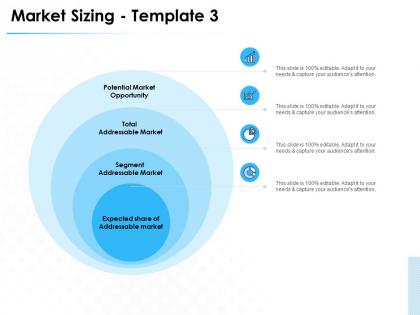
Market sizing template potential market ppt powerpoint presentation themes




Try Before you Buy Download Free Sample Product
 Impress Your
Audience
 100%
Editable
 Save Hours
of Time


Our Market Sizing Template Potential Market Ppt Powerpoint Presentation Themes are highly compatible. They will adapt to your thought process in a jiffy.
People who downloaded this PowerPoint presentation also viewed the following :
Market sizing template potential market ppt powerpoint presentation themes with all 2 slides:
Our Market Sizing Template Potential Market Ppt Powerpoint Presentation Themes are very compelling. They leave your audience with no other choice than to applaud.


FAQs for Market sizing template potential market ppt
So you need to figure out your target audience first, then work through TAM, SAM, and SOM - most people totally skip that last one but it's honestly the most useful since it shows what you can actually grab. Also factor in growth rates, customer acquisition costs, and who you're competing against. Oh and definitely back everything up with real data - industry reports, surveys, customer interviews, whatever you can get your hands on. I always start with the big picture TAM and narrow it down from there. Way more realistic that way.
Numbers tell you what, but not why. That's where talking to actual customers and industry experts comes in clutch. Like, your spreadsheet might say people will pay $50/month, but will they actually? Customer interviews help you reality-check those assumptions. I've seen so many models that looked perfect on paper but totally missed behavioral stuff - adoption barriers, weird market quirks, timing issues. The math matters, but combining it with real conversations makes your sizing way more believable. Try to back up your biggest assumptions with at least 2-3 solid qualitative insights.
Honestly, start with demographics - that's the easy stuff like age, income, where they live. For B2B add company size and industry. Then dig into how people actually behave with your product. Do they buy once or keep coming back? What's driving them crazy that you could fix? Oh and psychographics - I know it sounds fancy but it's just their values and lifestyle stuff. Like, why do they really buy? Status? Convenience? The real insight comes when you stack all this together instead of looking at each piece alone. Demographics first though, then build from there.
Your methodology totally shifts how you make strategic calls. Top-down gives the big picture for investor decks, but it's kinda hand-wavy if I'm being honest. Bottom-up is where you get tactical - shows exactly where revenue comes from and sets realistic targets. TAM/SAM/SOM helps you figure out timing and resource decisions. Here's what I'd do: run multiple approaches and compare them. When your bottom-up numbers look completely off from top-down estimates, that's your cue to dig deeper. Don't make big bets until you've sorted that out - learned this the hard way once.
Here's the thing about competitor analysis - it'll totally change how you think about market size. Look at what your competitors are actually pulling in revenue-wise and how many customers they've got. That gives you real data instead of just guessing at TAM. Their growth rates show you what's realistic too. I'd start by picking 3-5 direct competitors and basically reverse-engineer their market share. Also check out their pricing - you might realize you're targeting the wrong segments entirely. Your first market estimate is probably gonna be way off anyway (everyone's is), so use competitor data to get closer to reality.
Honestly, emerging tech makes your usual market research pretty much worthless. You can't rely on surveys or historical data when you're trying to figure out demand for AI tools that literally didn't exist last year. Instead, you gotta get scrappy with leading indicators - watch early adopter patterns, dig into adjacent markets for clues. I've found social listening and app download trends super helpful, plus patent filings are surprisingly revealing. Your estimates will be rougher for sure, but the trade-off is you can update them constantly as real usage data comes in. Way better than pretending you know exactly what'll happen.
Look, geographic segmentation matters because demand isn't spread evenly everywhere - that's just not how the world works. Urban areas hit differently than rural ones, and different states/countries have totally different penetration rates. You can't just assume your product will perform the same in Ohio as it does in California, you know? Start with your main geographic markets first. Then add in population density, economic stuff, and any regulatory weirdness. Way better than trying to analyze everything at once - that's just overwhelming. This approach gives you actual defendable numbers for your market size instead of some pie-in-the-sky estimate.
Honestly, you gotta mix a bunch of different approaches to really know if your idea's solid. Survey people, do interviews, maybe run a tiny pilot program - that's your primary research right there. Secondary stuff like industry reports and competitor analysis helps too. But here's the thing - all that desk research only tells you so much. The real test? Getting people to actually open their wallets. I'd run some kind of lean experiment or basic MVP to see if they'll pay. Then compare everything you found and look for patterns. Trust me, talking directly to your target customers beats any report you'll find online.
Oh man, the biggest trap is using old data - I've seen so many people pull reports from like 2019 that are completely useless now. Check those dates! Also, those TAM/SAM numbers everyone loves? Total BS half the time. They make everything look like a billion-dollar opportunity when it's really not addressable for your specific thing. Don't mix up correlation with causation either - super easy mistake. Cross-check everything with multiple sources because one report can be way off. And honestly? Write down your assumptions clearly so people can actually debate them instead of just nodding along.
Your historical sales data is basically your starting point for figuring out where the market's headed. I'd grab 3-5 years if you can get it (more is better but sometimes you work with what you have, right?). Look for trends, seasonal ups and downs, year-over-year growth - all that good stuff to project future market size. This helps double-check your bottom-up math too. Makes sure you're not totally off base. But don't forget about outside stuff that could mess with those trends - new competitors jumping in, regulatory changes, economic weirdness. Those factors can really speed things up or slam the brakes on growth.
Just use Excel, trust me. It's flexible and everyone already knows how to use it. Google Sheets is solid too if you need to collaborate with your team in real-time. Honestly, I'd skip the fancy stuff at first - though Tableau does make pretty visualizations if you're into that sort of thing. Some people map out their initial framework in Miro or Figma first, but that feels like extra steps to me. You can build both top-down and bottom-up calculations in a basic spreadsheet without any drama. Start there, then export your data to something fancier later if you actually need it.
So basically, consumer behavior totally changes your market size math. When people start wanting sustainable stuff, your eco-friendly market gets bigger while regular products shrink. Digital trends, what different generations buy, money pressures - all of it shifts who's actually buying what. I've watched teams completely whiff on this and end up with crazy unrealistic numbers! You can't just look at demographics and call it good. Layer in the behavior changes when you're doing your TAM/SAM work. Always double-check against real purchase data and recent surveys though.
Honestly, start with surveys and interviews - that's where you'll get the real insights. Hit up your existing customers or potential users with targeted questionnaires about buying patterns and spending habits. Interviews are clutch because you catch those lightbulb moments you'd totally miss otherwise. Also reach out to industry experts or distributors who actually know the market. Focus groups are solid if you've got the budget, though they're not make-or-break. Around 20-30 good data points should give you way more confidence in whatever numbers you're working with. Way better than just guessing, obviously.
Oh dude, you absolutely need all three - can't just wave around some massive TAM number and call it a day. TAM is like the total pie, SAM is what you could realistically grab with your current setup, and SOM is what you'll actually get. I've watched so many founders crash and burn because they're like "it's a trillion dollar market!" without explaining their actual slice. Super cringe honestly. Investors want to see you get the nuances and can back up your math. Give them TAM for the big picture, but really dig into your SOM - that's where the real conversation happens.
Regulations will absolutely destroy your market size math if you ignore them. They decide what you can even sell and where. Cannabis is the perfect example - you'd be totally off if you didn't check which states actually legalized it first. Licensing fees, compliance headaches, product bans... all that stuff shrinks your real addressable market fast. Plus regulations create these weird artificial bottlenecks that mess with your supply assumptions. Honestly, I learned this the hard way on a project once. Just dig into the regulatory mess early and bake those limits right into your calculations.
No Reviews