

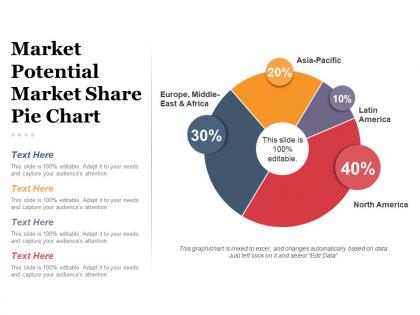
Market potential market share pie chart presentation deck




Try Before you Buy Download Free Sample Product
 Impress Your
 Audience
 100%
100% Editable
 Save Hours
 of Time


Get the chat going with our Market Potential Market Share Pie Chart Presentation Deck. The gathering will be abuzz with expectation.
People who downloaded this PowerPoint presentation also viewed the following :
Market potential market share pie chart presentation deck with all 5 slides:
Our Market Potential Market Share Pie Chart Presentation Deck are given to accomplishments. They are completely committed till the end.


FAQs for Market potential market share pie
So there are three main ones you'll want to look at. Revenue share is your dollar sales vs the whole market - that's usually what matters most to the higher-ups. Unit share tracks actual products sold, which is super useful if you're in a volume game. Then customer share shows what percentage of people pick you over competitors. Honestly, I'd track all three if you can swing the data collection. They each tell a different story about where you stand. Though if you're just starting out, revenue share is probably your best bet since that's what everyone upstairs cares about anyway.
Honestly, market share basically decides if you're playing offense or defense. Big players? They're usually trying to protect what they've got and block everyone else out. Smaller companies have to get scrappy - find gaps nobody's filling or shake things up with something new. When you're on top, you get all those nice perks like better pricing power and you basically set the rules everyone else follows. But if you're small, you're probably going after weird little segments the big guys ignore or just moving way faster than they can. Bottom line - don't copy what the market leader does if you're not the market leader, ya know?
So basically, when people change what they want or how they shop, companies either adapt or get left behind. Like when everyone suddenly cared about sustainability - some brands pivoted fast while others are still catching up. Your shopping habits matter more than you think. Whether you're loyal to a brand or constantly switching affects which companies win. Price sensitivity is huge right now too. I've noticed people are way more willing to try store brands than they used to be. The smart move? Watch consumer trends because they'll show you which way the market's headed before the big shifts happen.
Honestly, saturated markets are tough - you're basically fighting for scraps since there aren't new customers appearing out of thin air. Price wars seem tempting but they're a nightmare that just hurts everyone's margins. What's worked better in my experience? Find what actually makes you different and hammer that point home. Look for weird little niches your competitors ignore, or just obsess over customer service until people can't shut up about you. Strategic partnerships can give you a shortcut too. The real trick is being brutally honest about where you actually beat the competition, then going all-in on those strengths.
Honestly, chasing market share can totally backfire on you. You'll slash prices so hard that sure, you beat competitors, but your profits tank. Been there, seen that mess happen way too many times. Meanwhile you're missing these sweet niche opportunities because you're obsessed with what everyone else is doing in the mass market. Here's the thing though - having the biggest slice doesn't mean you're actually making bank. Focus on customer lifetime value and profit per segment instead. That combo gives you the real story, not just bragging rights about share.
Dude, emerging markets are absolutely insane compared to established ones. Companies can literally jump from 5% to 25% market share in like two years - it's wild. Meanwhile, established markets? Super boring honestly. You've got the same old players fighting over scraps, celebrating when they gain 0.5%. Consumer preferences are still all over the place in emerging markets, so new companies can swoop in and grab huge chunks. That's why your approach has to be totally different. Go aggressive and opportunistic in emerging markets. But with established ones, you're basically playing defense and hoping for tiny wins.
So here's the deal - when you've got a bigger chunk of the market, you can basically charge more. Customers don't have as many options, so they'll pay your premium prices. Smaller companies? They're stuck competing on price, which kills their margins. Think about it like this: if you're the only decent restaurant in a small town, you can charge way more than if you're competing with five other places. Plus you get those scale benefits where everything costs less per unit. Honestly, figure out where you stand competitively first - then you'll know if you can push prices higher or need to stay competitive.
So basically, new tech creates clear winners and losers by flipping who has the advantage. Look at Nokia - they owned mobile until smartphones hit, then Apple and Samsung crushed them. It's wild how fast that happened. The thing is, tech doesn't just make products better - it totally changes what people want. Like, suddenly everyone expected touchscreens and apps. When you're looking at market share shifts, check what tech changes are happening in that space. Companies that adapt fast usually win big, while the slow ones get left behind.
Excel's probably your best bet to start - I still use it for tons of stuff honestly. Google Sheets works too if you're broke lol. Once you want prettier charts, Tableau and Power BI are solid choices. For industry data, check out Nielsen or IBISWorld, though they can get pricey. SEMrush is amazing for spying on competitors online. Oh, and don't forget the boring government databases - they're free and sometimes have exactly what you need. Trade associations publish decent reports too. Just start simple and add fancier tools when you actually need them.
Market share numbers only tell you what's happening, not why. Say you're down 5% - that could be pricing, service issues, or something totally different. Without talking to actual customers, you're just guessing at solutions. I always dig into interviews and focus groups because they catch problems way before they tank your numbers. Social listening helps too, honestly. Like, customers might be complaining about your checkout process while you're over here tweaking prices. Pair those reports with real customer feedback and you'll actually know what's going on.
So basically, loyal customers don't jump ship to competitors, which pumps up your market share. Higher market share makes you more visible and trusted - then boom, even more loyalty. It's this whole cycle that feeds itself. Companies with bigger market presence also have more resources to keep customers happy, which smaller brands can't always match. Look for brands dumping money into retention programs instead of just chasing new customers. Those are the ones thinking long-term about actually owning their market, not just surviving in it.
So basically, SWOT analysis shows you exactly where to put your energy for gaining market share. Hit competitors where they're weak using your strong points. Fix your own weak spots before they bite you later. Jump on opportunities while they're hot - timing matters more than people think. Threats are probably the most overlooked part, but they'll show you what could wreck your current position if you ignore them. It's honestly just being real with yourself about your business situation. Way better than randomly spending money on growth tactics that might not even work. Helps you focus on stuff that'll actually make a difference.
When you're losing market share, revenue growth slows down even if you're technically still growing. Your competitors are just doing better. Pricing power gets weaker because customers have options now. It's also tougher to get good talent or negotiate decent supplier deals. Investors start getting antsy too, which screws with your stock price or funding. Here's the thing though - winning back customers is way harder than keeping them. Like, exponentially harder. I'd honestly figure out the "why" first. Is your product lacking? Pricing off? Could be something totally different.
Here's the thing - segmentation helps you stop wasting money on customers who'll never buy from you anyway. Instead of trying to please everyone (which never works), you pick specific groups and really nail what they want. Think of it like dating, honestly. You wouldn't use the same approach on every person, right? Same deal here. You can customize your product, messaging, pricing - the whole package. Your competitors are still doing the spray-and-pray method while you're actually connecting with people. Start by looking at who's already buying from you and find the patterns.
Honestly, M&As are probably the fastest way to grab market share overnight. You're basically mashing two customer bases together - Company A buys Company B, boom, their combined share jumps instantly. It's pretty crazy how dramatic those shifts can be. Smaller companies use this to catch up with the big guys, or it creates new market leaders entirely. The catch? Regulators will shut down deals that look too monopoly-ish, so you can't just buy everyone. But yeah, whenever you see M&A news in your space, that's usually what'll shake things up the most.
-
Very well designed and informative templates.
-
Great designs, really helpful.