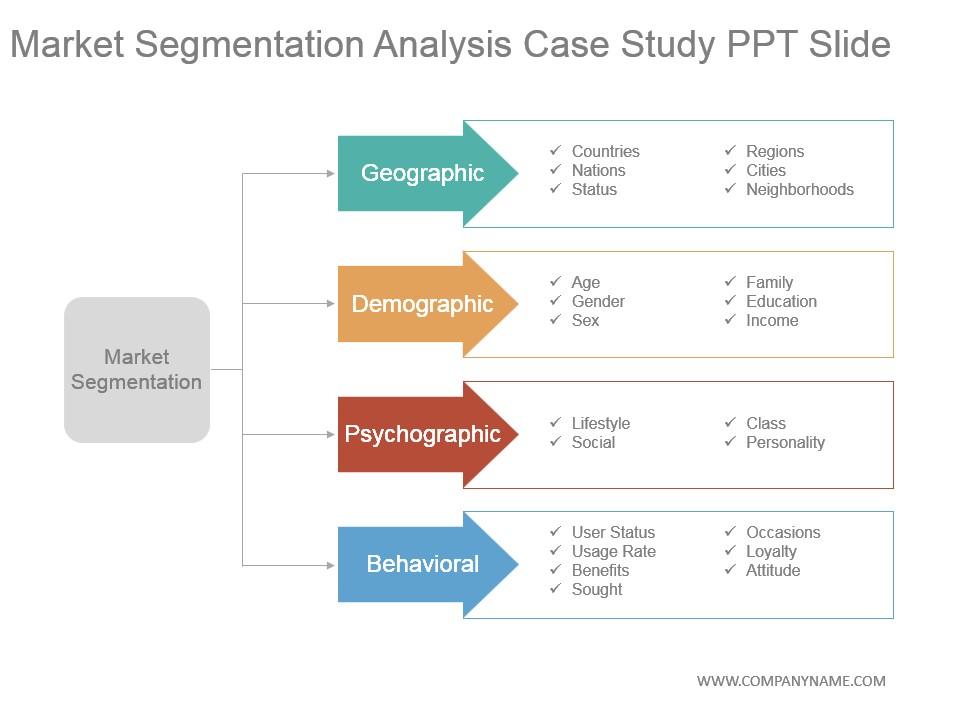
Market segmentation analysis case study ppt slide
Try Before you Buy Download Free Sample Product
Audience
Editable
of Time
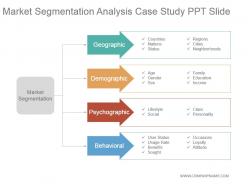
Understand your overall market and divide mass markets into groups with similar needs with the help of our market segmentation analysis case study PPT slide. This PPT theme of market segmentation analysis case study enables you to conduct customer segment analysis to achieve competitive advantage and superior performance. This market segmentation targeting and positioning template allows your business to distinguish entire market into smaller sub-segments to create uniform marketing mix for all customers. Market targeting PowerPoint slide allows you to segment market on general demographic information and also to target sections based on details such as buying habits, political affiliation, favorite pets, or travel habits. In this slide of market positioning, companies can position themselves to satisfy the needs and wants of a homogeneous audience. Market divisions case study template is designed by our professional team members and enables you to create basics of market segmentation, market segmentation analysis and each one's purpose, key pitfalls and to ensure if your market segmentation analysis is valid. Download this market analysis case study layout and boost customer loyalty, brand recognition and profits generated in these selected market segments. Hand down your expertise with our Market Segmentation Analysis Case Study Ppt Slide. Guide them along to great achievements.
People who downloaded this PowerPoint presentation also viewed the following :
Market segmentation analysis case study ppt slide with all 5 slides:
Build the framework with our Market Segmentation Analysis Case Study Ppt Slide. Create a bridge to carry your thoughts across.
FAQs for Market segmentation analysis case
Okay so market segmentation is basically figuring out who your actual customers are instead of just throwing stuff at the wall. You can make campaigns that don't suck because you're speaking to real people, not some imaginary "everyone." Pricing becomes way less of a guessing game too. I've seen companies waste so much money on broad campaigns that nobody cares about. When you dig into your customer data, you'll find patterns in how people buy - and honestly, some of those insights will surprise you. Focus your energy on the segments that actually matter. Way better than trying to please everyone and ending up with bland messaging that converts nobody.
So basically you'll want to group people by age, income, gender, education - stuff like that. Surveys and purchase history are great for collecting this data. Here's the thing though: millennials might shop online constantly while boomers still prefer walking into stores. Pretty obvious when you think about it! Don't just gather all this info and sit on it. Actually test if these groups respond differently to your ads or products. Run some A/B tests with different demographics. Otherwise you're just guessing whether your segments actually matter for sales.
So demographics are like the basic stats - age, income, where someone lives. Pretty surface level stuff. Psychographics go way deeper into the *why* behind buying decisions. Like, picture two 35-year-old moms in the suburbs. Same demographics on paper, right? But one's all about organic everything and sustainability, while the other just wants whatever's fastest. Totally different shoppers. That's where psychographics shine - they tap into people's actual values and motivations. Way better than just throwing ads at "women 25-45" and crossing your fingers. You can actually speak to what drives them.
SPSS or R are your best bet if you can handle the learning curve - they're basically the gold standard for clustering analysis. Tableau and Power BI work great for actually visualizing whatever segments you find. Google Analytics is super useful for behavioral stuff if you're looking at web users. Don't sleep on Excel though - it can handle basic demographic segmentation fine if your dataset isn't massive. Qualtrics has some decent built-in segmentation features too, way more user-friendly than the statistical stuff. Honestly I'd just start with whatever you already have before dropping money on new software.
Dude, you can't just slap the same campaign everywhere and hope it works. Different regions need totally different approaches - messaging, pricing, products, all of it. Look at McDonald's serving rice burgers in Asia but regular ones here. Makes sense though, right? In rich markets you might push premium quality, but in developing countries affordability wins. The trick is staying true to your brand while actually respecting what locals want. I'd start by mapping out your biggest markets first and figure out what makes each one tick. Brand consistency matters, but so does not looking tone-deaf.
Dude, behavioral segmentation is where it's at. Instead of guessing based on age or location, you're actually watching what people do - their buying habits, how often they use your stuff, what makes them pull the trigger on purchases. Way more reliable than assumptions, honestly. You can spot the bargain hunters and hit them during sales, or find your die-hard fans and show them premium products. I started doing this last year and it's crazy how much better my campaigns perform now. Just dig into your customer data first - look for patterns in how people shop, then build your messaging around those behaviors. Works like magic.
Here's the thing - big companies are trying to please everyone, which means they suck at serving specific groups really well. You can totally beat them by going super narrow. Like, instead of "pet products," think "eco-friendly stuff for millennials with dogs in apartments." Giants can't move fast enough to chase these smaller markets (plus their overhead makes it not worth it). Speed is your friend here. Pick something you actually get, then become THE person for that group. Honestly, personalized service alone will make you stand out when customers are used to being just another number.
Honestly, the worst thing you can do is go crazy with tiny segments. Like, you'll have 20 different micro-audiences but no budget to actually reach any of them properly. Super common mistake. Don't just segment by age and income either - that's so 2010. What people actually DO matters way more than their demographics. Oh, and here's something people forget - make sure your segments are big enough to be worth it AND that you can actually reach them through your channels. I always tell people to test with real data first before throwing money at assumptions.
Honestly, just run some cluster analysis on your customer data first - see if the natural groups actually match what you think. Then A/B test different messages across those segments. That's really where you'll know if you're onto something or just making stuff up. Look at buying patterns and lifetime value differences too. Survey data's helpful I guess, but people say weird things in surveys - their actual behavior tells the real story. Demographics can show overlaps you missed. Pick your biggest assumption and test that one hard before you get distracted by the others.
So market segmentation basically tells you what to build next. You map out different customer groups and see what they actually need - then you can create features that really hit the mark instead of generic stuff that's just okay for everyone. Honestly, I'd rather have one tool that's perfect for my specific situation than something trying to do everything. Start by looking at your current features and matching them to your segments. The gaps will jump out at you pretty quick. Then prioritize based on which segments have the biggest opportunities or pain points you haven't solved yet.
Honestly, just figure out where your different customer groups actually spend their time online. Gen Z? They're all over TikTok and Instagram Stories, so don't waste money on Facebook for them. LinkedIn's obviously your go-to for B2B stuff. But here's the thing - you can't just pick the right platform and call it done. Your messaging needs to be different too. Price-conscious customers want totally different ad copy than your premium buyers, even if they're on the same app. Pick your top 2-3 customer segments first. Map them to their favorite platforms, then test different approaches. Way easier than trying to be everywhere at once.
Start with conversion rates by segment - that's what actually matters. Then watch your CAC and LTV for each one because honestly, what's the point if you're bleeding money? Click-through rates and time-on-site will be all over the place between segments, which tells you a lot. Oh, and retention rates are huge - some segments convert great upfront but disappear fast. I'd probably build a monthly dashboard comparing everything so you can see which segments are worth it. Makes it way easier to spot the winners vs the ones that need work.
Honestly, personas are a game-changer because you stop throwing stuff at the wall hoping it sticks. You can actually speak directly to what each group cares about instead of that bland generic messaging that nobody connects with. Your engagement shoots up when people feel like you "get" them, you know? Plus your ad budget goes so much further - no more burning cash on people who were never gonna buy anyway. I'd say pick your top 2-3 segments first and really dial in what drives each one. Way better than trying to please everyone at once.
Look at Nike - they don't just go after athletes, they target anyone with that "athlete mindset" thing across all ages. Coke's genius at this too, changing up flavors and ads by region. McDonald's breakfast people are totally different from their dinner crowd, and their app knows it. Actually, their targeting is pretty scary good when you think about it. But here's what I'd do - pick maybe 2 or 3 segments tops and really dig into what makes each group buy. Don't try being everything to everyone because you'll just end up being nothing to nobody.
Honestly, AI can process way more customer data than you'd ever handle manually - we're talking behavioral patterns, purchase timing, social media stuff, plus hundreds of other variables all at once. The algorithms actually get smarter over time at spotting patterns you'd never catch. What's really cool is how it updates segments in real-time when customer behavior changes. Way better than just basic demographics. I'd probably start small though - maybe run a pilot with your current customer data first? That way you can see if it's worth the investment before going all in.
-
Unique and attractive product design.
-
Great product with effective design. Helped a lot in our corporate presentations. Easy to edit and stunning visuals.