


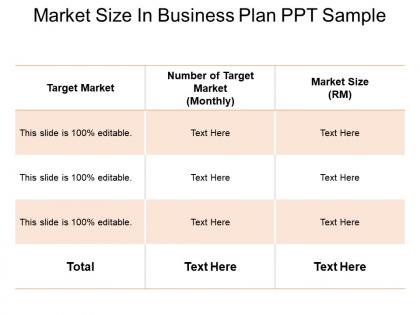
Market size in business plan ppt sample




Try Before you Buy Download Free Sample Product
 Impress Your
 Audience
 100%
100% Editable
 Save Hours
 of Time


Fruits are forever with our Market Size In Business Plan Ppt Sample. Your efforts will always come good.
People who downloaded this PowerPoint presentation also viewed the following :
Market size in business plan ppt sample with all 5 slides:
Deliver information to all corners of the globe with our Market Size In Business Plan Ppt Sample. It is an instrument for generating awareness.


FAQs for Market size in business
Customer demand and competition are your big ones to watch. Population demographics matter too - luxury stuff won't fly in broke areas, obviously. I'd also check the regulatory environment since that can tank businesses overnight. Economic conditions, market maturity, barriers to entry - all impact who can actually compete. Oh and tech disruption is huge depending on your industry. Geographic factors and distribution channels come into play as well. Honestly, I'd start by figuring out which factors change most in your specific market, then just keep tabs on those.
Demographics are like your crystal ball for spotting hot sectors before everyone else catches on. Aging population? Healthcare tech is about to explode. More Gen Z with actual spending power? Digital everything, plus they're obsessed with sustainability. But here's the thing - don't just count heads. Income matters way more than population size, honestly. I always check census data against what people actually spend money on because sometimes trends look amazing on paper but flop hard in real life. Tech adoption rates tell you a lot too. Start by figuring out which demographic groups are growing fastest in your area, then see where your business idea fits.
So there's basically two main ways to tackle this. Top-down means you start with the huge total market and work your way down to your slice. Bottom-up is the opposite - build from your actual target customers upward. You can also look at similar markets for comparison, or do surveys/interviews if you've got the cash (spoiler: it's pricey). TAM/SAM/SOM is pretty much the standard framework everyone uses. Honestly, I'd start with free secondary research first to get rough numbers, then maybe validate with real data later. Just don't rely on one method - single estimates are usually garbage.
Honestly, market sizing is clutch for figuring out where to actually put your time and money. Map out your current market share vs. the total opportunity - that'll show you where you're missing out. Use those numbers to pick which segments to hit first and set revenue goals that aren't completely delusional. Big gaps usually mean big opportunities, not just chasing whatever's hot right now. Oh and investors eat this stuff up - way better than just winging it with gut feelings. Start there and see what jumps out at you.
Honestly, competition is weird - it can make markets bigger or smaller depending on the situation. Look at smartphones, right? All those different companies fighting actually made the whole market explode because everyone started wanting one. That's the good kind where competition creates awareness and drives prices down. But then you've got other markets where companies are just beating each other up over the same small group of customers. Those situations suck because nobody's really growing anything, they're just stealing sales from each other. You need to figure out which type your market is - are competitors expanding the pie or just cutting it into smaller pieces?
So here's the thing - market segmentation totally flips how big your opportunity actually looks. You might think you're chasing billions when you look at the whole market, but start breaking it down by location, age groups, buying habits? Your actual reachable market gets way smaller, fast. Honestly, it's kinda like those weird optical illusions where circles look different sizes next to each other. The trick is being real about which chunks you can actually go after and do well with. I'd start small with the segments that make sense for you, then see if what's left is still worth the effort.
Honestly? Both ways screw you over, just differently. Miss the mark low and you won't have enough inventory, staff, or marketing budget when demand actually hits. Go too high and you're basically lighting cash on fire - kinda like those startups that spend millions on fancy offices before they have real revenue. Strategic planning gets messy either way since you're working with bad numbers. What I'd do is run three different scenarios: pessimistic, realistic, and optimistic. That way you're not caught totally off guard regardless of what actually happens.
Tech usually grows markets way bigger than you'd expect - it creates totally new customer groups. Look at smartphones and photography. Before, only pros had decent cameras. Now literally everyone's a photographer, which exploded that whole market. Same pattern happens everywhere - technology makes stuff cheaper and easier for regular people to use. Sure, it might kill off some old segments, but overall the market gets huge. I'd honestly look for any tech that could make your industry way more accessible. That's where the real growth potential hides.
So I usually hit up IBISWorld or Statista first - their industry reports are solid. Government stuff like Census Bureau data is free and pretty reliable too. McKinsey reports are great but can be pricey. Trade association publications are underrated honestly. Once you've got the baseline, do some surveys or interviews to double-check what you're seeing. Oh, and if you're looking at public companies, their annual reports and SEC filings have tons of good info. I learned this the hard way - always cross-reference like 3-4 sources because you'll catch weird inconsistencies that way.
Break down your total market into smaller chunks - geographic areas, customer types, price points, whatever fits. Hunt for segments growing fast but with few competitors. Those pockets are goldmines! Talk to potential customers in those segments to understand what they actually need. You'll want segments big enough to matter but small enough that you can realistically grab a decent chunk. Oh, and don't ignore the boring segments - sometimes they're the most profitable because everyone else thinks they're too unsexy to bother with.
Honestly, the biggest mistake is thinking your Total Addressable Market equals what you'll actually get - those numbers are completely different. Don't rely on old data or just do top-down math without checking it bottom-up. That whole "we only need 1% of this huge market" thing? Way harder than people think. Define your actual target segments instead of being super vague about it. I always cross-check multiple sources because one dataset can be totally wrong. Be real about competition and market saturation too. Oh, and start conservative - you can always revise up later but it's awkward going the other direction.
Look, geography completely changes your market size in ways most people miss. Population density is obvious - cities beat rural areas every time for customer concentration. But weird stuff matters too, like trying to sell snow gear in Miami (good luck with that). Economic development across regions creates massive differences in spending power. Infrastructure can make or break distribution costs. Then you've got local regulations and cultural preferences throwing curveballs at your assumptions. Here's what I'd do: segment everything geographically first, then throw out those national averages. They're pretty useless when Texas and Vermont are completely different worlds.
Start with TAM calculations - that's your foundation. Then break it down into SAM and SOM. Track things like online penetration rates, user acquisition costs, and lifetime value. Conversion rates are clutch too (I'm way too obsessed with checking mine daily lol). Monthly active users will give you a solid pulse on growth. Oh, and definitely split your data between mobile and desktop - people act completely different on each platform. Work backward from your TAM to reality-check everything. The numbers don't lie about what's actually happening versus what you think could happen.
Don't just do market analysis once at the beginning - that's where most people mess up. Check your total addressable market during discovery, then keep refining those numbers as you build features. I've seen too many teams skip the mid-development checks and then wonder why their launch flopped. User feedback changes everything, so update your market segments during sprints. Competitive stuff shifts constantly too. Before you actually launch, revisit those penetration assumptions or you'll set yourself up for disappointment. Think of it as a living doc that grows with your product knowledge.
Yeah so the economy hits different sectors in totally different ways. Luxury stuff and real estate go crazy during good times, but when things get rough they tank hard. Meanwhile boring sectors like utilities just... exist, regardless of what's happening. Dollar stores actually do better in recessions which is kinda depressing but makes sense. Your market probably falls somewhere on this spectrum. I'd track economic indicators before they show up in your projections - gives you a heads up. Also watch how people's spending habits change since that's what really drives market size shifts.
-
Great product with highly impressive and engaging designs.
-
Great quality product.