

Market forecast business plan powerpoint guide





Try Before you Buy Download Free Sample Product
 Impress Your
 Audience
 100%
100% Editable
 Save Hours
 of Time


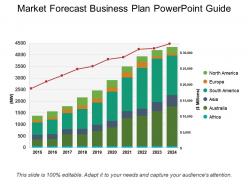
Get this Market Forecast Business Plan PowerPoint Guide to help corporate strategists, marketers, and business analysts assess the market. Estimate future sales and expenditures with proper market analysis. Analyze how different products are performing in the market and devise strategies to increase sales. With a standard analysis like this, show the projected number of potential customers over the various continents easily. Identify the patterns in the actual market behavior using this professionally designed market forecast PowerPoint slide. With thorough market research, help your analysts provide anticipated figures and calculations for your product over the years. With the charts and diagrams used in this PPT slide, interpret complex data easily for your audience. Reduce the time of preparation of your presentation with this readily available market potential PPT slide. Choose this market projection PPT template to make a visually appealing yet comprehensive PowerPoint presentation.
People who downloaded this PowerPoint presentation also viewed the following :
Market forecast business plan powerpoint guide with all 5 slides:
Our Market Forecast Business Plan Powerpoint Guide give it an earnest attempt. They keep at it till they succeed.
FAQs for Market forecast business
For solid forecasting, I'd mix quantitative stuff (GDP growth, inflation, employment) with qualitative insights like consumer sentiment and sales trends. Technical indicators help if you're looking short-term, though honestly the charts can drive you nuts after a while. Also watch for competitive shifts, new regulations, and tech disruptions - that's where the real surprises come from. My advice? Pick 3-4 indicators that actually matter for your specific market. Don't try tracking everything or you'll just confuse yourself.
Economic trends are seriously your best friend for market forecasting. GDP growth, inflation, employment numbers - all that stuff gives you the bigger picture of where markets might go. Interest rates though? Those can literally change everything in a day (I've learned this the hard way). Consumer spending patterns matter too since they show real economic health. Track these indicators and you'll spot sector rotations and sentiment shifts way easier. Oh, and set up alerts for major economic releases - saves you from scrambling to catch up later. Always factor in the broader cycle when you're making predictions.
Look, consumer behavior is basically what drives everything in market forecasting. People's buying habits, how they react to economic shifts, their overall confidence - that's your foundation right there. Demographics and income levels matter tons too. But here's the thing that cracks me up: one random TikTok can completely throw off models that took years to build. It's honestly insane. You've got to blend the old-school data with real-time social stuff now. Seasonal patterns still count for a lot though. Track sentiment changes and you'll get way better at predicting where things are headed.
You want to mix numbers with gut feelings - trend analysis and regression models are solid starting points. Technical stuff works for quick predictions. For the long game, fundamental analysis is where it's at. Market sentiment data? That's honestly where things get interesting. Nothing's foolproof though, so don't put all your eggs in one basket. Pick maybe 2-3 methods that match your timeline. Test them against old data first - learned that the hard way! Short sentences hit different sometimes. Before making any big moves, see how accurate they actually were historically.
Dude, the difference is night and day when you throw tech at forecasting. AI can crunch through datasets that would literally make your head explode - economic stuff, consumer trends, social media vibes, all at once. Real-time feeds are a game changer too since you're not stuck with last month's numbers (seriously, that was the worst part of my old job). Machine learning spots patterns you'd never catch manually. Plus these algorithms actually tell you how confident they are in their predictions, which is huge. I'd start by figuring out what data you're missing and just automate pulling it in.
Dude, geopolitical stuff will mess up your market predictions every single time. Wars break out, elections go sideways, trade wars start - and suddenly everyone's either freaking out or getting way too excited. Those solid forecasts you made based on actual economic data? Gone. I learned this the hard way watching my predictions fall apart during that whole Russia situation. Political chaos in unstable regions is the worst for this. You've gotta build in some wiggle room and have backup scenarios ready. Short answer: expect the unexpected when politics get messy.
Demographics totally change your forecasts - like, way more than people realize. Aging populations? Suddenly healthcare's booming. Younger crowds drive tech sales through the roof. Population shifts, income changes, where people move... all that stuff changes who's actually buying your product. I learned this the hard way on a project last year - completely missed how millennials were leaving our main market area. Start with figuring out which demographic trends hit your specific product hardest. Then tweak your numbers based on that data. Short sentences work here. Don't overthink it, but definitely don't skip this step either.
Start with your main number right away - don't bury the lead. Charts are your friend here, but keep them simple. Nobody wants to squint at messy spreadsheets. Always mention how confident you are in the forecast and what assumptions you're using, since someone will definitely grill you on that stuff. I'd show best/worst case scenarios too so they get the full picture. Oh, and practice your methodology pitch until you can nail it in 30 seconds flat. Trust me, executives have zero patience for long explanations before they start firing questions at you.
Honestly, most companies just guess at this stuff which is wild to me. Market forecasts can really help you time big decisions better. Demand projections? Super useful for planning inventory and when to hire people. Revenue forecasts help you set budgets that actually make sense and figure out when to invest vs. when to play it safe. Match your planning to the forecast timeline - quarterly ones work great for day-to-day operations, annual for the bigger strategic moves. Obviously these aren't crystal balls, so don't bet everything on them. Build in some wiggle room.
Honestly just start with Excel or Google Sheets - they're way more capable than most people realize. If you can code at all, R and Python are game changers for serious forecasting work. Tableau and Power BI are solid for making your data actually look good (which matters more than you'd think). SPSS is great but costs a fortune. Oh, and FRED from the Federal Reserve is free and has tons of economic data. I'd say begin with whatever you already know, then slowly work your way up to the fancier stuff as you need it.
Yeah, seasonal stuff will totally throw off your long-term forecasts if you're not careful. Try using seasonally adjusted data or some smoothing techniques to find the real trends hiding under all those predictable patterns. I mean, everyone knows retail goes crazy in Q4 - that's just how it works. What you really need is separating actual growth from the regular cyclical noise, otherwise your projections are basically just riding seasonal waves. Oh, and definitely run your models with both raw data and seasonally adjusted versions. You'll probably be surprised how different the long-term outlook looks between the two.
Overconfidence will bite you in the ass every time - I've seen it happen so much. Don't just lean on old data either, markets change constantly. Confirmation bias is another killer where you cherry-pick info that backs up what you already believe. External stuff like new regulations or economic chaos can wreck your forecast too, which people forget about. I always tell people to use ranges instead of exact predictions. Makes way more sense. And stress-test everything against different scenarios - seriously helps catch blind spots before they become expensive mistakes.
Look for patterns that keep showing up - seasonal stuff, how different indicators move together, that kind of thing. Don't just focus on prices though. Volume, economic data, market mood all matter too. Yeah, I know everyone says past performance doesn't predict the future (boring disclaimer), but honestly it's still your best starting point. Longer timeframes work better since they cut through all the daily chaos. Oh and definitely backtest whatever theory you're working with - see if it would've actually worked before. Sometimes what looks obvious now was completely wrong back then.
Dude, get some industry experts to look at your forecasts - they'll catch stuff you totally missed. These people deal with your market every single day, so they know about regulatory changes or supply chain weirdness before it hits your data. Honestly, I learned this the hard way after presenting some wildly optimistic numbers to my boss last year. Find 2-3 people who actually work in the space, not just consultants. They can tell you if your assumptions are realistic or completely off base. It's like having a reality check before you embarrass yourself.
When recessions hit, defensive stuff like utilities and consumer staples usually hold steady while tech and luxury brands get crushed. Housing and cars always tank first - makes sense since nobody's buying expensive stuff when they're worried about money. Financial services forecasting becomes a nightmare because nobody knows how bad the credit losses will get. I'd build out different scenarios with varying recession depths and timeframes. Then stress-test everything against past downturns in your sector. Oh, and definitely plan for longer recovery periods than you think you need. Growth assumptions need to be way more conservative across the board.
-
I discovered this website through a google search, the services matched my needs perfectly and the pricing was very reasonable. I was thrilled with the product and the customer service. I will definitely use their slides again for my presentations and recommend them to other colleagues.
-
Excellent Designs.