

Market feasibility study powerpoint presentation slides




Try Before you Buy Download Free Sample Product
 Impress Your
 Audience
 100%
100% Editable
 Save Hours
 of Time


Analyze the economic, demographic and competitive factors with our content ready Market Feasibility Study PowerPoint Presentation Slides. The professionally designed market research PowerPoint complete deck comprises of easy-to-use templates such as introduction to industry and description, SWOT analysis, industry vertical, market share, market landscape, total addressable market, market gap analysis, competitor analysis, characteristics, competitive landscape framework, market potential, revenue sources, sales projections, recommendations on market feasibility study and many more. Utilize industry feasibility analysis PowerPoint template to ascertain the likelihood of completing a project successfully. Analyze social, economic, technical factors before undertaking a project with the help of this topic-specific market research & analysis presentation deck. Furthermore, market feasibility in project analysis PPT slides is also useful to showcase the depth and condition of a particular market. Therefore, download this high quality visually appealing market viability PPT visuals to discuss the pros and cons of investing in a particular business. Our Market Feasibility Study Powerpoint Presentation Slides give everyone a chance to find happiness. They bring cheer even to the heavy hearted.
People who downloaded this PowerPoint presentation also viewed the following :
Content of this Powerpoint Presentation
Slide 1: This slide introduces Market Feasibility Study. State Your Company Name and begin.
Slide 2: This is an Agenda slide. State your agendas here.
Slide 3: This slide presents Introduction to Industry with related imagery.
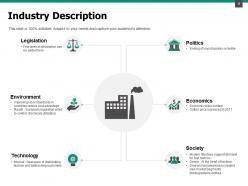
Slide 4: This slide displays Industry Description describing- Legislation, Politics, Environment, Economics, Technology, Society.
Slide 5: This slide is titled as Strengths. Show your firm's strengths here.
Slide 6: This slide is titled as Weaknesses. Describe your firm's weaknesses here.
Slide 7: This slide displays Opportunities with related imagery and text.
Slide 8: This slide shows Threats with related imagery.
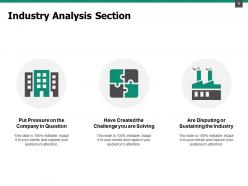
Slide 9: This slide presents Industry Analysis Section describing- Put pressure on the company in question, Have created the challenge you are solving, Are disputing or sustaining the industry.
Slide 10: This slide displays Industry Vertical Description.
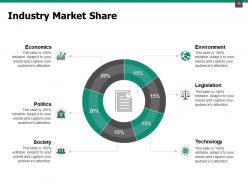
Slide 11: This slide represents Industry Market Share describing- Economics, Environment, Legislation, Politics, Technology, Society.
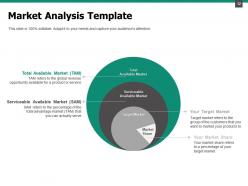
Slide 12: This slide showcases Market Analysis Template describing- Total Available Market (TAM), Serviceable Available Market (SAM), Target Market, Market Share.
Slide 13: This slide shows Market Research Results Template.
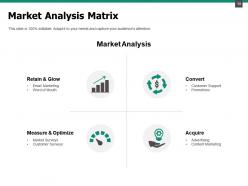
Slide 14: This slide presents Market Analysis Matrix describing- Convert, Retain & Grow, Acquire, Measure & Optimize.
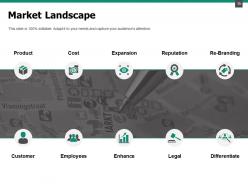
Slide 15: This slide displays Market Landscape describing- Employees, Cost, Enhance, Expansion, Legal, Reputation, Differentiate, Re-branding, Customer, Product.
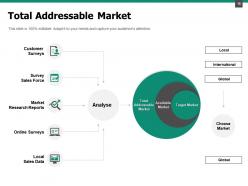
Slide 16: This slide represents Total Addressable Market explaining- Customer Surveys, Survey Sales Force, Market Research Reports, Online Surveys, Local Sales Data.
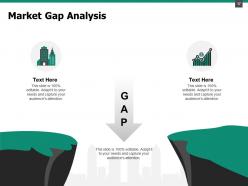
Slide 17: This slide showcases Market Gap Analysis with related imagery.
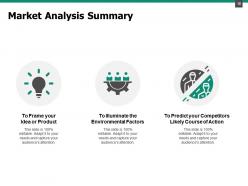
Slide 18: This slide shows Market Analysis Summary with related diagram.
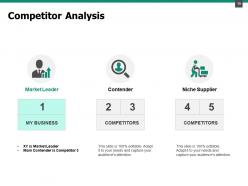
Slide 19: This slide presents Competitor Analysis. Add data as per needs.
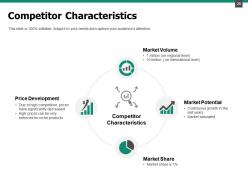
Slide 20: This slide displays Competitor Characteristics describing- Market Volume, Market Potential, Market Share, Price Development.
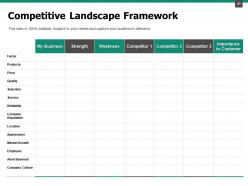
Slide 21: This slide represents Competitive Landscape Framework in tabular form.
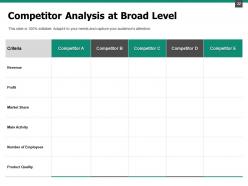
Slide 22: This slide showcases Competitor Analysis at Broad Level.
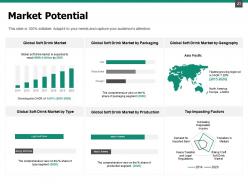
Slide 23: This slide shows Market Potential in graphical forms.
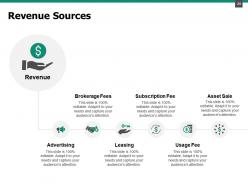
Slide 24: This slide presents Revenue Sources as- Leasing, Advertising, Brokerage Fees, Subscription Fee, Asset Sale, Usage Fee.
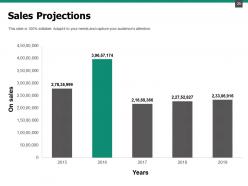
Slide 25: This slide displays Sales Projections in graphical form.
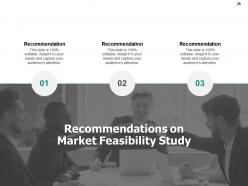
Slide 26: This slide represents Recommendations on Market Feasibility Study.
Slide 27: This slide reminds about a coffee break.
Slide 28: This slide showcases Market Feasibility Study Icons.
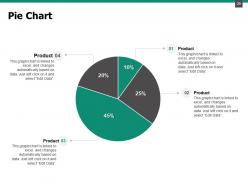
Slide 29: This slide displays Pie Chart with data in percentage.
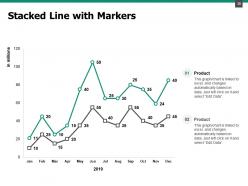
Slide 30: This slide shows Stacked Line with Markers with two products comparison.
Slide 31: This is About Us slide to show company specifications etc.
Slide 32: This is Vision Mission and Goal slide with related imagery and text.
Slide 33: This is Our Team slide with names and designation.
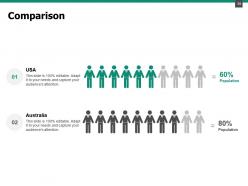
Slide 34: This is a Comparison slide to state comparison between commodities, entities etc.
Slide 35: This is a Quotes slide to convey message, beliefs etc.
Slide 36: This is an Idea Generation slide to state a new idea or highlight information, specifications etc.
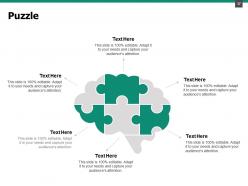
Slide 37: This is a Puzzle slide with text boxes to show information.
Slide 38: This is a Thank You slide with address, contact numbers and email address.
Market feasibility study powerpoint presentation slides with all 38 slides:
Use our Market Feasibility Study Powerpoint Presentation Slides to effectively help you save your valuable time. They are readymade to fit into any presentation structure.


FAQs for Market feasibility study
Okay so market feasibility - you've got five main things to look at. Market size is honestly the big one, like is there actually enough demand here? I'd start with that because if the answer's no, you can save yourself a ton of work. Next up: who's your target customer and how do they buy stuff? Competitive analysis is pretty critical too - figure out who you're competing with and what they charge. Oh, and think about how you'll actually get your product to people, plus any annoying regulations you might hit. Pricing's the last piece - can you make decent money at a price people will actually pay?
Look, demographic analysis is honestly the backbone of your whole feasibility study. It shows you who's actually gonna buy your stuff and if there's enough people to keep you in business. Pull age, income, location data - basically become a detective about your future customers. This info drives everything: your revenue forecasts, pricing, marketing angle. I'd start with census data and consumer surveys for your area first. Without decent demographic insights you're just throwing darts blindfolded at market size. Trust me, the guesswork approach rarely works out well for anyone.
Look, competitive analysis is basically your sanity check before diving in. You gotta see who's already out there serving your customers and how they're doing it. I've watched so many people skip this step then wonder why they can't get anywhere - it's painful honestly. Start with your top 3-5 direct competitors and really dig into what they're good at versus where they suck. This shows you pricing patterns, what customer problems aren't being solved yet, and what barriers you'll hit. There might be a random niche competitor too that's worth checking out. Bottom line: you need to know if there's actually room for you in this space.
Honestly, figure out who actually has the problem you're solving - not who you *think* should care. Survey real people, check competitor customers, dig into demographics and buying patterns. I've watched so many startups tank because they just assumed their audience instead of doing the homework. Look at age, income, location, how they shop. Oh and don't make your target too narrow or you'll run out of customers fast. The research part sucks but it's way better than launching blind and hoping for the best.
Honestly, I'd start with online surveys - cheap way to get a ton of data on what people actually want and what they'll pay. Focus groups are amazing for understanding the why behind decisions, but heads up, agencies charge crazy money for them. For B2B stuff, one-on-one interviews are where it's at since you need those detailed insights from whoever's making the call. Oh, and don't forget about just watching people - sometimes their actions tell a completely different story than their words. Cast that wide net with surveys first, then dig deeper with interviews to double-check everything.
Look, financial forecasting is the make-or-break part of your feasibility study. Seriously. I don't care how amazing your product sounds - if those numbers are wonky, investors will ghost you so fast. Your forecasts need to show realistic revenue projections, actual costs (not wishful thinking), break-even analysis, cash flow timelines. The whole nine yards. I've watched brilliant concepts crash and burn because people got lazy with this part. Oh, and definitely lowball your revenue estimates rather than going wild with optimism. Trust me on that one - you can always beat expectations later, but overpromising kills credibility instantly.
Watch out for confirmation bias - it's so easy to cherry-pick data that backs up what you want to hear. Been there! Also don't survey random people or use tiny sample sizes. You need actual conversations with potential customers, not just Google research. Competitive analysis sucks but you can't skip it. Oh, and set clear success metrics upfront so you're not lying to yourself later about whether this thing's actually working. The biggest mistake is being way too optimistic about your target market.
Market trends basically decide if your business idea will actually work out. You're fighting an uphill battle if you pick a dying market - fewer customers, higher costs, the whole mess. Growing trends are great but everyone's chasing them too. What matters is matching the trend to what you can actually handle. Like, if some hot trend needs a ton of cash upfront and you're bootstrapping? Probably not gonna work. You gotta figure out if it's a real trend or just some flash-in-the-pan thing. Compare how long the trend might last with when you need to start making money.
Honestly, mix both types of research or you'll get a wonky picture. Start with the boring stuff first - industry reports, competitor data, market research to get your bearings. Then hit up real people through surveys and interviews. The interview part is where you strike gold - people will say stuff that completely catches you off guard. Also peek at how your competitors are pricing things. Oh and budget way more time for talking to actual humans than you think you'll need. Trust me on that one. Test your survey questions on like 5 people first too, otherwise you'll get garbage responses.
Build flexibility into your study design right from the start. COVID taught me this lesson the hard way - all our assumptions just vanished overnight! Use real-time data like social media analytics and mobile surveys that you can pivot quickly. Check in on your consumer segments monthly or quarterly, depending on how crazy volatile your market gets. Focus on understanding WHY people do things, not just tracking what they're doing. The motivations stick around longer than specific behaviors anyway. Oh, and definitely monitor 2-3 early warning signs that'll tell you when preferences are shifting.
Look at five main things when sizing up market opportunities. TAM and SAM calculations first - basically how big is this thing you're chasing? Customer acquisition cost vs lifetime value is huge (seriously, so many companies mess this up and wonder why they're broke). Growth rate shows if the market's actually expanding or if you're pushing a rock uphill. Competition analysis is pretty obvious but still necessary. Then test actual demand through surveys or pilot programs - way better than just guessing. Oh, and start with the TAM/SAM stuff since those numbers help you prioritize everything else. Makes the whole process less overwhelming.
Look, quantitative data shows you the what - market size, trends, all that stuff. But qualitative? That's your "why." Interviews and focus groups tell you what actually drives people, what frustrates them, what they're missing. I swear some of my biggest breakthroughs came from random customer chats, not Excel sheets. Numbers don't lie, but they don't tell the whole story either. You'll spot gaps your competitors totally miss. Real demand vs. what looks good on paper - there's a difference. Start with deep customer interviews alongside your usual market research. Trust me on this one.
So risk assessment is like the reality check part of your feasibility study. You're figuring out what could actually kill your business idea before you invest everything. Think competitor moves, new regulations, economic crashes - all that fun stuff. Honestly, it sounds depressing but you need it. List out your biggest 5-10 threats and rate how likely they are plus how much damage they'd cause. Then you can decide if the opportunity's still worth it or if you should bail. Sometimes the risks aren't as scary as they seem on paper.
Dude, skip the surveys and gut feelings - data analytics tools are where it's at for feasibility studies. Google Analytics and SEMrush are solid starting points. You can pull real consumer behavior data instead of just guessing what people want. Social media sentiment analysis is huge too. Tableau's great if you've got the budget for it. The crazy thing is how much free data there is now compared to like 2019. Start small with maybe one or two tools that won't break the bank, then add more once you're not drowning in spreadsheets anymore.
Dude, you absolutely need to run your findings by stakeholders first. Share everything with potential customers, industry people, suppliers - basically anyone who knows this space better than you do. They'll spot stuff you totally missed and catch assumptions that are way off. I learned this the hard way on a project last year! Document what they tell you because their feedback will probably change your market size numbers and competitive analysis. Short sentences work. Longer ones help you explain the nuances of why their input matters so much for your final recommendations.
-
Amazing product with appealing content and design.
-
Great product with effective design. Helped a lot in our corporate presentations. Easy to edit and stunning visuals.
-
Designs have enough space to add content.
-
Designs have enough space to add content.
-
Unique design & color.