


Market Research Proposal Template Powerpoint Presentation Slides




Try Before you Buy Download Free Sample Product
 Impress Your
 Audience
 100%
100% Editable
 Save Hours
 of Time


Highlight the targeted demographics of the market and grab the attention of your client by using our content ready Market Research Proposal Template PowerPoint Presentation Slides. You can showcase the various strategies that assist your consumer to upgrade their brand productivity in the marketplace. Take advantage of this interactive market research proposal PPT theme and define the several methodologies like survey, focus group, interview, and customer feedback that are provided by your company. Pitch your services and different technologies to your clients and gain their confidence in a positive manner. Talk about the overall cost estimation of a particular project that helps the consumers to invest their money appropriately. Take the assistance of this professionally designed market analysis proposal PowerPoint layout to showcase some market phases like the research phase, design phase, analysis phase, and project completion. With the aid of this PPT layout, you can display the capabilities and skills of your highly-experienced professionals. Employ this creatively designed PPT template to portray the best path to your clients that help them in achieving their short-term and long-term goals. Take the assistance of our PowerPoint theme to highlight the research context & objectives, sampling demographics, client testimonials, investment on a project, etc. Use a market research proposal presentation template and discuss the detailed project reports with analytics and recommendations to hook up your client. By using this well-informed market research PowerPoint layout, you can also showcase your detailed written project report with analysis and recommendations. Take the assistance of our brand awareness proposal PPT theme and display the offerings such as quantitative & qualitative research, and PR pollings & surveys. You can mention the overall timeline of market research services with the help of this visually appealing PowerPoint presentations. Download our ready-to-use research proposal presentation layout and create an attractive proposal to land more clients.
People who downloaded this PowerPoint presentation also viewed the following :
Content of this Powerpoint Presentation
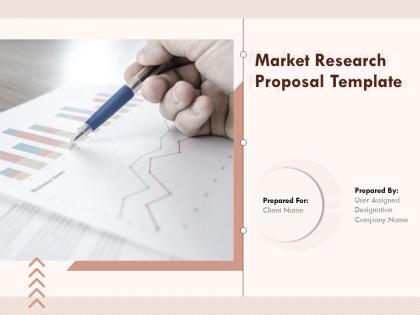
Slide 1: This slide introduces Market Research Proposal Template. State Client name, User assigned and Company name.
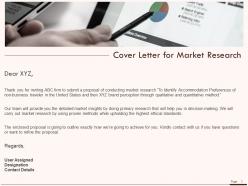
Slide 2: This slide displays Cover Letter for Market Research.
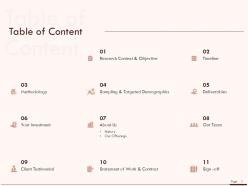
Slide 3: This slide displays Table of Content of the presentation.
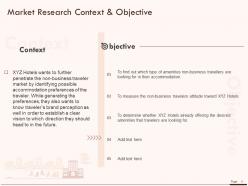
Slide 4: This slide showcases Market Research Context & Objective.
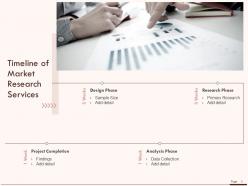
Slide 5: This slide represents Timeline of Market Research Services.
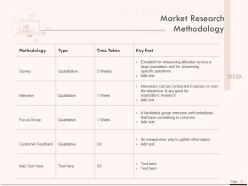
Slide 6: This slide shows Market Research Methodology
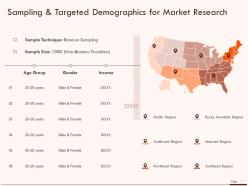
Slide 7: This slide shows Sampling & Targeted Demographics for Market Research.
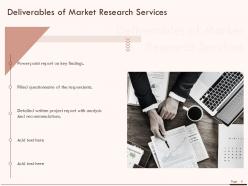
Slide 8: This slide depicts Deliverables of Market Research Services.
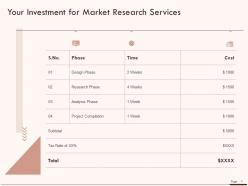
Slide 9: This slide shows Your Investment for Market Research Services.
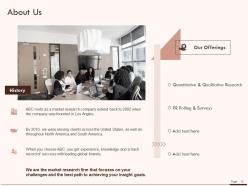
Slide 10: This is About Us slide with Company specifications.
Slide 11: This is Our Clients slide with Clients name and Logo.
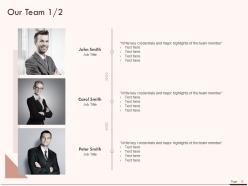
Slide 12: This is Our Team slide. Write key credentials and major highlights of the team member.
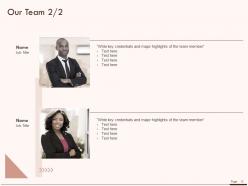
Slide 13: This is Our Team slide. Write key credentials and major highlights of the team member.
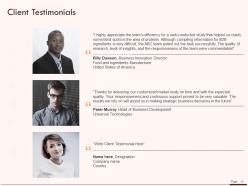
Slide 14: This slide displays Client Testimonials
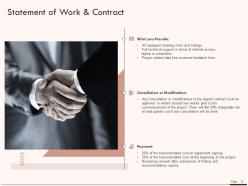
Slide 15: This slide showcases Statement of Work & Contract
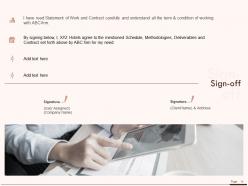
Slide 16: This is Sign-off slide with Company name, Signature and Address.
Slide 17: This slide is titled as Additional Slides for moving forward.
Slide 18: This is Our Mission slide with Vision, Mission and Goal.
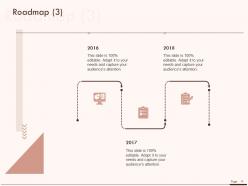
Slide 19: This slide depicts 3 step Roadmap process.
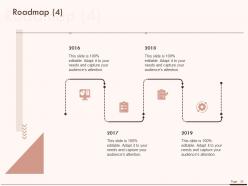
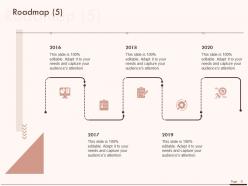
Slide 20: This slide depicts 4 step Roadmap process.
Slide 21: This slide depicts 5 step Roadmap process.
Slide 22: This is 30 60 90 Days Plan slide.
Slide 23: This slide shows Timeline process.
Market Research Proposal Template Powerpoint Presentation Slides with all 23 slides:
Use our Market Research Proposal Template Powerpoint Presentation Slides to effectively help you save your valuable time. They are readymade to fit into any presentation structure.

FAQs for Market Research Proposal Template
So here's the thing - you gotta nail down exactly what you're trying to figure out first. Are you trying to understand why customers hate something? Figure out how big a market is? Test if people actually want your new idea? Whatever it is, write it down super clearly because that becomes your north star. I've seen so many research projects go sideways because people skipped this step. You'll waste money and end up with a bunch of data that doesn't help you decide anything. Everything else - your methods, timeline, budget - should flow from that core question you're trying to answer.
Be super specific about who you're targeting - demographics, behaviors, what problems they're dealing with. Then nail down exactly how you'll find these people. Email surveys? Focus groups through recruiting companies? Social media posts? I can't tell you how many proposals I've seen crash because they were fuzzy on the "how" part. Include your sample size and what criteria you'll use for recruiting. Oh, and definitely have a backup plan if your main approach falls through. The more detailed you get with the who and how, the better your proposal's gonna look.
Pick 2-3 methods that actually make sense for what you're studying. Surveys and focus groups work great for customer attitudes. Behavioral stuff? Go with user analytics and observational studies. For market sizing, I always do secondary research plus expert interviews - honestly that combo hasn't failed me yet. Don't just throw methods in there though. Explain why each one answers your specific questions and what you'll learn. Oh, and include sample sizes, timelines, recruitment plans for each method. Basically show you've thought it through.
Grab a sample size calculator and plug in your population size, confidence level, and margin of error. Most people go with 95% confidence and 5% margin of error - pretty standard stuff. The tricky part? Actually nailing down your total population if you're targeting a specific group. I've seen people mess this up constantly. For general consumer research, 400-500 responses usually does the trick. But let's be real - your budget and timeline are gonna matter just as much as the "perfect" statistical number. Start with what the math says, then tweak based on reality. Just document whatever you end up doing so nobody's confused later.
So it really depends on what you're trying to figure out, but I'd start with the basics - demographics like age, income, where people live. Then look at how often they buy stuff and if they stick with certain brands. The psychographic stuff is interesting too - what people actually care about and how they live their lives. Market size matters obviously, and honestly the competition can totally change everything. Oh, and don't skip pricing sensitivity - that one's huge. Customer satisfaction metrics are solid too. I'd pick maybe 5-7 of these that'll actually help you make decisions. Otherwise you'll just drown in data.
So basically, list out everything you're actually gonna give them when you're done. Final report with all your findings, charts, recommendations - the works. Plus any raw data, survey responses, interview notes they might want. Here's the thing though - don't be vague here because you'll hate yourself later. Get super specific about file formats, when they'll get each thing, what's included in every deliverable. I know it feels like overkill but this becomes your contract with them. Make sure you can actually pull off everything you're promising within your timeline and budget, otherwise you're screwed.
Okay so first thing - don't just survey people who already buy from you or you'll get nowhere. Cast a wider net across different demographics, income brackets, geographic areas, all that. Your questions need to be neutral too because leading questions are basically useless (I've definitely messed this up before lol). Try mixing methods - surveys plus interviews plus just watching how people actually behave. Oh and test your findings with totally different groups to double-check. Honestly the biggest thing is just being honest about where you might screw up, then planning around those blind spots from the start.
Honestly, it's all over the place depending on what you're doing. Most projects I've seen take 6-12 weeks start to finish. Primary research with surveys drags on forever compared to just pulling existing data. I always add extra time because getting people to actually respond is such a pain - learned that the hard way! For typical market research, figure 8 weeks. Two weeks upfront for planning and designing your survey. Data collection eats up about 3 weeks. Analysis takes another 2, then you've got a week left for writing everything up. Build in cushion time from the start or you'll be pulling all-nighters at the end.
Break your costs down into the main buckets - research method, participant incentives, data tools, analyst hours, and reporting. Incentives always get underestimated though, people want fair pay for their time now. Don't forget the sneaky stuff like travel, software licenses, vendor fees. I always add 10-15% buffer because something inevitably costs more. Present it with clear line items so stakeholders see where their money's going. Oh, and double-check it matches your timeline and scope - nothing worse than a budget that doesn't make sense with what you're actually planning to do.
So basically you want three main pieces: executive summary with your big insights right up front, then your detailed analysis with all the charts and stuff, and finally your recommendations. Don't bury the good stuff in data tables - nobody has time for that honestly. Start with the "so what" because stakeholders eat that up. Format-wise, just match whatever your audience expects - could be slides, a formal report, whatever works. Make sure your recommendations actually connect back to what you were supposed to research in the first place. The whole point is making it easy for people to actually use your insights to make decisions.
Just pick 2-3 tools and explain why they work for your project. SurveyMonkey or Qualtrics are solid for surveys, Google Analytics if you need web data. For analysis, Excel works fine - honestly, I've seen people do amazing stuff with just pivot tables. SPSS is good too if your team knows it. Don't go overboard with fancy tools nobody understands. Match what you choose to your actual budget and timeline. Oh, and make sure your team can actually use whatever you pick - sounds obvious but I've seen people choose tools they've never touched before.
Definitely add an ethics section right up front - cover informed consent, data privacy, participant rights, all that jazz. Outline your anonymization process and make sure consent forms are solid. ESOMAR standards are your friend here. I know it feels like drowning in paperwork (because honestly, it kind of is), but it'll save your butt later. Don't forget IRB approval if you're dealing with sensitive topics or vulnerable groups. The whole point is showing you've already thought through the messy ethical stuff before it bites you.
Definitely add a competitive landscape section - map out 3-5 key competitors with their positioning, pricing, and who they're targeting. SWOT analysis for each major player is clutch (clients love that). Look at both direct competitors and indirect ones - like alternative solutions customers might pick instead. Market gaps are where the money is, so dig into those opportunities. You'll need to explain how you're gathering this intel too - public data, mystery shopping, social listening, whatever works. Oh and make sure you show them exactly where they stand versus everyone else. That's honestly half the battle right there.
Honestly, you gotta nail down your success metrics right from the start - response rates, data quality, hitting your target sample size, all that stuff. Match them to what you're actually trying to find out. So like if you're testing whether people want your product, success means getting solid preference data from the right demographics. Timeline and budget matter too since stakeholders will definitely ask about those later. Maybe set up a simple dashboard to track everything? Trust me, having specific benchmarks now beats trying to explain messy results after the fact. Oh and make sure the metrics actually make sense for your specific project - sounds obvious but you'd be surprised.
Honestly, sample size is gonna be your biggest headache - you can only survey so many people before running out of budget or time. Online surveys are tricky too because you'll miss certain groups who aren't as active digitally. Good luck getting solid competitor data unless you know someone on the inside, which most of us don't. Fast-moving markets? Your research could be stale by the time you finish it. Budget constraints will definitely limit how fancy you can get with methods. I'd build in extra time and be super upfront with stakeholders about what you realistically can't deliver.
-
Great experience, I would definitely use your services further.
-
Editable templates with innovative design and color combination.
-
Very unique and reliable designs.