

Research techniques presentation design





Try Before you Buy Download Free Sample Product
 Impress Your
Audience
 100%
Editable
 Save Hours
of Time


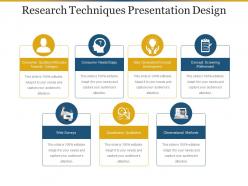
Individual or business professionals usually gather data for important creation of facts as well as business strategies. The research technique PowerPoint slide is a most widely useful tool for research applicable to both academic and business purposes. The research paper technique presentation slide describes that it research paper is different from term papers because the user can present comprehensive detail on the problem or on the topic being addressed with. The research technique PPT template design helps a presenter to illustrate several ways for categorizing the various market research methods such as secondary research, surveys, focus groups, interviews, observation, experiments or field trials, etc. A user can take help of the research method PowerPoint slide to make the viewers understand how to write a research paper because it needs the proper outline together with a reasonable topic as well as research data as compare to other paper. The research paper slide design for PowerPoint is ideal for business organizations as well as academic students for giving guideline to make amazing research papers. The research methodology PPT slide design describes associated things of research paper such as analysis of a particular perspective, argument of a point, and decision-making. Other people give boring presentations. You use high quality Research Techniques Presentation Design to add perfect design to every project.
People who downloaded this PowerPoint presentation also viewed the following :
Research techniques presentation design with all 5 slides:
Ensure you don't feel the heat with our Research Techniques Presentation Design. Conditions never go beyond control.


FAQs for Research
So quantitative is all about numbers and data you can measure - surveys, experiments, stuff you'd throw into Excel. Qualitative digs into the "why" behind people's behavior through interviews and observations. Honestly, I think qualitative gets overlooked sometimes but it's super valuable for understanding what's actually going on in people's heads. Most solid research uses both since they work well together. Go quantitative when you need hard proof with statistics. Pick qualitative if you're exploring complex human stuff or need deeper context about motivations and experiences.
Honestly, mixed-methods is where it's at. You get hard numbers showing *what's* happening, plus the story behind it from interviews or observations. Like, the stats might show 60% of users bounce from your site, but talking to people reveals it's because the checkout process is confusing as hell. When both your data types agree, you know you're onto something real. I'd say try adding just a few quick follow-up calls to your next survey - even 5-10 interviews can totally change how you interpret those spreadsheet numbers. It's like... why settle for half the picture?
Honestly, the consent thing is huge - you've gotta be upfront about what you're actually studying. Privacy protection is obvious but worth mentioning since data breaches happen all the time now. Think about whether your research might mess with people emotionally or socially, not just physically. Kids and vulnerable groups need way more careful handling. Oh, and definitely get your ethics board paperwork in early because those people take forever to approve anything - learned that one the hard way! The whole process can drag on for weeks if you're not on top of it.
Honestly, this is where most people get stuck but it's not as scary as it seems. Power analysis software will be your best friend here - way better than guessing randomly. Think about what difference actually matters for your research, then work backwards. Statistical power around 80-95% is pretty standard. Don't forget response rates though, especially for surveys (learned that one the hard way). Effect size and margin of error matter too. Experimental studies usually need bigger samples than surveys. There's online calculators that'll do the math if you're not into statistical software.
Think of a lit review as your roadmap - shows what's been done and what's missing. Reading other studies helps you sharpen your research questions so you're not beating a dead horse. You'll see which methods actually worked vs ones that totally bombed. Honestly, I always end up changing my approach after diving into what others tried. Building on existing frameworks beats starting from scratch every time. Oh, and start this process early! Trust me, it'll keep you from wasting weeks chasing ideas that go nowhere. Super worth the upfront time investment.
Dude, seriously - turn those boring spreadsheets into actual visuals. Bar charts, scatter plots, whatever works. I've watched amazing research get completely ignored because people presented it as giant walls of numbers (who has time for that?). Your audience will spot patterns instantly instead of hunting through data for hours. Plus they'll actually remember your findings later. Maybe I'm biased, but I think even basic graphs beat text every time. Start simple then get fancy if you need to. Trust me, your research is probably solid - just don't bury it under a mountain of raw data.
Okay so first thing - ask open questions and let them just talk. Build some rapport first, maybe chat about random stuff before jumping into the heavy questions. I usually say "tell me more about that" like a million times lol. Record everything (with permission!) so you're not scrambling to write notes. Here's the thing though - silence is your friend. People hate awkward pauses and will fill them with the real good stuff. Don't stick too rigidly to your question list either. Sometimes the best insights come from totally unexpected tangents. Oh, and always ask at the end if there's anything else they want to add!
Honestly, survey design comes down to three main things. Write questions that are super specific - vague wording will totally screw up your results. Your sample needs to actually represent the people you're studying, not just whoever's convenient to grab. I always run a pilot test first because you'll catch weird issues you never thought of. Keep it short though - nobody wants to answer 50 questions about toothpaste preferences or whatever. Each question should connect directly to what you're trying to figure out. Test everything before you launch it for real.
Randomize your sampling and go for blind methods when you can - stops you from accidentally skewing things. Also standardize everything so each participant gets identical treatment. I totally messed this up in my first study, interviews were chaos lol. Train your team on neutral language too, that's huge. But honestly? The best thing I ever did was pre-registering my methodology beforehand. Forces you to stick to your plan instead of tweaking things when results look weird. Oh and it prevents cherry-picking later, which... yeah, that's tempting sometimes.
Honestly, get yourself a reference manager like Zotero or Mendeley - they'll save your sanity by auto-grabbing citations. I'm kicking myself for not using one sooner. AI search tools are pretty decent for finding papers quickly, and if you're doing interviews, transcription software is a game changer. Those collaboration platforms beat endless email chains too. But here's the thing - don't go crazy downloading every research tool that exists. Pick maybe 2 or 3 that actually work with how you already do things. Otherwise you'll spend more time learning apps than actually researching.
Honestly, the biggest traps are cherry-picking data that fits what you want to prove and running a million tests without adjusting for multiple comparisons. P-hacking is so tempting too - we've all done it! Small samples are another killer, plus ignoring confounding variables. And that confirmation bias thing where you only notice results that match your expectations? Super common. Also never assume correlation means causation - learned that one the hard way in grad school. Best bet is pre-registering your analysis plan beforehand and getting someone else to check your work.
Honestly, case studies are great when you need to really dig into messy, complicated stuff that numbers alone won't explain. You're looking at "how" and "why" things happen in the real world - like why a company's restructuring failed or what makes certain patients respond differently to treatment. Yeah, you can't apply findings to everyone, but that's kinda missing the point anyway. The whole value is getting those detailed insights into what's actually going on behind the scenes. Plus they're perfect for studying weird or rare situations you'd never capture in a regular survey. Think of it as zooming way in instead of taking the wide-angle shot.
Okay so first thing - check who actually wrote it and if they know what they're talking about in that area. Publication date matters too, especially in stuff like tech or medicine where things change fast. Is it peer-reviewed or from somewhere legit? I get sketched out when there's zero info about the author lol. Look at their methods if you can find them, and see if other good sources reference it. Oh and definitely cross-check with a couple other sources - if something seems way off compared to everything else, that's a red flag. Making a little checklist helps so you don't forget to check the same stuff every time.
Honestly, the whole replication crisis freaked everyone out but it's actually making science better. Researchers are pre-registering studies now and sharing their raw data instead of hiding it. Sample sizes are way bigger too - those n=12 studies were kind of a joke. People used to just chase flashy results to get published, but now there's more respect for solid, reproducible work. Oh and replication studies are finally getting published, which is huge. My advice? Document everything obsessively from day one. Maybe even try replicating someone's work - sounds boring but it's actually pretty satisfying when you nail it.
Double-blind reviews work really well - nobody knows who's who, so less bias creeps in. Get 2-3 reviewers from different places if you can. Give them clear criteria and don't rush them, because hurried reviews always miss stuff. I've seen some journals trying post-publication review lately, which honestly seems pretty cool. Pairing junior and senior researchers together is smart too - you get fresh perspectives plus experience. The main thing is being transparent about your process and giving reviewers structured guidelines so they're not just winging it.
-
Great experience, I would definitely use your services further.
-
Thanks for all your great templates they have saved me lots of time and accelerate my presentations. Great product, keep them up!