

Trend analysis sample powerpoint show





Try Before you Buy Download Free Sample Product
 Impress Your
 Audience
 100%
100% Editable
 Save Hours
 of Time


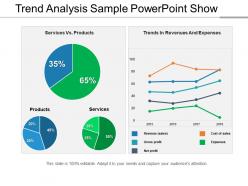
Empower planners, sales, operations personnel, and management to work smartly to achieve sales demand creation. Quickly analyze trends and enrich forecasts by automatically collecting planning data after proper demand planning and forecasting. Easily identify constraints and risks in supply with the help of efficient supply planning metrics. Improve the collaboration between the sales, purchasing, and production teams. Visually represent quantities that change over time using our PPT sample. Focus on generating revenue with a visually appealing PPT template. Use the chart and graphs in this PPT layout when you want to show the trend of income and expenses of your products and services. This area PPT chart layout is readily available and entirely professional. Use it to prepare an impressive presentation.
People who downloaded this PowerPoint presentation also viewed the following :
Trend analysis sample powerpoint show with all 5 slides:
Give belief a boost with our Trend Analysis Sample Powerpoint Show. Greater faith is bound to emerge.

FAQs for Trend analysis
Look, you need solid data sources and clear timeframes first. Gather both the hard numbers and softer stuff - customer feedback, regulatory shifts, competitive moves. Pattern recognition matters, but don't get stuck in historical trends or you'll miss what's coming next. Focus on leading indicators over lagging ones. Economic changes and tech disruptions? Yeah, those matter too. Oh, and honestly the 3-month vs 12-month horizon makes a huge difference in what you track. Start with maybe 3-5 data sources you can actually monitor consistently without burning out.
Trend analysis is basically looking at your historical data to predict what's coming next. Sales numbers, customer behavior, market changes - whatever you've got data on. Pick one important metric and track it monthly. You'll start seeing if patterns are seasonal, cyclical, or actual growth/decline. Then you can time your launches better and allocate resources smarter. Honestly, most teams just react to problems instead of spotting them early. I do this with our quarterly reviews and it's saved us from a few bad decisions. Way better than flying blind.
Honestly, Tableau and Power BI are your best bets for dashboards that actually update live. Python's awesome too if you don't mind coding - Pandas and Plotly make it pretty straightforward. Google Analytics is obvious for web stuff. For social media tracking, Hootsuite Insights or Brandwatch work well for mentions and sentiment. Just make sure your data feeds are truly real-time, not that fake "near real-time" garbage that's like 3 hours behind. Oh, and pick whatever plays nice with your current setup first - smooth integration beats all the bells and whistles.
So income obviously affects what people can actually buy, but education changes which brands they even want. Social status? That's where aspirational purchases kick in - people buying stuff to look a certain way. Millennials drowning in student loans act completely different from boomers who own their homes outright, even when they make similar money. Employment stability matters too. Oh, and location - city vs rural changes everything. When you're looking at data, segment by these things first. Trust me, it'll show you why customers do what they do and where trends are actually going.
Honestly, big data is a total game-changer for spotting trends. Instead of working with like hundreds of data points, you're getting millions to play with. That means you can catch patterns way earlier and see stuff that'd be completely invisible otherwise. The variety is insane too - social media vibes, what people are buying, search trends, all of it. It's basically like upgrading from squinting at numbers to having a microscope. What I love most is you can double-check patterns across different sources, so you're not getting fooled by one weird metric. Just focus on the data that actually matters for your specific situation first.
So trend analysis is basically spotting patterns in your past data to predict what's coming next. Look at seasonal stuff, growth rates, how customer behavior changes - you know, the usual suspects. Honestly, it's way better than just guessing randomly. You can see busy periods ahead of time and stock up accordingly. Marketing gets easier too when you know demand's about to spike. The trick is mixing different data sources together - sales numbers, market research, economic trends. Gives you a clearer picture. Not perfect, but definitely beats flying blind with your inventory planning.
Oh man, there's so many ways to mess this up! Don't cherry-pick data that just supports what you want to prove - I see that all the time. Also avoid drawing conclusions from like 3 measly data points (honestly, what's the point?). Watch out for seasonal stuff you might be missing, and don't let outliers completely wreck your analysis. Correlation isn't causation either - that's a big one. Make sure your data sources stay consistent throughout. My take? Always double-check trends with different datasets and timeframes before you present anything.
Think of qualitative data as the story behind your numbers. Sales dropped 15%? That's just the what. But when you actually talk to customers, you might find out your competitor launched something amazing - not the seasonal dip you were expecting. Numbers tell you what's happening, but people tell you why. I always try to mix both when I can because honestly? The combo helps you catch trends way earlier. Customer interviews and feedback basically add context to all those charts and graphs you're staring at. Makes predictions way more accurate too.
Start with your big finding and why they should care - skip straight to the story. Visuals need to show the trend direction immediately. Don't bury the context either; timeframes and what caused changes matter. Here's the thing though - stakeholders literally don't care about your p-values. They want to know what this means for their business. So lead with implications, not methodology. You'll definitely get hit with "okay, so what do we do?" Have 2-3 actionable recommendations ready. Short sentences work better than long explanations. Oh, and ditch the statistical jargon unless someone specifically asks.
So it totally depends on what industry you're dealing with. Finance guys are all about price movements and trading volumes - trying to predict where stocks will go. Marketing is different though, more focused on how people actually behave and what they're saying on social media. Then you've got tech trend analysis which tracks if people are actually using new innovations or just hyping them up. Honestly, the biggest mistake I see is people copying metrics from other sectors instead of focusing on what actually drives their specific industry. Your data sources should match what you're trying to figure out.
Honestly, tracking your competitors over time beats just taking random snapshots any day. You'll catch way more - like how their market share shifts, pricing moves, when they drop new products, even how customers feel about them. I got into this after missing a huge competitor pivot last year, whoops. Short bursts of checking work better than marathon research sessions. The cool part? You start seeing patterns that help predict what they'll do next. Plus you can jump on opportunities when they slip up or ignore something. Just don't wait months to analyze the data or you'll miss everything.
Honestly, I spend way too much time on Reddit and Discord - those niche communities are goldmines for spotting stuff early. TikTok's where Gen Z lives, and they're always like 6 months ahead of everyone else. Social listening tools are clutch for tracking when mentions suddenly spike around random topics. Patent filings sound boring but they're actually pretty revealing about what's coming. Same with VC investments - follow the money, you know? I've got Google Alerts set up for keywords I care about, check them maybe once a week. Oh, and don't sleep on academic research either.
Honestly, the best way is just tracking your hit rate - write down your predictions with actual dates so you can look back later and see how often you were right. I'd also measure how quickly you spot trends before everyone else does, plus whether your insights actually get used (or if they just sit in some folder nobody opens). The real proof is business impact though. Did catching that trend early help you launch something successful or dodge a bad market move? Oh, and don't forget to track engagement - if your team isn't acting on your trend analysis, then what's the point? Document everything with timelines. You'll be surprised how bad most people's prediction accuracy actually is.
Oh man, privacy stuff is super important - don't accidentally leak customer data or break consent rules. Your data sources can be biased as hell and mess up your whole analysis. I've literally watched teams create results that just reinforced weird stereotypes without realizing it. Think about who gets hurt by your predictions too - like, will this lead to discrimination? Document everything so people know your limitations. And honestly? Always ask yourself who wins and who loses from whatever conclusions you're drawing. It's messier than most people think.
Honestly, social media is a goldmine for spotting trends early. People share everything online - reviews, posts, random forum rants. They're way more honest than they'd be in some formal survey too. I'd start monitoring hashtags and keywords in your space, then use social listening tools to track how sentiment shifts over time. The real trick is filtering out all the noise to find actual patterns. It's like having a crystal ball, except it's just people being brutally real about what they want. Way faster than waiting for traditional data to catch up.
-
Very unique and reliable designs.
-
Easily Editable.